




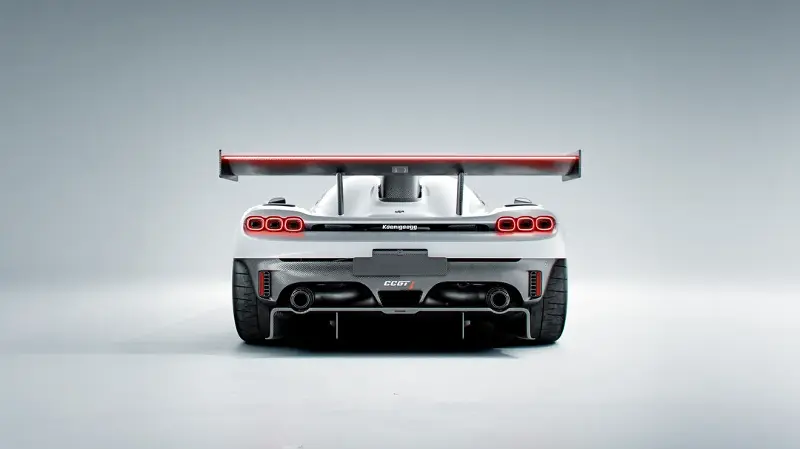
Koenigsegg has unveiled the CCGT1, a new tribute model that pays homage to the CCGT, the Swedish carmaker’s ill-fated GT1 endurance racer from the mid-2000s. Built on the platform of the award-winning CC850, the CCGT1 carries the CCGT’s name and spirit into a fully homologated, road-legal Megacar.
Related: The Koenigsegg Sadair’s Spear is a no-holds-barred Jesko
Christian von Koenigsegg’s ambition to compete in endurance racing dates back to the company’s earliest days. While designing the first CC prototype, he studied Le Mans GT1 regulations closely, scaling the car’s width and frontal area to fit within GT1 dimensions from the outset. That same footprint carried over to the CC8S and CCR, laying the groundwork for what eventually became the CCGT.
Working with longtime Koenigsegg engineer and fabricator Dag Bölenius, von Koenigsegg built the CCGT to weigh around 1,000 kg, well under the GT1 class limit of 1,100 kg, leaving room to place ballast for optimal balance. Power came from a naturally aspirated 5.0-liter Koenigsegg V8 producing 600 hp, the class maximum, paired with a magnesium sequential gearbox and an aero package generating more than 600 kg of downforce. Test driver Loris Bicocchi handled setup duties, and early laps showed the car had genuine race pace.
The program never got the chance to prove it. Two months after shakedown testing began, the FIA rewrote GT1 regulations to favor higher-volume production cars, prompting manufacturers to withdraw and the series to fold. Koenigsegg shelved its racing plans, and the CCGT never turned a competitive lap. The car spent the next fifteen years with its first owner before surfacing for sale at the Goodwood Festival of Speed in 2024. Only one CCGT was ever built, and it has since been restored by the Koenigsegg Legend Division under a new US-based owner, who intends to campaign it in GT1 historic racing.
The CCGT1 marks the moment Koenigsegg can finally celebrate that unfinished story. “This is something truly special – our first creation that’s designed deliberately as a track-optimized circuit scalpel as well as an extraordinary daily driver,” von Koenigsegg said. “It has been so rewarding seeing the original CCGT come back to life over the last few years. This seems like an appropriate way to celebrate.”
Nearly every body panel has been reworked from the CC850’s design, with only the doors and removable roof carried over. CFD engineer Andreas Tjernberg Persson led the aerodynamic development, which centers on balancing a large, active rear wing against front-end downforce. The wing adjusts automatically across 30 degrees of travel, switching between a low-drag setting for straights, an air-brake mode under heavy braking, and a high-downforce mode for corners. A front splitter and active underbody flaps offset the rear wing’s load, while a sculpted underfloor with strakes and a rear diffuser handle most of the aerodynamic work. According to Persson, the floor is much larger than the wing and plays a greater role in controlling airflow, despite being less visually prominent.
Total downforce reaches 800 kg at 250 km/h, placing the CCGT1 between the Jesko Attack and Sadair’s Spear in Koenigsegg’s lineup. Persson noted the car was tuned to make that downforce usable at lower speeds rather than chasing the highest possible peak number.
Power comes from Koenigsegg’s twin-turbo V8, rated at 1,280 hp on standard pump fuel and 1,600 hp on E85 biofuel, with the company’s engine management system allowing any blend of the two. A new roof scoop feeds an enlarged oil cooler and a dedicated damper cooling circuit to support extended track use.
Shifting duties fall to Koenigsegg’s Light Speed Transmission, now paired with a new interface called Koenigsegg Sequential Shift, standard on every CCGT1. The system uses a clutch pedal for takeoff and ignition-cut, clutchless shifts once underway, mirroring how the original CCGT operated. A four-position dial labeled ASMR (Auto, Sequential, Manual, and Reverse) controls the shifter’s mode. Buyers who prefer a traditional setup can instead opt for the CC850’s Engage Shift System, a gated six-speed manual that uses six of the LST’s nine ratios in manual mode while still allowing nine-speed automatic operation in D mode.
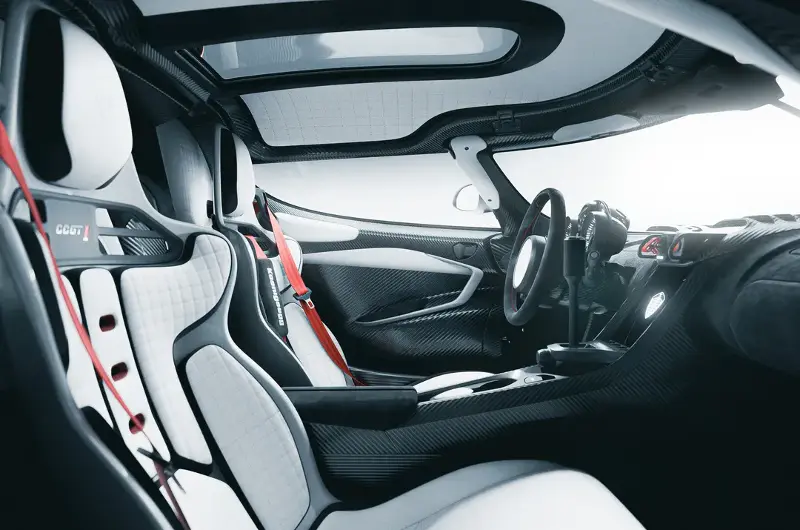
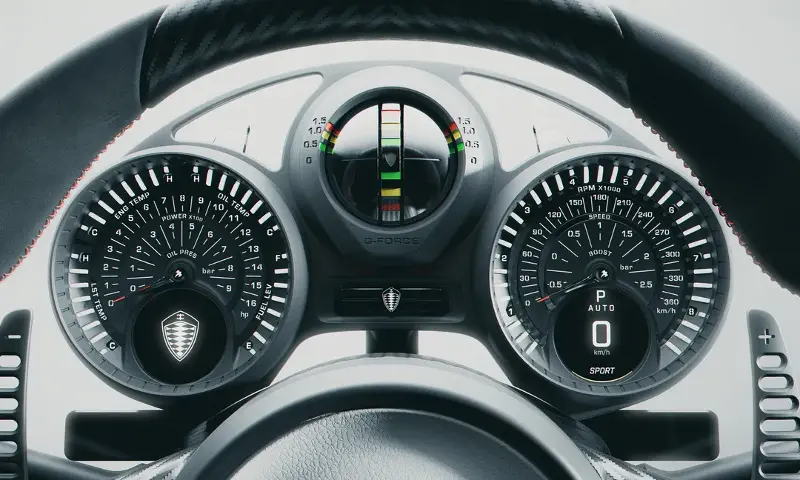
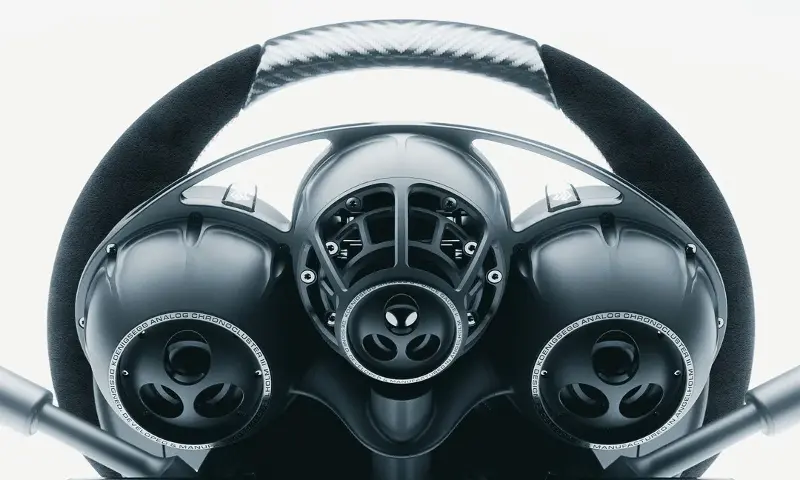
Inside, the cockpit includes a covered ignition switch, a fuel pump priming toggle, and a red starter button. The third-generation Chronocluster display centers on Koenigsegg’s analog G-meter, which runs purely off G-force with no electrical connection. Standard seats are carbon fiber with a six-point harness for the driver; the optional track package adds a matching setup for the passenger along with a race-grade fire-suppression system.
For buyers who want to take the CCGT1 further, Koenigsegg is offering its first-ever factory-designed track package, installable and removable through any Koenigsegg Certified Dealer. It includes a full carbon roll cage, HANS-compatible racing seats, fire suppression, a race exhaust, air jacks, track-tuned suspension and brakes, a second set of wheels on track tires, additional aero elements, and access to CCGT1 track days with factory support. Koenigsegg says the combination makes the CCGT1 its fastest-lapping car to date.
New three-spoke Aircore carbon fiber wheels, among the lightest the company has produced, round out the visual package with a retro-inspired design.
The CCGT1 also debuts a new material Koenigsegg calls Ghost Fibre. The company first introduced a white carbon fiber finish in 2009 on the Trevita, a process so difficult to execute that production was eventually halted despite strong customer demand. Ghost Fibre reworks the concept from the ground up, combining the same shimmering finish with added ballistic protection, sound-deadening properties, and a lighter overall weight than a standard carbon fiber layup. Von Koenigsegg described it as building on the Trevita’s legacy from the same era as the CCGT program.
The post The Koenigsegg CCGT1 is an endurance race car in disguise appeared first on YugaAuto: Automotive News & Reviews in the Philippines.