



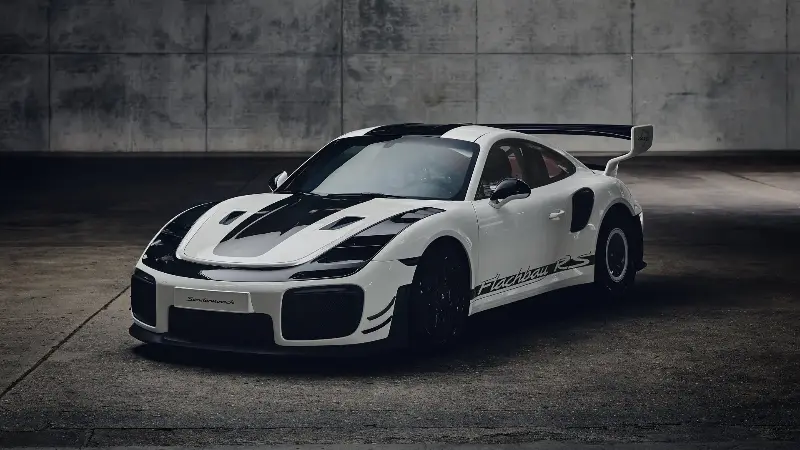
Porsche has unveiled a one-off 911 GT2 RS built by its Sonderwunsch (special wishes) department in partnership with Manthey, transforming a 2018 GT2 RS with the Weissach Package into a slantnose model called the Flachbau RS. The project originated from a customer request for added performance, a Flachbau body style, and a rear wing modeled after the 911 GT3 R Rennsport.
Related: Porsche revives the manual of the 911 Carrera S
The car explains why Porsche filed “Flachbau” and “Flachbau RS” as model names with the European Patent Office in May 2025. That filing had prompted speculation in the sports car community before Porsche confirmed the names belonged to this individual commission rather than a production model.
A team from the Sonderwunsch department, Style Porsche, and engineers from Weissach, Porsche Motorsport, and Manthey worked on the build for close to three years. Alexander Fabig, Vice President, Product Offering & Individualization at Porsche, said converting the car to a slantnose configuration was difficult, even with the drivetrain untouched at the customer’s request, since the GT2 RS with Weissach Package is already heavily optimized for weight. Lightweight measures on the finished car reduced weight by an additional 31.6 kilograms.
Design work was led by Grant Larson, now retired from Porsche, who had previously designed the modern 935 tribute car Porsche revealed in 2018 for that racer’s 70th anniversary. Larson said the Flachbau RS references the 935/78 “Moby Dick” through its flatter front wings and a staggered headlight layout using narrow LED units, along with a color scheme combining Grand Prix White with matte black sections and exposed carbon fiber. The white shade was custom-matched to a historic 911 from the Porsche AG collection. Porsche introduced Grand Prix White as a 911 color in 1974.
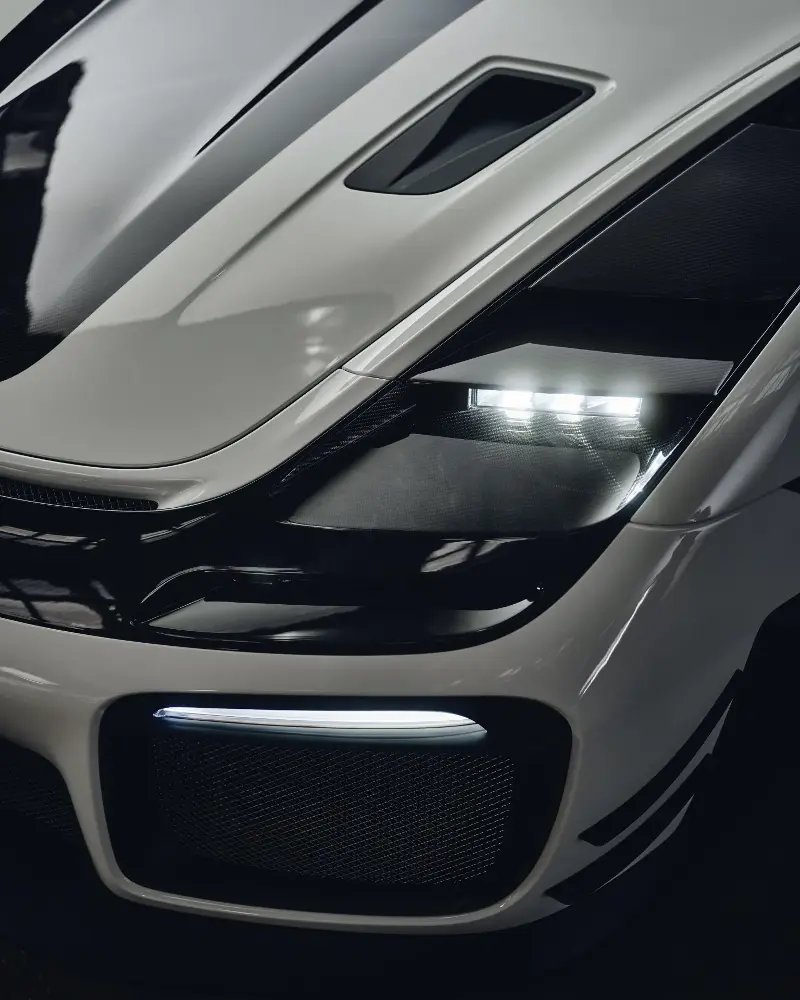
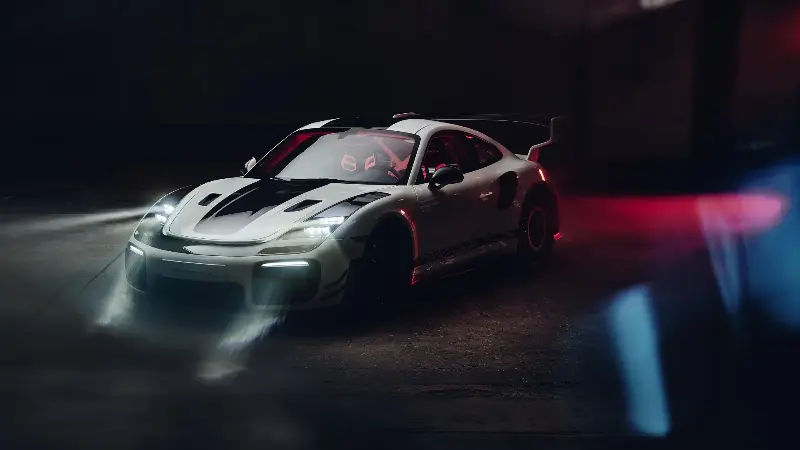
Bodywork changes include lower-set front wings with slatted air outlets to vent the wheel arches, a new contour that required modifying the fuel filler flap and its mechanism, a redesigned front bumper, and black aero flaps from Manthey. In place of standard round headlights, the car uses tiered LED units for high beam, low beam, and daytime running lights; the high and low beam elements are just under four centimeters tall, while the daytime running lights are under two centimeters.
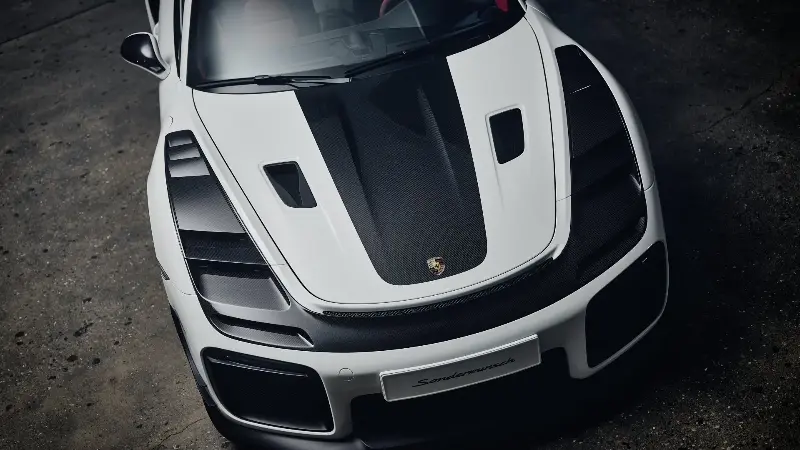
Black exposed carbon fiber marks the center stripe on the hood and roof as well as the U-shaped element at the front, set against the white body. Bonnet and roof stripes are inverted relative to the standard GT2 RS. Rear aerodiscs are finished in Grand Prix White, while brake calipers are painted deep black.
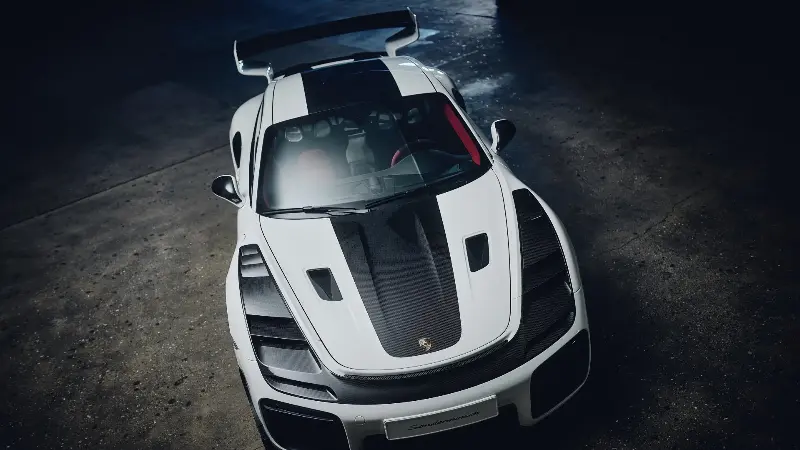
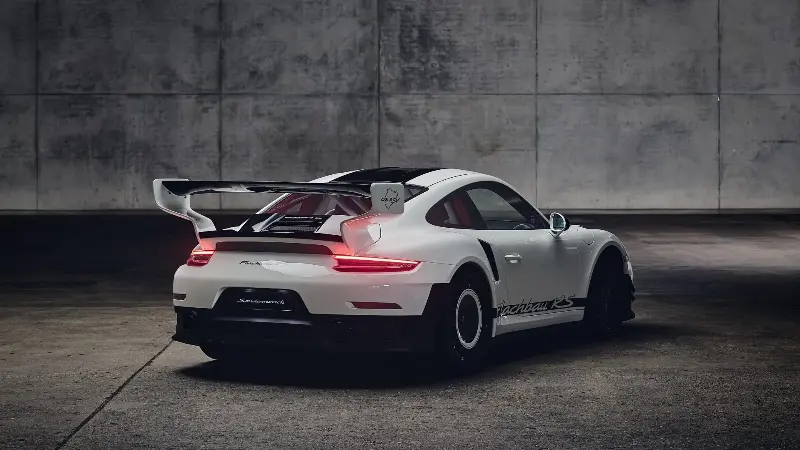
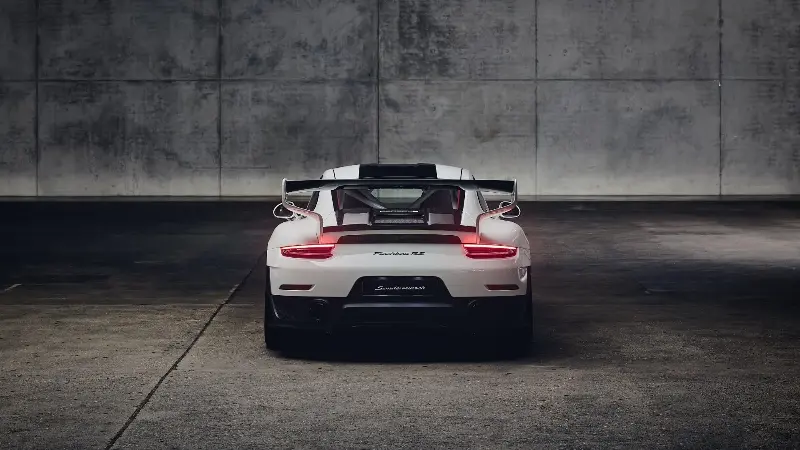
Aerodynamic hardware includes a front splitter paired with the underbody structure and rear diffuser from the Manthey Kit, plus carbon aerodiscs on the rear wheels to cut drag. The rear wing uses S-shaped mounts inspired by the 992-generation 911 GT3 R Rennsport but sits about five centimeters higher and can be manually set to three positions for different downforce levels. In the High Downforce setting, Porsche says the wing produces 2% more downforce on the rear axle than a GT2 RS fitted with the Manthey Kit wing in the equivalent position, and 3% more in Low Downforce. At a top speed of 340 km/h in High Downforce mode, the car generates 554 kg of downforce on the rear axle. The wing’s adjustment mechanism and position markings are patented.
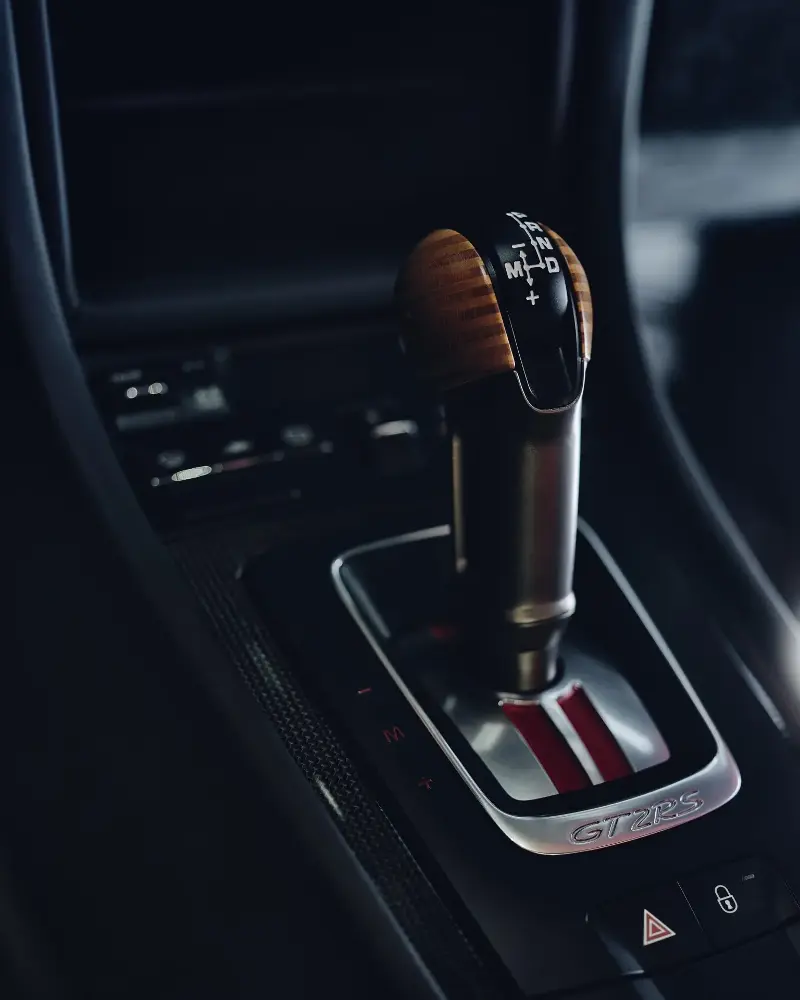
Inside, the front section up to the seats retains the red Alcantara, black leather and exposed carbon fiber trim from before the conversion, while the area behind the seats has been stripped down. Porsche removed the Porsche Communication Management system in favor of a leather-trimmed storage compartment, took out the audio system entirely, and stripped most sound-deadening material and floor coverings from the cabin and luggage compartment. Remaining surfaces are largely bare metal painted Grand Prix White, with carbon trim on select areas, such as the armrest extension. The rewired wiring harness is left exposed under protective sheathing, with unused wiring removed to save further weight.
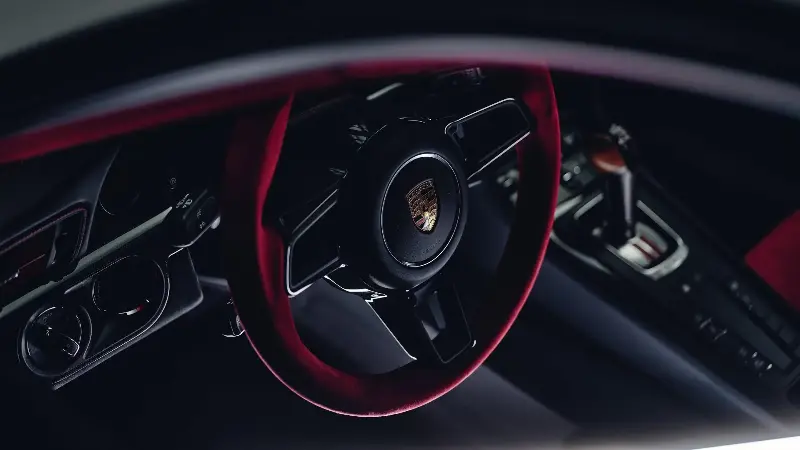
“Flachbau RS” lettering is embroidered on the carbon-fiber bucket seat headrests, with a stylized Nordschleife outline stitched behind it. The passenger side of the dashboard features a gold “Sonderwunsch” badge and a plate reading “Factory One-Off 2026 | Flachbau RS.” Mandatory road equipment, such as the warning triangle and towing eye, previously mounted in the body, now sits in a removable “emergency box” that owners can remove before track use to reduce weight.
Development included simplified crash simulations, airbag deployment testing, structural analysis of rear-wing loads, and CFD-based aerodynamic calculations before new tooling was approved for the modified components. The rear wing was then tested on a hydropulse rig to simulate vibration loads, and its static load capacity was checked using sandbags.
Porsche built three test vehicles for further validation in lighting and wind tunnels, as well as on public roads. Testing included runs at the Mendig airfield, 50 laps of the Nürburgring-Nordschleife, and endurance testing at Weissach that simulated roughly 150,000 kilometers of wing loading. Porsche test driver Lars Kern, who drove the car on the Nordschleife, said the Flachbau RS stayed stable and precise at high speed, calling that feedback necessary to validate the reworked body design. A camouflaged test car spotted lapping the Nürburgring had already garnered over 100,000 views on social media within hours of its sighting, before the official reveal.
The post Porsche has built a one-off slantnose 911 GT2 RS called the Flachbau RS appeared first on YugaAuto: Automotive News & Reviews in the Philippines.