


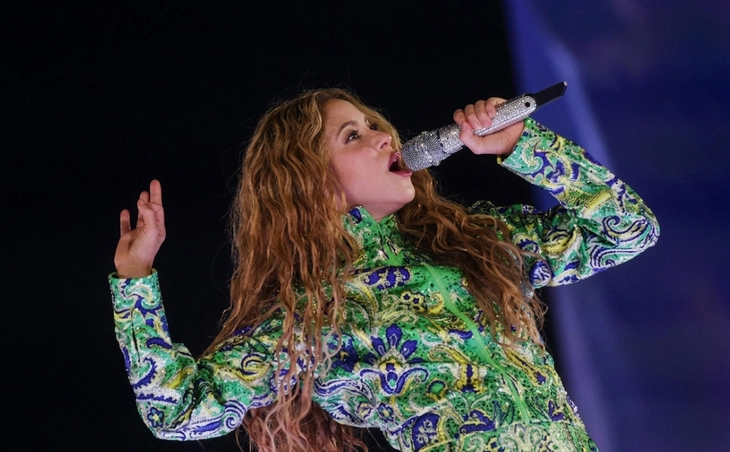
Shakira will open the 2026 World Cup - Photo: Reuters
When the International Football Federation (FIFA) officially announced the program for the 2026 World Cup opening ceremony at the Azteca Stadium in Mexico City, fans not only received information about the opening match between Mexico and South Africa but also anticipated a mega-entertainment event.
Music Festival
The opening ceremony will take place at 11:30 AM on June 11, 2026 (local time). FIFA says the program will last approximately 45 minutes and will feature a host of world-renowned artists.
Shakira, who made her mark with "Waka Waka" at the 2010 World Cup, will return to the World Cup stage with Burna Boy to perform the tournament's official song. Alongside her will be J Balvin, Tyla, Alejandro Fernández, Belinda, Danny Ocean, Lila Downs, Los Ángeles Azules, and the rock band Maná. A lineup of artists that would make even many international music awards ceremonies envious.
For decades, World Cup opening ceremonies typically lasted only a few dozen minutes, featuring performances that showcased the host country's cultural symbols. But FIFA is building the 2026 World Cup in a completely different way.
Many media experts believe this is the most distinctly American World Cup in history. Instead of focusing solely on football, FIFA is trying to transform the tournament into a global entertainment product, similar to how the Americans built the Super Bowl, where the show sometimes receives as much attention as the game itself.
This wasn't just the opening ceremony. For the first time in World Cup history, FIFA confirmed the final will feature a halftime show. This concept is familiar to American sports fans but has never appeared in the World Cup's more than 90-year history.
Furthermore, FIFA and the host cities are preparing dozens of FIFA Fan Festival zones across the United States, Mexico, and Canada. These spaces will combine football viewing, live music performances, interactive activities, exhibitions, video games, and technology experiences.
In many host cities, fans without stadium tickets can still participate in festivals that last from morning to night, accommodating tens of thousands of people each day.
A technology feast
If entertainment is one of the biggest highlights, then technology is expected to be the differentiating factor for the 2026 World Cup.
The tournament will take place in some of the world's most modern stadiums. SoFi Stadium in Los Angeles boasts a giant ring-mounted screen over 1,000 meters long, considered one of the most impressive sports display systems on the planet.
AT&T Stadium in Texas is famous for its massive central screen visible from every seat in the stands. Meanwhile, MetLife Stadium – the venue for the final – is undergoing significant upgrades to meet FIFA's latest technological standards.
At many venues, fans will use entirely electronic tickets, combining facial recognition technology and mobile platforms to reduce queuing times and enhance security.

FIFA is also stepping up the application of artificial intelligence (AI) in the operation of the tournament. AI is used to analyze audience data, predict crowd flow, optimize security measures, and support the provision of real-time information to fans.
In the tournament's official apps, viewers can access a range of personalized features such as live statistics, additional camera angles, content tailored to their preferences, and interactive, AI-powered experiences.
In addition, augmented reality (AR) and virtual reality (VR) technologies are expected to be more prevalent than in previous World Cups. Several of FIFA's commercial partners are developing products that allow fans to experience stadiums, tour backstage areas, or interact with digital content directly on their smartphones.
Broadcasters are also preparing for a leap in broadcast quality. The 2026 World Cup is predicted to become the sporting event with the largest amount of digital content ever, with thousands of hours of live broadcasts, millions of short videos, and massive interaction on social media platforms. FIFA expects the tournament to reach approximately 6 billion people globally through television and digital platforms.
From the opening ceremony featuring a lineup of musical superstars, the halftime show at the final, the large-scale fan festivals, to the most advanced technological applications, the 2026 World Cup is being shaped as more than just a football tournament.
The ambition is to transform the planet's biggest sporting event into a global entertainment and technology festival, where football remains central but is no longer the sole element on the stage.