


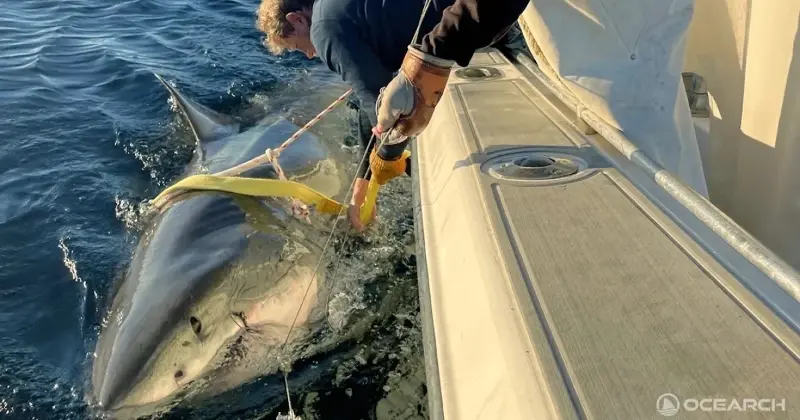
Researchers first encountered Contender – a male shark, approximately 4.2 meters long and weighing nearly 770 kilograms – on January 17, 2025, about 72 kilometers off the coast of Florida and Georgia.
They attached a satellite tracking device to its dorsal fin, transmitting a signal whenever the shark surfaced. Since then, Contender has traveled thousands of kilometers north, along the coasts of North Carolina, New Jersey, and the Cape Cod region of Massachusetts in search of food.
However, prior to its most recent reappearance, this giant shark had been missing since late April 2026, when tracking units determined it was in waters near North Carolina.
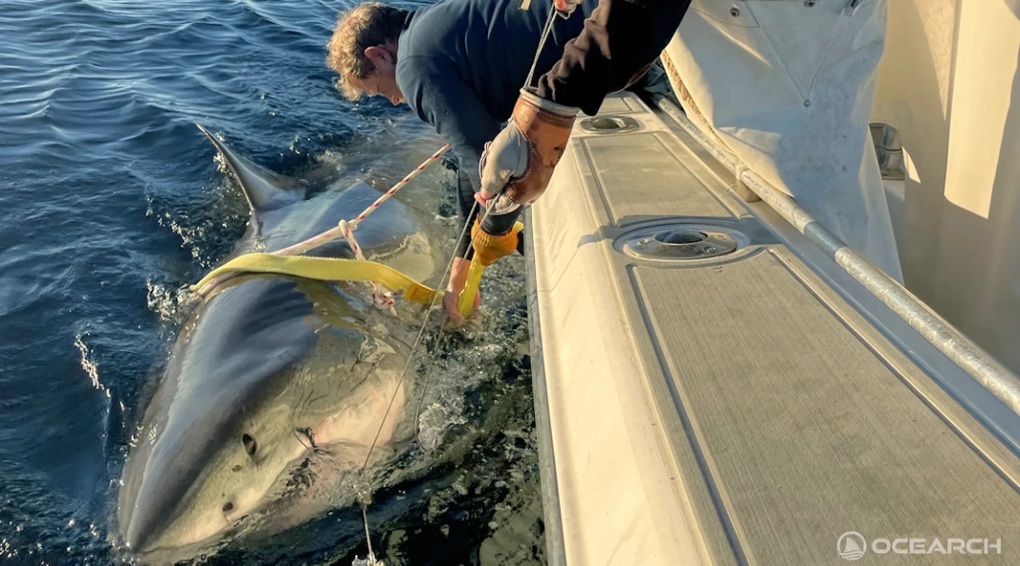
Contender, a male measuring approximately 4.2 meters in length and weighing nearly 770 kg, is the largest great white shark ever tracked by Ocearch in the North Atlantic (Photo: Ocearch).
Ocearch, a non-profit organization dedicated to shark research and ocean conservation, reported that the tracking device attached to Contender unexpectedly re-transmitted a signal on July 10th in an area near the East Coast of the United States. While the latest signal indicates Contender is still alive and active, satellite data is insufficient to pinpoint its exact current location.
According to Ocearch, Contender is the largest male great white shark they have ever attached a tracking device to in the North Atlantic population. This shark is also significantly larger than the average size of male great white sharks, which are typically around 3.7-4 meters long.
A brief signal across the Atlantic.
The sighting on July 10th was called a “Z-ping,” meaning the signal emitted when the Contender surfaced for only a few seconds before quickly diving back down. This brief period was not enough for the Argos satellite system to lock onto the signal and pinpoint the shark's exact location near the US coast.
The Argos satellite can only receive signals when the shark's entire dorsal fin is protruding from the water and the data transmitter is sent into space. If the signal is maintained for longer, the system can display the near-real-time location of each individual shark fitted with a tracking device.
Therefore, scientists can only confirm at present that Contender is still alive and active somewhere near the US coast, possibly even around a new great white shark hunting area in the North Atlantic.

Ocearch tracking satellites detected Contender on July 10 but were unable to pinpoint its exact location (Image: Ocearch).
A 2023 study suggests that waters near Massachusetts may be becoming a breeding ground for great white sharks after years of activity. The study, published in the journal Marine Ecology Progress Series, estimated that approximately 800 great white sharks were spotted off the coast of Cape Cod between 2015 and 2018 alone.
A year ago, Contender was also discovered in an area near the Massachusetts coast, where one of the great white shark's main food sources, seals, is concentrated.
Then, in September, it continued to move into Canadian waters and approached the Gulf of St. Lawrence in Quebec, more than 1,900km from its last recorded location near North Carolina earlier this year.
Over the past year, Contender has been tracked along nearly the entire East Coast of North America, from Florida in the south to Quebec in Canada in the north.
They once approached many crowded beaches.
Contender was previously spotted near Canada's Cape Breton Island and in the waters off Florida this past winter. In Florida, it at one point approached beaches in St. Augustine, Daytona Beach, and Port St. Lucie.
As summer approaches and millions flock to the beaches, scientists predict that encounters between humans and sharks could increase, simply because more and more people are entering the water in areas traditionally used by sharks for hunting.
According to Ocearch, environmental and wildlife protection laws over the past 30 years have significantly benefited shark populations.
The return of many shark populations is believed to stem from stricter regulations on hunting along with improved ecological conditions, which have helped to replenish their food sources in the Atlantic.
"People will encounter things they consider unusual, but which are actually the natural features of the ocean," said Chris Fischer, founder of Ocearch.
Over the past two decades, Ocearch has tagged nearly 500 sharks. However, Fischer suggests that Contender may be just one of thousands that have returned to U.S. waters.