


After much anticipation, the Brazilian national team has finalized its squad for the 2026 World Cup. However, the list has sparked considerable controversy.
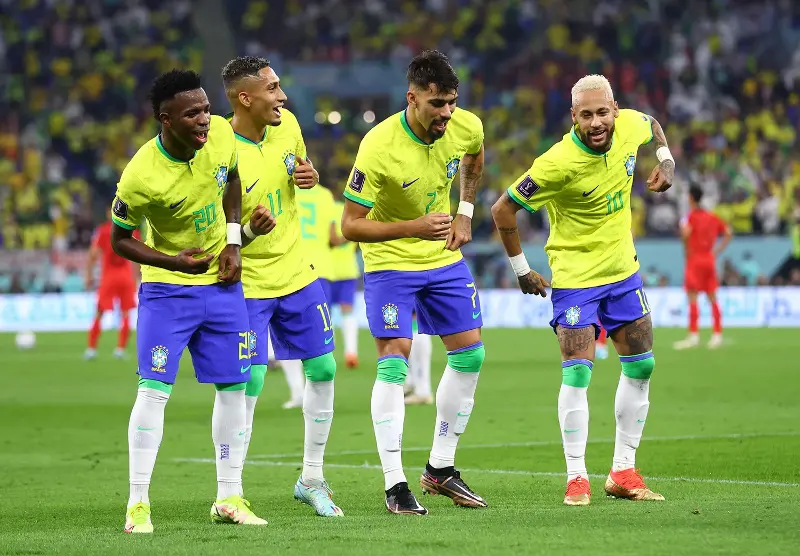
The Brazilian national team is heading into the 2026 World Cup with the determination to win the championship.
The first point of contention lies in coach Carlo Ancelotti's decision to bring Neymar back to the Brazilian national team after a long absence due to injury struggles. Meanwhile, several stars who are playing well in Europe have been ruthlessly left out.
But that didn't significantly affect their arrival at the biggest football event on the planet as one of the title contenders.
Historically, Brazil has always been the team that attracts the most attention at the World Cup, and consequently, the pressure on them is immense. For many teams, progressing deep into the tournament is considered a success, but the standard for the Selecao is to win the championship.
At the 2026 World Cup, doubts about the Brazilian national team were not unfounded. Brazil had a less than ideal qualifying campaign, finishing only 5th out of 10 teams and trailing their arch-rivals Argentina by 10 points. This shows that they are not maintaining consistency.
Brazil's current squad also lacks many stars in peak form, as former pillars like Neymar and Casemiro are getting older. Meanwhile, many other key players are not in their best physical condition or form.
But underestimating Brazil at the 2026 World Cup would be a huge mistake. Although they no longer have the iconic figures of previous generations, the South American team still has a very high-quality squad with names like Vinicius Junior, Raphinha, Gabriel Martinelli, Matheus Cunha, and Endrick.
Furthermore, at the upcoming tournament in North America, Brazil will be led by the talented coach Carlo Ancelotti, and this could be the biggest difference. This coach understands how to manage the dressing room, control the egos of star players, and transform a group of big individuals into a team that plays for a common goal. This was proven when he was in charge at Real Madrid.
For Brazil, this is extremely important. It's worth noting that they've never lacked talented players, but their recent World Cup performances have been unsuccessful, demonstrating that they lack a strategist who can transform those outstanding individuals into a formidable team.
The two most recent World Cup champions, France and Argentina, have shown the world that, in the highest level of football, organization, discipline, and balance are sometimes more important than talent and flair.
Argentina's victory in the 2022 World Cup wasn't solely due to the individual brilliance of superstar Lionel Messi; behind him was a team that knew how to fight and sacrifice for each other. France's success over the years wasn't based on exceptional players like Mbappe or Dembele, but rather on a pragmatic and effective playing structure.
Looking at that, it's clear that if Brazil wants to succeed, they need to follow that path. Of course, they don't need to simply copy the formulas of Argentina or France, but they need to break free from the shell of a team that only knows how to play individually and rely on the moments of genius from Neymar or Vinicius. Instead, they need to learn to control risk, win in multiple ways, and be more composed in big matches.
That is one of the reasons why coach Ancelotti has received so much expectation. Under the Italian-born coach, Brazil has the opportunity to become a stronger, more confident, effective, and cohesive version of itself.
Most of Brazil's current key players are playing at the highest level in Europe, where football demands a very high level of tactical awareness. They are no strangers to pressing, transitions, positional control, and team discipline. If Ancelotti can connect these pieces, Brazil could become a team that is both rich in South American character and pragmatic enough by European standards.
But Brazil's biggest challenge lies in its identity. For many years, Brazil has been stuck between the past and the present. They want to maintain their image of flamboyant attacking football, but they no longer have enough geniuses to overwhelm opponents solely through inspiration. They also want to be more modern and disciplined, but they lack a truly stable system. Therefore, Ancelotti is not just here to select the team, but also to answer the question of what kind of team Brazil wants to become in this new era.
Looking at that, it's clear that Brazil still has many issues to address before the 2026 World Cup. But undoubtedly, they remain a genuine contender for the title, and any opponent who underestimates them could pay a heavy price.