



- Towards modern, sustainable agriculture.
- Digital technology helps make agriculture greener.
- Pharmacist leaves city to return to countryside for green agriculture.
The bold application of modern irrigation technology not only helps farmers reduce costs and labor but also contributes to improving agricultural productivity and quality, especially in the context of increasingly complex climate change and the scarcity of freshwater resources.
Reduce costs, increase efficiency.
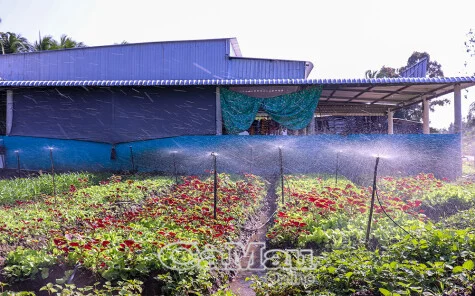
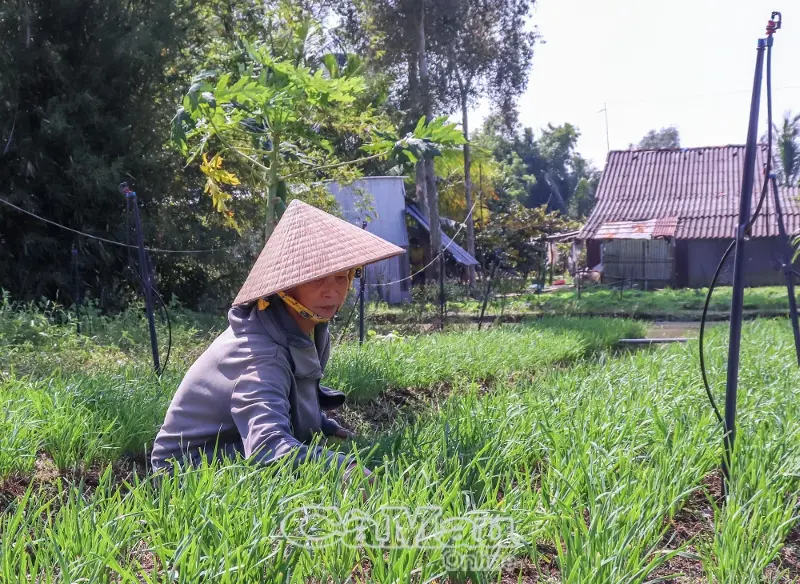
Having been involved in farming for over 10 years, Mrs. Nguyen Thi Thu's family (Hamlet Coi 6A, Da Bac Commune) used to struggle with manual irrigation. Each irrigation was laborious, time-consuming, and inefficient, especially during the dry season. Since installing an automatic sprinkler irrigation system, Mrs. Thu's work has become much easier; water is distributed evenly, helping vegetables such as onions, chives, coriander, water spinach, and cabbage grow healthily. Thanks to the reduced labor, she has more time to care for her fields and expand production.
Ms. Thu said that since having the sprinkler irrigation system, the work has become much easier; all she has to do is open the valve and the system operates automatically, ensuring the vegetables always have enough moisture and grow faster. "Thanks to this irrigation system, I'm less stressed, I can grow more, and I have more time to take care of the fields and my family," Ms. Thu shared.
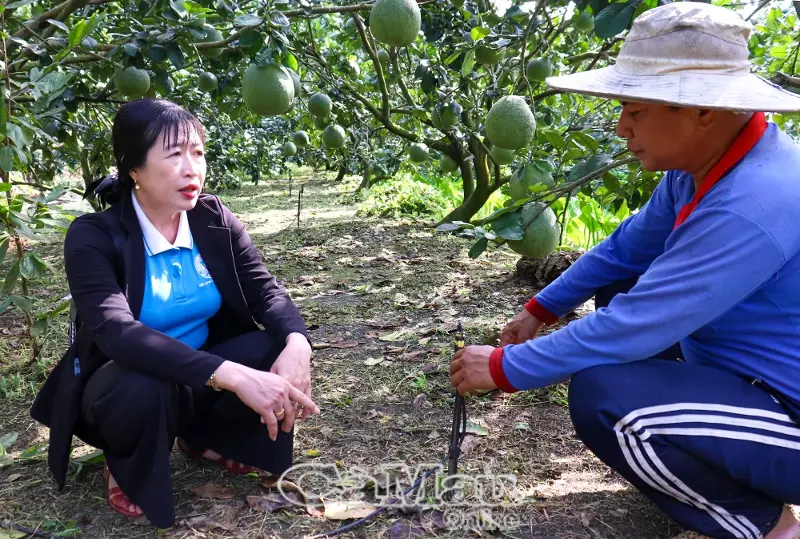
Not only effective for vegetables, the water-saving irrigation system also brings significant benefits to fruit orchards and is being adopted by many farmers in the province. The nearly 1-hectare pomelo orchard of Mr. Lam Van Viet's family (Khanh Hung commune) has been equipped with a fully automated sprinkler irrigation system. Since adopting this model, his pomelo orchard has developed more steadily and grown uniformly.
Mr. Viet said that the irrigation system helps his family proactively manage water resources, distributing it evenly to each tree, minimizing waste, and significantly reducing labor. As a result, the pomelo trees grow well, the fruit is large and uniform, and the quality has improved noticeably. He expects his family's pomelo orchard to yield about 15 tons of fruit for the upcoming Lunar New Year (Year of the Horse).
The inevitable direction of sustainable agriculture
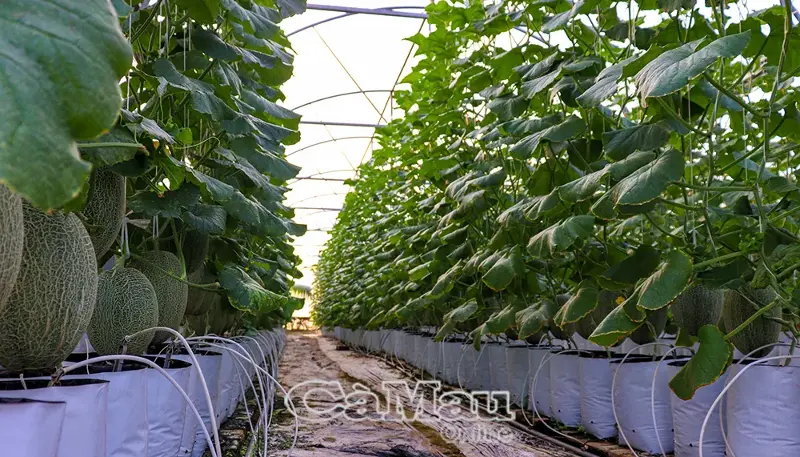
For over four years, Mr. Ho Quoc Trang (Hamlet 7, Tan Thanh Ward) has been involved in growing cantaloupe, and the drip irrigation system is considered a "powerful assistant." Mr. Trang said that besides reducing labor and ensuring watering according to the plant's needs, the drip irrigation system also has the advantage of combining watering and fertilizing simultaneously. "I mix fertilizer into the water and deliver it directly to the plant roots at each growth stage, helping the plants absorb nutrients better, reducing fertilizer loss, saving costs while still ensuring yield. In addition, this method helps control soil moisture, limit pests and diseases, and improve the quality of the cantaloupe fruit. I use a remote control and set a timer, so I can still water my cantaloupe garden adequately even when I'm not home," Mr. Trang explained.
In practice, most crops struggle to thrive with either insufficient or excessive water. Given the increasing complexity of climate change, droughts, and saltwater intrusion, and the growing scarcity of freshwater, the application of water-saving and automated irrigation technologies is a crucial solution for sustainable agricultural production.
According to Ms. Nguyen Thi Kieu Khuyen, Deputy Director of the Provincial Agricultural Extension Center, in recent times, water-saving irrigation models such as sprinkler irrigation, drip irrigation, and automatic timed irrigation have attracted the attention of many farmers in the province, who have proactively invested in and applied them to production. In practice, these models have proven to be highly effective, reducing water consumption by 30-50% compared to traditional irrigation methods and significantly saving labor. Furthermore, crops receive water according to their needs, leading to better growth, increased yield, and improved quality of agricultural products.
However, to maximize the effectiveness of the irrigation system, farmers need specific guidance on installation techniques and operating procedures suitable for each crop type and production scale; special attention should be paid to electrical safety during use to avoid risks during operation.
"In the coming time, the provincial agricultural sector will continue to promote and replicate water-saving irrigation models suitable for each type of crop and each ecological zone; at the same time, strengthen training and technical guidance on installation and operation for farmers. This will help farmers effectively utilize water resources, adapt to climate change, and move towards sustainable agricultural development," added Ms. Nguyen Thi Kieu Khuyen.
Cam Nhi