


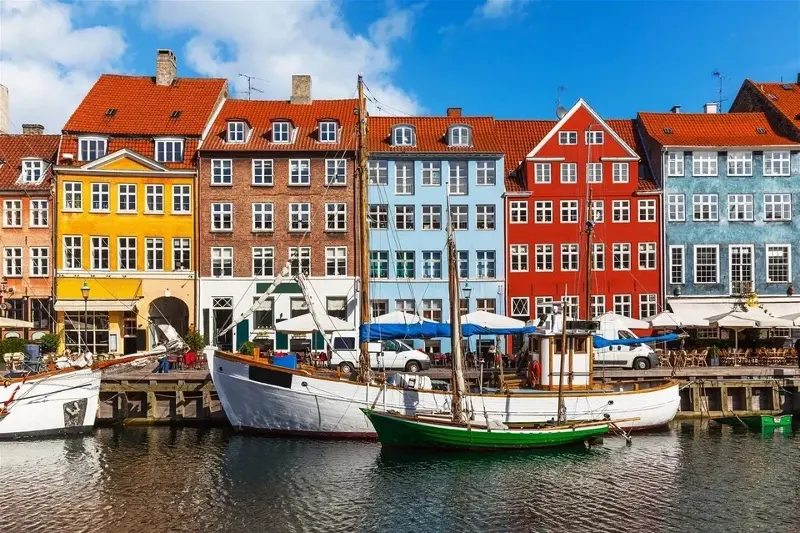
Copenhagen, Denmark, continues to hold the title of the world's most livable city. Photo: SOPA Images .
On July 7th, CNN Travel announced the ranking of the world's most livable cities for 2026, compiled by the Economist Intelligence Unit (EIU). For the second consecutive year, Copenhagen (Denmark) held the number one position, surpassing many famous cities in Europe, Asia, and Oceania.
According to the EIU, Copenhagen scored perfectly in three criteria: stability, infrastructure, and education . The city was also highly rated for its living environment, cultural life, and quality of public services.
EIU representatives believe Copenhagen's success stems from "a combination of high stability, quality infrastructure, an attractive living environment, and an efficient public service system."

Cherry blossoms are in full bloom at Arakurayama Sengen Park ( Japan ). This year, two of Japan's cities are in the top 10 most livable cities in the world. Photo: @japanstartshere.
This year's ranking evaluates 173 cities worldwide based on five criteria: stability, healthcare, education, infrastructure, and culture/environment.
Following Copenhagen is Vienna (Austria) – a city that held the number one spot for three consecutive years before being overtaken by Copenhagen last year. Melbourne (Australia) rose to third place, while Sydney climbed two places to fourth.
Zurich (Switzerland) dropped from its second-place ranking last year to fifth, followed by Geneva (Switzerland) in sixth place. Osaka (Japan) maintained its seventh position, Adelaide (Australia) ranked eighth, Vancouver (Canada) ranked ninth, and Tokyo (Japan) rounded out the top 10.
In this year's top 10, Australia has 3 representatives, the most among all ranked countries.
According to the EIU, Western Europe remains the most livable region in the world with an average score of 91.7, although slightly down from the previous year. Meanwhile, Asia saw an increase of 0.3 points, rising to 73.9.
The improvement is primarily in the healthcare sector, particularly in Chinese cities. The EIU reports that the health scores of the country's urban areas have risen after the nation increased investment in its healthcare system and implemented a long-term care insurance program.
As a result, several cities made significant progress in the rankings, with Fuzhou climbing 7 places to 93rd.
Conversely, conflicts in the Middle East significantly impacted stability scores. Muscat (Oman) dropped 14 places to 123rd, while Kuwait City fell 12 places to 105th.
Tehran (Iran) also dropped to 164th place due to the impact of the conflict with Iran, while Kyiv (Ukraine) ranked 166th.
According to Ana Nicholls, EIU's industry director, the average global livability score remained virtually unchanged from the previous year, as a decline in stability in the Middle East was offset by improvements in health in Asia.
Notably, nine Asian cities are now included in the top 20, reflecting the improving quality of life in the region in recent years.