


Would Portugal be "stronger" without Ronaldo?
For over two decades, Cristiano Ronaldo reshaped the world 's perception of the Portuguese national team, once considered the "underdog" in major tournaments. However, as his final World Cup approaches, the question is increasingly being asked: would Portugal truly be stronger without Ronaldo in the squad?
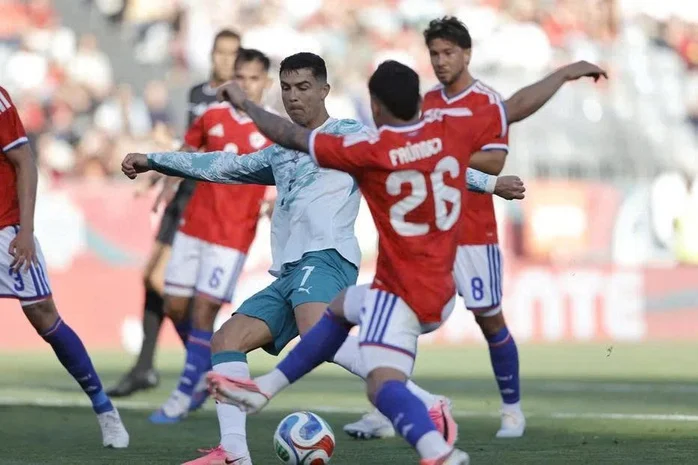
Ronaldo (number 7) had a lackluster performance as Portugal warmed up ahead of the 2026 World Cup.
In the recent friendly match against Chile, CR7 only played in the first half and made no significant impact. Throughout the 45 minutes, the Al-Nassr striker only touched the ball three times in the opponent's penalty area and took two shots. One shot on target went into the net, but the goal was disallowed due to offside.
On the other hand, striker Gonçalo Guedes, Ronaldo's "backup" player brought on by coach Roberto Martinez at the start of the second half, was the one who opened the scoring for the European team. Bruno Fernandes continued his role as the "orchestrator," contributing one goal in the 2-1 victory against Chile.
The way the "European Selecao" overcame Chile reflects a Portuguese national team system that no longer relies entirely on a single individual. The lines now work more synchronously, the midfield is more creative, and the attack is more flexible. Under coach Roberto Martinez, the European team's two biggest wins both did not feature CR7.
However, judging Portugal's strength without Ronaldo solely based on those matches isn't entirely convincing. While his speed and overall ability may not be at their peak, the Al-Nassr star remains a tactical anchor in the penalty area and a significant source of mental energy in big games.
In the Euro 2016 final, Ronaldo left the field in the 25th minute due to injury. But instead of resting in the dugout, the striker, born in 1985, became a "second coach" on the sidelines, constantly urging, encouraging, and reminding his teammates. This enthusiasm helped maintain the morale of the Portuguese players on the field until Eder scored the decisive goal in the 109th minute.
Leadership in the locker room
Coach Roberto Martinez has repeatedly emphasized that Ronaldo is a crucial part of his plans, not only for his goal-scoring ability but also for his leadership role in the dressing room. His experience from the previous five World Cups is something that almost no player in the current squad can replace.
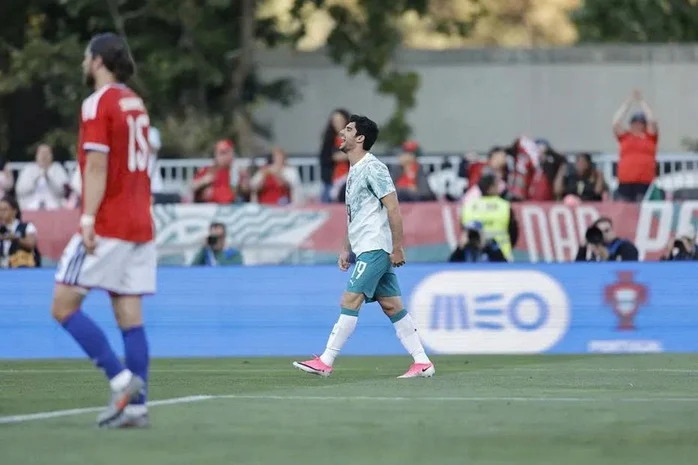
Gonçalo Guedes scored after coming on as a substitute for Ronaldo.
Of course, from a tactical standpoint, it could be argued that Portugal plays more openly and diversely without Ronaldo because attacking options like Rafaao Leao and Francisco Conceicao can swap positions and press more flexibly. However, in difficult matches, a lethal striker like CR7 can make a difference in the penalty area.

According to statistics, since Roberto Martinez took over as coach of the "European Selecao," Portugal has achieved a 77.4% win rate, scoring an average of 2.2 goals per game when CR7 is playing. Conversely, the win rate drops to 62.5%, but the number of goals per game increases to 3.9.
Therefore, Portugal isn't necessarily weaker with Ronaldo, nor is it certain to be stronger without him. Instead, they change their playing style depending on the situation, shifting from a team with a clear central axis to a team with more dispersed power in attack.
The biggest issue right now is probably not whether or not Ronaldo is playing, but whether Portugal is adequately prepared for both scenarios.