



The crew, consisting of Reed Wiseman, Victor Glover, Christina Koch, and Jeremy Hansen, returned in excellent physical and mental condition.
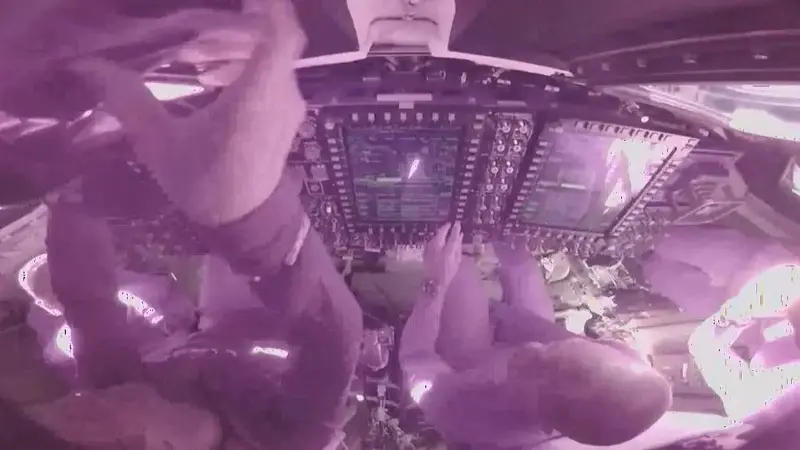
Astronauts preparing to re-enter the atmosphere.
The Artemis II mission was more than just a test flight; it was a strategic turning point in humanity's journey back to the vicinity of the Moon after more than half a century. Laurie Leshin, Director of the Jet Propulsion Laboratory (JPL), affirmed in a press conference following the event: "NASA has proven that ambitious goals are worth pursuing and can inspire the world."
Behind the machine's glory lies the perseverance of four individuals who directly confronted the profound darkness of space.
The crew, consisting of Reed Wiseman, Victor Glover, Christina Koch, and Jeremy Hansen, returned in excellent physical and mental condition. Aviation doctors described them as "happy and healthy," while program manager Howard Hu stressed that their cohesion was essential: "You could observe how smoothly they operated the Orion spacecraft for the past 10 days; it was incredible teamwork and camaraderie."
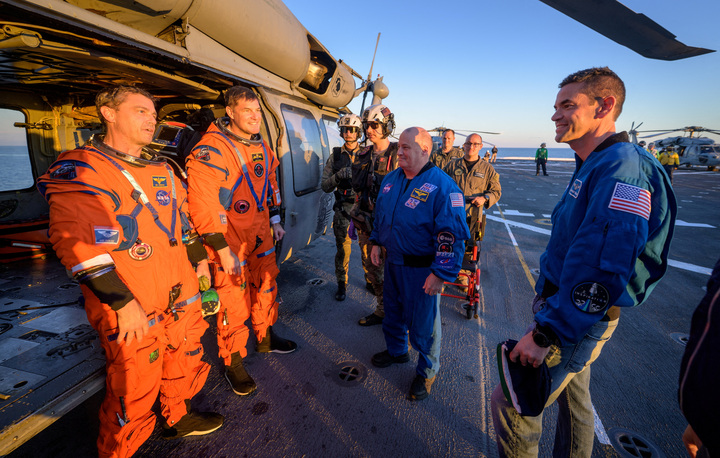
NASA astronaut Reid Wiseman, commander of Artemis II, and CSA (Canadian Space Agency) astronaut Jeremy Hansen, Artemis II mission specialist, converse with NASA Administrator Jared Isaacman on the flight deck of the USS John P. Murtha.
After refueling, the crew was noted to be in very positive spirits, with Victor Glover appearing with a radiant smile right on the edge of the helicopter, showing his exhilaration and readiness to share the experience. They were praised as excellent communicators, even "almost like poets" in their ability to convey inspiration about space.
Regarding their recovery, the entire team is expected to return to Houston to reunite with their families within 12 to 24 hours.
The safety of the crew was ensured by the absolutely precise recovery procedure aboard the USS John P. Murtha. After a journey of approximately 1,126,919 km, the Orion spacecraft landed with impressive accuracy. Flight Director Rick Frand stated that the spacecraft reached a maximum speed of approximately 39,684 km/h, struck its target with an orbital angle error of only 0.4%, and landed less than 1.6 km off target.
During the Artemis II mission, the crew and operations team overcame a series of technical challenges and harsh conditions to complete the historic test flight. During the flight, they discovered a leak in the pressure control unit on the Orion spacecraft, and before entering the atmosphere, they experienced sensor malfunctions and propulsion system warnings.
After landing, the communication system also experienced an unspecified malfunction, forcing the technical team to quickly resolve the issue to ensure the operational handover process. Upon returning to Earth, the crew experienced approximately 6 minutes of complete loss of communication as the spacecraft was enveloped in a layer of extremely high-temperature plasma, creating a tense period where all operations relied entirely on the spacecraft's autonomous capabilities.
Throughout their journey, they traveled approximately 1,126,000 km and reached a maximum distance of about 406,685 km from Earth, while enduring a maximum speed of about 39,684 km/h before slowing down sharply to about 26 km/h upon parachuting and landing.
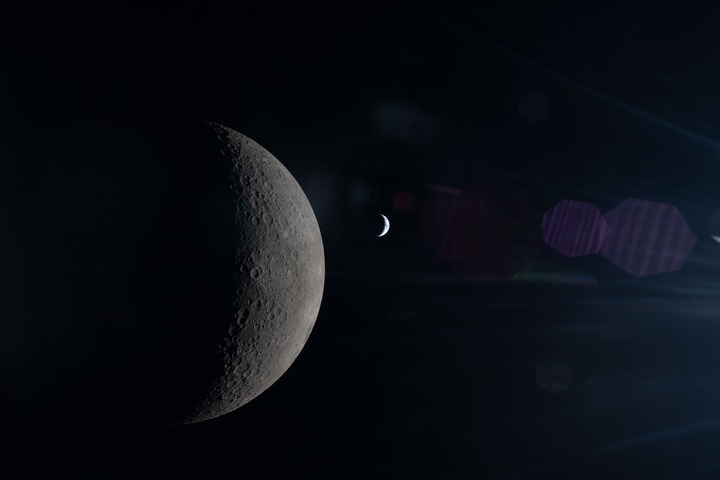
Stunning images observed from Artemis II. (Photo: NASA)
The process of handling the Orion spacecraft after the Artemis II mission was carried out continuously from sea to land with many closely coordinated steps. Immediately after landing, the spacecraft was recovered and transferred to the USS John P. Murtha for preliminary inspection, during which experts quickly assessed the condition of the heat shield based on data and images recorded underwater by divers. The module was then transported to the Kennedy Space Center for more in-depth processing, including decontamination of the system, particularly the removal of hydrazine to ensure safety.