


Video shows baby dolphin using a seashell to catch fish - Video: University of Sunshine Coast, Australia
The video was recorded by a research team from the University of Sunshine Coast (UniSC), Australia, at Great Sandy Marine Park, off Hervey Bay, Queensland. The results will be published in August 2026 in the journal Marine Mammal Science.
Scientists call this behavior "shelling," a form of tool-based hunting.
Instead of directly chasing the fish, dolphins herd their prey into a large shell. Then, they hold the shell in their mouths, lift it out of the water, and shake or tilt it to let the water drain out, causing the fish to slide towards their mouths.
The research team recorded two instances of Indo -Pacific bottlenose dolphins (Tursiops aduncus) performing this behavior between July and October 2025.
Notably, "shelling" was previously primarily observed in Shark Bay, Western Australia, more than 6,000km from the study area. The new findings suggest that dolphin populations in these two distant regions may have developed a similar hunting strategy.
Researchers later found photos taken by local tour companies between 2013 and 2019, showing dolphins in the Great Sandy River using seashells to hunt fish for many years prior.
Notably, during the second observation, a mother dolphin surfaced with a shell containing a fish. When the fish escaped, the mother dolphin abandoned the shell to chase after it.
A few minutes later, the baby dolphin appeared and held the shell in the same way.
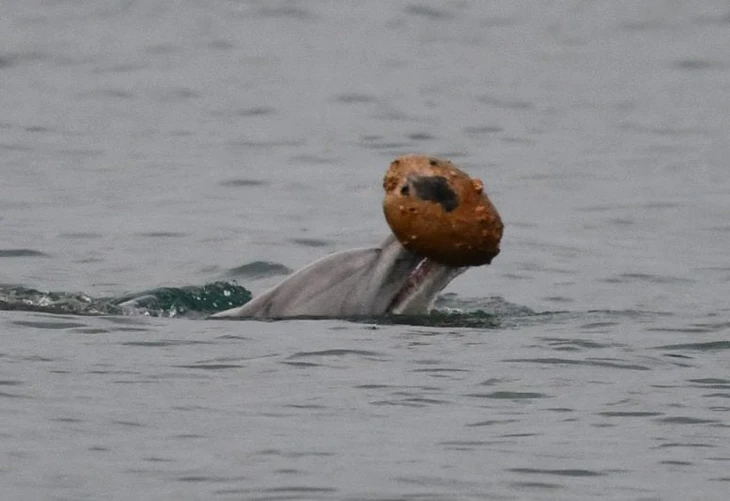
Baby dolphins can mimic their mothers' use of tools - Photo: University of Sunshine Coast, Australia
According to researchers, this could be a sign of "vertical social transmission," meaning that young learn a behavior by observing an adult, in this case, the mother.
However, scientists cannot yet confirm whether the mother dolphin is actively "teaching" her offspring or whether the baby dolphin actually learns hunting skills from its mother. More observations are needed to determine how these skills are passed on.
Previously, some dolphin populations in Shark Bay were also observed using sponges to cover their snouts while foraging on the seabed. This new discovery further suggests that the tool-using abilities and social learning of dolphins may be more complex than previously understood.