


A protoplanet roughly the size of Mars crashed into young Earth , creating an impact so massive that it both shaped our planet and could have created the Moon in just a few hours.
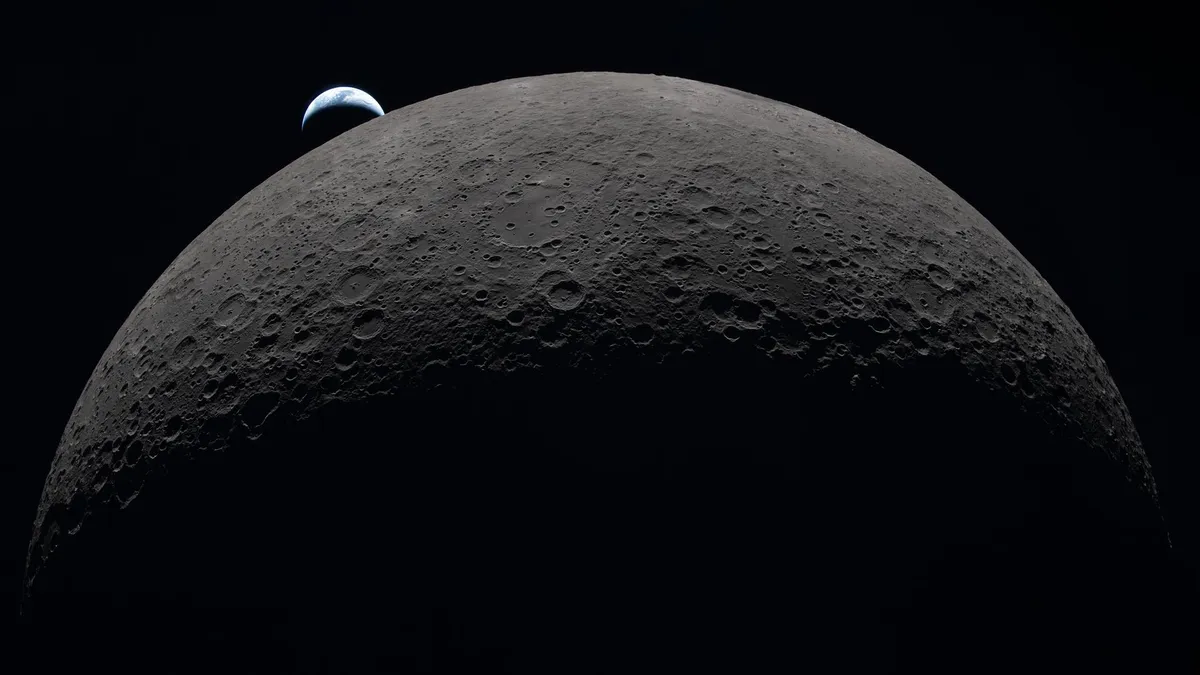
This possibility is bolstered by new computer simulations, in which scientists take into account a factor previously overlooked: the internal temperature of the protoplanets at the time of impact. This temperature could determine the hardness, deformability, and how the matter of the celestial bodies reacts when they collide.
A massive collision may have created the Moon.
The giant collision hypothesis is currently considered the leading explanation for the origin of the Moon. According to this scenario, about 4.5 billion years ago, a primitive planet roughly the size of Mars, named Theia, collided with Earth when the Solar System was very young.
Planetary scientist Robin Canup is one of the most important contributors to this hypothesis. Since 2001, she has developed and continuously improved numerous computer simulations to recreate the collision between Theia and the early Earth.
Models suggest that Theia crashed into Earth at a particular angle and speed, causing a large amount of material to be flung into orbit. This material then coalesced and formed the Moon.
However, new research led by Adeene Denton of the Southwest Research Institute has taken the model further. The research team examined in more detail the geological properties of both Earth and Theia, particularly the temperature dependence of material stability.
"The stability of matter is a very important factor when studying collisions between small celestial bodies like asteroids," Denton said. Initially, the team wasn't sure if this factor significantly influenced the formation of the Moon. But simulation results showed that it actually played a very large role.
The hotter Earth and Theia become, the more different the collision will be.
Scientists have discovered that hotter celestial bodies are generally significantly weaker than cooler ones. This is especially important in the early stages of the Solar System, because newly formed planets still contain a huge amount of heat inside.
When Theia collides with Earth, the temperatures of the two celestial bodies will determine how they deform and absorb momentum from the impact. In other words, the same collision would result in different amounts of matter being broken apart and distributed around Earth if Theia were hotter or colder.
The iron-rich core of Theia largely sank to Earth after the impact. Meanwhile, a large amount of other material was crushed and formed a giant disk of debris surrounding Earth. This disk of material is believed to be the source of the material that formed the Moon.
The temperature of the outermost few hundred kilometers of Theia is particularly important. When hotter, this layer of material is more prone to deformation under impact, and it absorbs momentum in a different way. This directly affects how debris is ejected and eventually coalesces into the Moon.
By incorporating different temperatures and material strengths into the model, Denton's team was able to recreate the collision with far greater detail than previous simulations.
The Moon may not have taken millions of years to form.
Previous simulations have presented two main scenarios for the formation of the Moon.
In the first scenario, a giant disk of material exists around Earth for a relatively long time. Debris within the disk gradually collides, aggregates, and eventually forms the Moon.
The second scenario is far more surprising. Simulations led by NASA in 2022 suggest that the Moon may have formed extremely rapidly, within just a few hours of the impact.
Denton's new simulations are reinforcing this particular capability.
If Theia was relatively cold, meaning the collision occurred later, about 100-150 million years after the planets in the Solar System formed, the material from the collision would have formed a structure that allowed the Moon to gradually accumulate.
Because Theia was colder and harder at the time, a large portion of this celestial body may have survived the impact before merging with Earth.
But if Theia had remained very hot and the collision had occurred less than 60 million years after the planets formed, things would have been completely different.
In that case, Theia could have been almost completely destroyed, creating a massive amount of material surrounding Earth. And astonishingly, the Moon could have formed from this disk of material in just a few hours.
"When I used the same parameters as the original collision models, including the same temperature structure inside both celestial bodies, a complete moon appeared in just about 5 hours," Denton said.
If this scenario is correct, Earth's history witnessed an unimaginable event: in just a few hours, our planet experienced both a devastating collision and gained a new natural satellite.
The composition of the Moon still raises big questions.
This new discovery not only helps explain the rate at which the Moon formed but may also provide clues about the characteristics of the Moon today.
Robin Canup, who was not involved in the study, suggested that the new results could open a link between the Moon's current physical properties, which may include the content of volatile elements, and the thermal state of Earth and Theia at the time of the collision.
This connection could help scientists more accurately determine when the collision that created the Moon occurred.
Notably, both simulation scenarios suggest that the Moon is primarily composed of Theia's mantle material, with only a small amount of material mixed in from Earth's mantle.
This is quite surprising, because the Moon's composition has many similarities to Earth's mantle. If most of the Moon's material comes from Theia, the fact that the two celestial bodies have similar compositions raises a major question about Theia's origin as well as the process of planet formation in the Solar System.
Previous studies have shown a more complex story. While Earth and the Moon share many similarities, they also exhibit unexplained differences, particularly in the ratios of certain isotopes. These differences cannot yet be fully explained by existing collision simulations, including Denton's new model.