


If this condition persists, especially in people with pre-existing musculoskeletal disorders, the pain may recur or become more pronounced, affecting sleep quality and daily activities.
Not all cases of neck or back pain stem from sleeping posture. However, maintaining a posture that causes spinal twisting, neck flexion, or improper body support can increase pressure on certain muscle groups, joints, and structures around the spine.
1. Sleeping in the wrong position can affect the spine.
When sleeping in an improper position, such as excessively arching the back, twisting the neck, or causing the spine to deviate from its natural axis, muscle groups and ligaments may have to maintain tension for extended periods. This can easily lead to aches and pains in the neck, shoulders, back, or lower back upon waking.
- 1. Sleeping in the wrong position can affect the spine.
- 2. What sleeping position is good for the spine?
- 3. When should I see a doctor?
Some common incorrect sleeping positions include sleeping on your stomach, using a pillow that is too high or too low, or sleeping on your side with your body misaligned and not adequately supported.
For individuals suffering from conditions such as spinal degeneration, herniated discs, or neck and shoulder pain, improper sleeping posture can exacerbate symptoms of pain, stiffness, or numbness radiating down the arms and legs. However, it should not be assumed that sleeping in the wrong position is a direct cause of herniated discs or spinal degeneration. These conditions have many contributing factors.
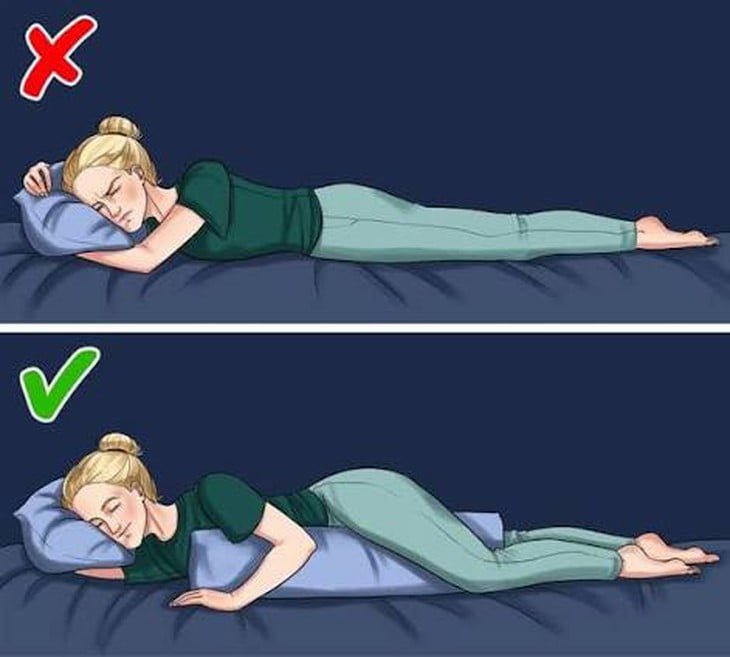
Sleeping in an improper position can affect your bones and joints. (Image: AI)
The potential consequences of sleeping in the wrong position.
- Neck and shoulder pain: Positions that cause the neck to be twisted or bent for extended periods can increase muscle tension, leading to pain and stiffness in the neck upon waking. If this happens frequently, the discomfort can affect mobility and daily activities.
- Back pain, especially in the lumbar region: When the lumbar spine is not properly supported, certain muscle groups have to work harder to maintain posture. This can be one of the contributing factors to lower back pain or stiffness.
- Worsening symptoms in people with spinal conditions: For people with herniated discs or musculoskeletal disorders, improper sleeping posture can increase pain, numbness, or discomfort. If the pain radiates down the legs or arms, accompanied by numbness, tingling, and muscle weakness, the patient should be examined to determine the cause.
- Impact on sleep quality: Pain and discomfort make it difficult for patients to find a comfortable position, leading to frequent tossing and turning or waking up in the middle of the night. Conversely, lack of sleep can also cause fatigue and make the sensation of pain more pronounced.
Specifically in children and adolescents, it should not be asserted that simply sleeping in the wrong position can cause scoliosis. Scoliosis has many causes, including idiopathic, congenital, or neuromuscular disorders. However, an inappropriate sleeping position can cause discomfort, pain, or affect the quality of sleep.
2. What sleeping position is good for the spine?
There isn't one single sleeping position that suits everyone. The important thing is a position that supports the spine, keeps the head and neck relatively aligned with the body, and feels comfortable.
Sleeping on your back is a suitable option for many people. Use a pillow of moderate height to keep your head and neck in a natural position. You can also place a thin pillow under your knees if you feel comfortable, to help reduce lower back tension.
Sleeping on your side is also a common position and can be suitable if your body is properly supported. The pillow should be high enough so that your head and neck are not tilted too far down or too high up. A pillow can be placed between your knees to help keep your pelvis and spine in a more balanced position.
Sleeping on your stomach is generally not recommended if it forces you to turn your neck to one side for extended periods. This position can increase neck muscle tension and cause back discomfort in some people.
Besides posture, the quality of pillows and mattresses also plays an important role. The pillow needs to be suitable for the sleeping posture and body characteristics; the mattress should have appropriate support, not too soft, which could cause the spine to curve or become misaligned.
3. When should I see a doctor?
If neck or back pain is mild and only appears after sleeping and quickly improves with movement or changes in posture, it is usually not a cause for concern. However, patients should see a doctor if the pain is prolonged, recurs frequently, worsens, or affects movement and sleep.
In particular, early examination is necessary if pain is accompanied by numbness, weakness in the arms and legs, or pain radiating down the arm or leg. If there is loss of bladder or bowel control, numbness in the genital-anal area, progressive weakness or paralysis, or severe pain following injury, prompt medical attention is required.
For individuals with spinal conditions, sleeping posture should be adjusted according to their specific situation. Instead of trying to maintain a "standard" posture in all circumstances, patients should choose a position that provides good body support, does not cause pain, and should consult their doctor if symptoms persist or become unusual.
Sleeping in the wrong position, the man suffered a stroke due to carotid artery dissection.
A 40-year-old male patient suffered an acute ischemic stroke due to carotid artery dissection after sleeping in a prolonged tilted, flexed neck position in a car.
A 40-year-old male patient was recently admitted to the Stroke Center at Bach Mai Hospital for treatment of acute ischemic stroke. Before the onset of symptoms, the patient had traveled a long distance by car and slept in a position with his head and neck tilted and bent for an extended period.
Through examination and imaging, doctors determined that the patient had carotid artery dissection, a possible cause of stroke in young people.
According to Dr. Phung Dinh Tho, from the Stroke Center, arterial dissection occurs when the artery wall is damaged, causing blood to leak into the wall and form a blood clot. This damage can narrow or block the artery lumen, or form a thrombus that then causes a blockage in the brain.
Cervical artery dissection, involving the carotid and vertebral arteries, is a significant cause of ischemic stroke in young people. The condition can occur spontaneously or be associated with trauma or mechanical impact to the neck region.
Therefore, when evaluating young people who have had a stroke, doctors need to explore factors that occurred before the onset, such as neck trauma, excessive neck movement, or maintaining an abnormal neck posture for extended periods.