


|
Around 11 PM on July 10th, while waiting to photograph the Milky Way in Con Dao , Tran Hai Huy Truong (37 years old) unexpectedly spotted strange streaks of light in the sky, resembling "light swords." After investigating, Truong learned that this was a phenomenon called light pillars , formed when light from the ground – in this case, from fishing boats operating offshore – reflects off ice crystals in thin clouds at high altitudes, creating vertical columns of light. Photo: Hht Tran. |
|
Experts explain that the light pillars are a rare phenomenon, appearing only when multiple conditions regarding light sources and atmosphere converge. Notably, the light pillars recorded in Con Dao this time displayed multiple colors such as orange, red, green, and blue, instead of just white as in some previous cases observed in Vietnam. Photo: Hht Tran. |
|
"I feel very lucky. As someone who has a passion for astronomy and astrophotography, I've spent the past three years photographing the night sky in many countries around the world , but I've never encountered anything like this," Truong told Tri Thuc - Znews. Photo: Hht Tran. |
|
This is the second consecutive time Truong has captured a rare natural phenomenon in Con Dao. Previously, he photographed a "giant pink streak" appearing in the sky, coinciding with China's launch of the Long March 8A rocket from the Wenchang commercial space launch site on Hainan Island. Photo: Hht Tran. |
|
This phenomenon, known as the space jellyfish , only occurs when certain conditions—time, observation location, and the angle of sunlight—converge. At high altitudes, the rocket exhaust is still illuminated by sunlight while the ground is shrouded in darkness, creating a vibrant reddish-pink cloud, shaped like a teardrop or a giant comet. Photo: Hht Tran. |
|
In mid-April, also in Con Dao, Truong recorded images of comet C/2025 R3 (Pan-STARRS) , a celestial body with an orbital period of approximately 170,000 years, as it passed by Earth. Experts from the Hanoi Astronomical Society said that observing and photographing this comet was truly a "race against time." The ideal observation time lasted only about an hour, from 4:30 to 5:30 AM, about 90 minutes before sunrise. Photo: Hht Tran. |
|
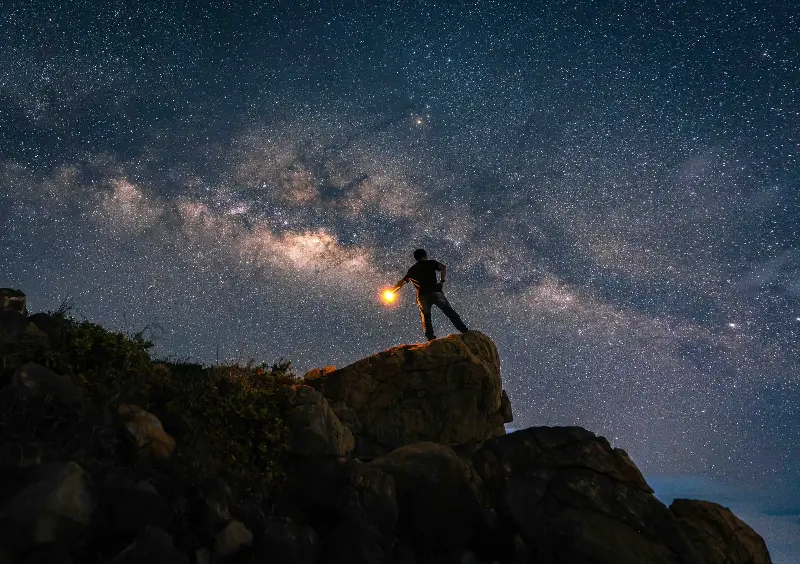
Additionally, the period from June to August is ideal for observing and photographing the Milky Way, as this celestial body appears for the longest time in the night sky. However, this is also the peak of the rainy season with many clouds, making photography more difficult than the period from February to April. In Con Dao, photographing the Milky Way has unexpectedly become one of the most sought-after experiences by locals and tourists in recent years. Photo: Hht Tran. |