


Interestingly, it is precisely in this context that localities rich in cultural depth are facing a very special opportunity. Because the digital economy , if understood correctly, is not simply about putting what already exists online. It is a new way of looking at development assets. And in this new coordinate system, heritage, identity, experiences, cultural memories, historical knowledge, or community data can all become new sources of growth. Hue is a prime example of this shift in thinking.
In a digital coordinate system, everything is changing.
For a long time, Hue has been seen as a center of heritage, culture, and tourism in Vietnam. However, if viewed only from a traditional perspective, heritage can easily be limited to the logic of mere preservation or narrowly defined tourism exploitation. A palace is a tourist attraction. A tomb is a check-in point. A festival is an event. A Hue folk song is a performance for visitors. But in the digital realm, everything is changing.
An architectural structure is no longer just a physical object; it can become spatial data, educational learning material, a digital experience platform, or a source of inspiration for creative products. A traditional court music piece can be performed on a real stage, while simultaneously becoming digital content, academic material, an immersive experience, or material for cultural industry products.
A Hue-style ao dai (traditional Vietnamese dress) is not just a traditional garment; it can also become a cultural identity symbol, a creative asset, a design product, and a local soft brand. More importantly, technology is enabling values that were previously difficult to measure, such as identity, emotions, experiences, and cultural memories, to become part of the new economy. That is the core point.
The new growth space lies not in digitizing the old, but in re-examining development assets from a different frame of reference. Hue today stands before a tremendous opportunity to transform from a "heritage city" into a "digital cultural and economic space based on heritage and experiences." This is not about replacing real heritage with technology, nor is it about turning culture into cold data on a screen. On the contrary, technology only truly has meaning when it helps heritage to be understood more deeply, accessed more widely, managed better, and create more value for the community.
In fact, Hue started this process quite early. Digitizing historical sites, building databases, developing electronic tickets, smart tour guides, archiving Han Nom documents, digitizing documentary heritage, and developing digital promotional platforms are all important steps. But that's only the beginning. Because digitization is not the destination. The destination is the ability to transform cultural data into new value.
A heritage database is only truly meaningful when it is standardized, interconnected, interpreted, and put into creative use. A database system on poetry and literature on Hue's imperial architecture not only serves for archiving but can also open up applications for digital education, digital museums, experiential tourism, international research, or creative products for young people.
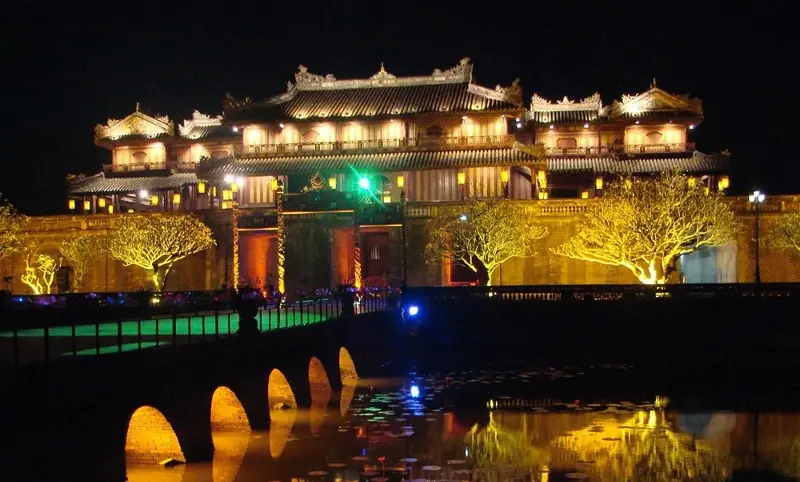
A nighttime view of the Imperial Citadel is not just about extending visiting hours; it can become an experiential ecosystem combining light, sound, performing arts, historical data, and interactive technology. From this perspective, Hue has an advantage that few other localities possess: a relatively intact connection between tangible and intangible heritage, landscapes, people, and cultural lifestyles. This very connection creates Hue's unique "digital growth DNA."
Development built on heritage, culture, and creativity.
While megacities have advantages in terms of data scale, businesses, and markets, Hue has the advantage of cultural depth, heritage density, and the ability to create sophisticated and distinctive experiences. In the digital economy, differentiation is a crucial form of asset. Mass-produced items can be quickly copied, but deep cultural identity is very difficult to replace.
This also explains why the digital economy doesn't necessarily make all localities more alike. On the contrary, if done correctly, technology will help each locality better see its own unique advantages. Ho Chi Minh City can develop from urban data, public services, and an innovation ecosystem. Da Nang can develop from smart cities and digital technology. But Hue needs to develop from heritage, culture, experiences, and creative industries. Not by going slower, but by going differently. Of course, this path is not simple.
Hue's biggest challenge isn't a lack of technology. Technology can be bought, acquired through collaboration, or experts can be hired. The real challenge is changing the development mindset. If we continue to view heritage sites merely as ticket sales, tourism as simply welcoming guests, data as just archived records, or culture as just a movement, it will be very difficult to open up new avenues for growth. Hue needs a different approach: viewing heritage as the foundation for development; culture as a soft resource; data as an asset; experiences as a product; and the creative community as a partner.
In this approach, technology companies shouldn't just play the role of selling software or providing technical platforms. What Hue needs are partners capable of working with the locality to solve development problems. These could include CultureTech, TourismTech, heritage data, digital museums, AR/VR, digital learning materials, smart destination management, or platforms connecting artisans, researchers, designers, and the creative community.
More importantly, technology companies need to understand that culture is not a "small market," but a vast space of value for the future. When data meets identity, when technology meets cultural depth, when creativity is coupled with responsibility, the digital cultural economy can absolutely become a new growth engine for Vietnam. Hue today, as a centrally-governed city, is facing the demand to develop faster, stronger, and more modernly. But what is commendable is that Hue is not choosing to sacrifice its identity for short-term growth. The city is trying to follow a different path: development based on heritage, culture, and creativity.
It might be the more difficult path. But it could also be the more sustainable one. Because in an era where technology is increasingly making the world uniform, it is identity, memory, and cultural depth that create lasting value for each locality. And who knows, Vietnam's new growth space in the future may not only come from industrial zones, seaports, or investment capital, but also from places like Hue, where heritage is gradually entering the digital coordinate system with all its cultural depth.