



Astronomers observing the interstellar comet 3I/ATLAS as it flew past Jupiter discovered it may be much older than previously estimated, potentially predating the entire Solar System.
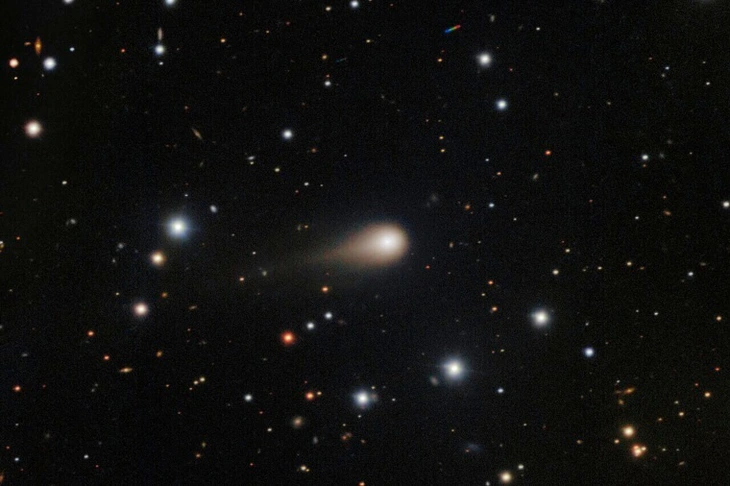
Interstellar comet 3I/ATLAS is making a flyby of our solar system - Photo: NBC NEWS
When the interstellar comet 3I/ATLAS made its closest approach to Jupiter on March 16, astronomers observed and concluded that the object may be much older than previously estimated, according to IFLScience on March 17.
New analysis suggests that it is not only "completely different" from any other celestial body in the Solar System, but may also have formed very early in the history of the Milky Way galaxy – the galaxy containing our Solar System.
3I/ATLAS was first discovered when it hurtled through the Solar System in July 2025. It is the third interstellar object ever observed by humans as it passed through the Solar System.
The most noteworthy aspect lies in the chemical composition of 3I/ATLAS.
The research team used spectral data from the James Webb Space Telescope and discovered unusual isotope ratios of 3I/ATLAS.
The deuterium content in the water is an order of magnitude higher than in known comets, while the ratio of the two stable carbon isotopes (¹²C/¹³C) also far exceeds the values typically found in the Solar System and nearby interstellar clouds.
These indications suggest that 3I/ATLAS did not form in the galaxy's "local region," but may have originated from a carbon- and oxygen-rich star system with relatively high levels of metals.
The data consistent with the 3I/ATLAS scenario dates back to the early period of star formation in the Milky Way, 10-12 billion years ago, and is older than the Solar System (which is approximately 4.6 billion years old).
This makes 3I/ATLAS a "fossil" of an ancient planetary system, preserving chemical traces of ice and volatile matter from its earliest beginnings.
This discovery not only helps trace the origin of a comet but also opens up opportunities to study the conditions under which exoplanets form.
The presence of compounds containing C, H, O, N, and S in 3I/ATLAS suggests that these ancient environments had sufficient components to lead to complex chemical reactions during the early stages of our galaxy's formation.
Currently, 3I/ATLAS is leaving the Solar System and heading towards the constellation Gemini. Scientists are racing to gather more data before this "ancient messenger" disappears into interstellar space.