



Concerns about supply from the Middle East continued to be the focus of the global commodities market on July 29, driving up energy prices across the board and contributing to a 1.1% increase in the MXV-Index to 2,762 points.
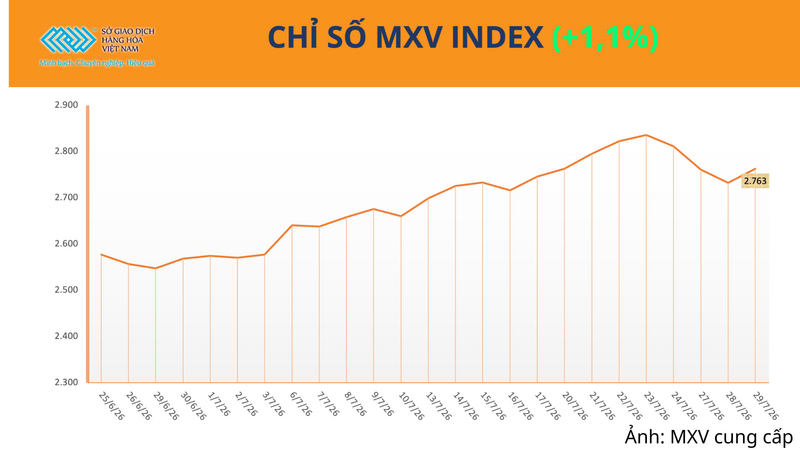
MXV-Index.
In contrast to the positive performance of the energy market, agricultural commodities were dominated by red in yesterday's trading session. At the close, soybean prices fell 2.2% to $438.2 per ton; soybean meal prices decreased 1.3% to $356.6 per ton; while soybean oil prices also lost nearly 2%, retreating to $1,490 per ton.
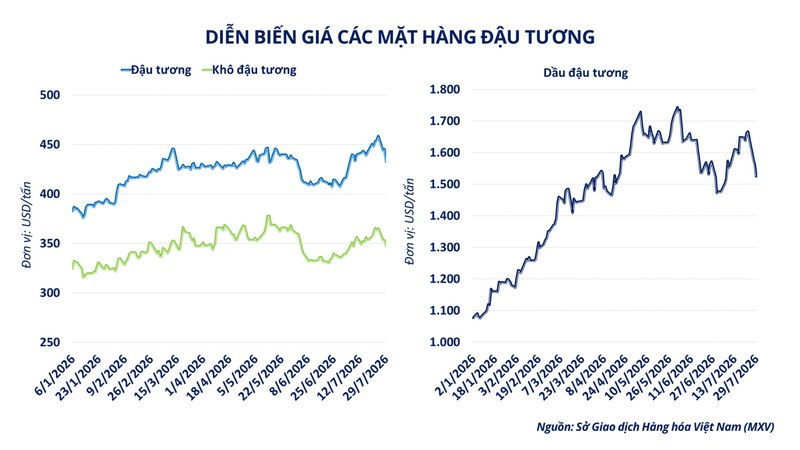
Trends in soybean prices.
According to MXV, the decline in the soybean group was mainly due to profit-taking by hedge funds after the weather outlook in the US improved. In addition, the weakening of soybean oil, influenced by developments in the energy market, also contributed to increased selling pressure on the entire group.
The MXV-Index for agricultural products closed at 1,486 points, marking a correction after reaching a peak of nearly 1,563 points in mid-July.
According to the latest forecasting models, the western part of the U.S. Corn and Soybean Belt (WCB) will receive fairly abundant rainfall in the coming weeks, while temperatures across the entire Midwest are expected to remain cool in early August. This is the period when soybean plants enter the fruiting and seed development stage – a crucial time for determining crop yield. The favorable weather outlook has eased concerns about heat stress, thereby triggering a wave of profit-taking in the futures market.
Despite a significant drop from the record high of around 502,000 contracts earlier this year, large hedge funds currently hold a net long position of approximately 320,000 contracts in the bean sector. This position size suggests that there is still considerable room for technical selling if weather conditions in the US remain favorable in the coming weeks.
In terms of demand, the market is also facing additional pressure as China 's import activity shows signs of slowing down after a period of strong purchasing. Furthermore, recent diplomatic developments between Washington and Beijing regarding regulations restricting artificial intelligence (AI) technology are raising concerns that agricultural trade could continue to be one of the tools of retaliation between the two economies.
In China, record soybean imports of 13.55 million tons in June helped oilseed mills maintain production capacity at 2.25-2.5 million tons per week, pushing commercial soybean oil inventories above 1.2 million tons – the highest level in nearly three years. To ease storage pressure, China's State Reserve Corporation (Sinograin) is expected to auction off approximately 500,000 tons of soybeans later this week.
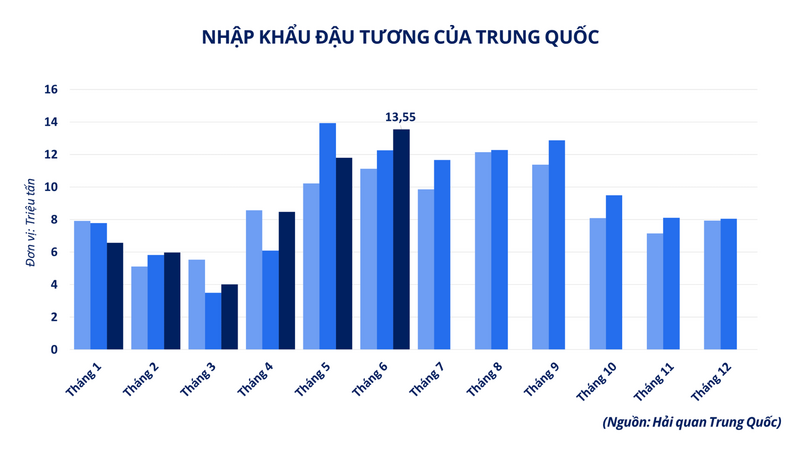
China's soybean imports.
Domestically, the supply of soybean meal in August is projected to be quite abundant. In addition to over 400,000 tons of imported soybeans for oil extraction, Vietnam is expected to import approximately 400,000 tons of finished soybean meal, bringing the total supply to around 700,000 tons. However, the pace of purchases for August-September delivery remains quite slow, while delivery time is limited. This is causing trading companies to continue maintaining prices, making the domestic soybean meal market more sensitive to fluctuations in world prices.
According to Ms. Nguyen Thi Thu Hien, Head of News Department at Hitech Finance Joint Stock Company - Business Member 036 of MXV, favorable weather prospects in the US Midwest are likely to continue putting pressure on soybean prices in the short term. However, the market will still fluctuate strongly depending on weather forecasts, crop progress reports from the US Department of Agriculture (USDA), and developments in import demand from China - factors that can quickly change the expectations of speculators.
According to Ms. Hien, investors should monitor the price reaction at the current support level. If the price breaks through this level with increased liquidity, downward pressure may continue to expand.