



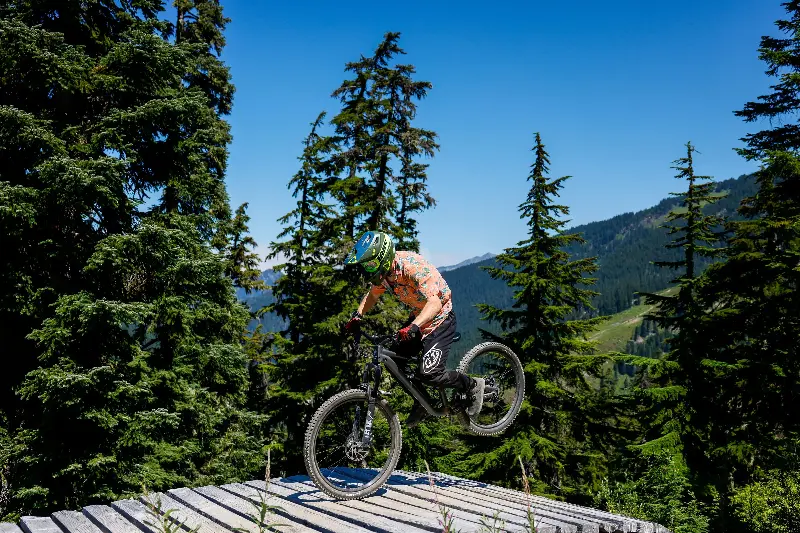
STEVENS PASS, Wash. — Washington's hardest-to-pronounce mountain biking trail might also be its most fun.
In Norse mythology, Jörmungandr (YOR-mun-gahn-dr) was a serpentlike sea monster born to the trickster god Loki and archenemy of thunder god Thor. The namesake of the newest trail at the Stevens Pass Bike Park suggests it's not one to take lightly, but seasoned downhill mountain bikers should definitely consider charming this snake and ride what feels like the dirt equivalent of a banked slalom course.
Debuted in the middle of last season, Jörmungandr's first two phases (a third is in the works) are part of a renaissance at the Stevens Pass Bike Park. First opened in 2011 under previous ownership, Vail Resorts mothballed the park in 2021 but brought it back the next year by popular demand and has invested in new and better trails ever since.
Coupled with the second iteration of the Summit Mountain Bike Park, which also opened in 2022 and has debuted three new trails since, this decade's fifth season of lift-serviced mountain biking in Washington has seen the outdoor pursuit come back stronger than ever. From just three trails that only went halfway down the mountain before petering out on service roads, today the Stevens Pass Bike Park boasts nearly a dozen top-to-bottom trails and a full slate of jumps, berms, slabs and bridges that offer plenty of g-force-inducing, stomach-churning moments for advanced riders looking for something they can't find on their neighborhood trails.
While the $71 lift ticket costs more than pedaling, bike patroller Tony Fortune argues it's money well spent if you're hoping to hone your technical skills in short order. Because you can get so many laps without pedaling, you can really see progression in one day and even in one hour," he said.
Suiting up
One of the perks of summer at Stevens Pass? Easy parking. The notoriously congested ski area provides a much mellower arrival experience in the warmer months. No reservations are required, nor any risk of satellite parking.
If you bring your own bike, ride from the lot to the base area. Otherwise, head over to the rental shop for a full suspension downhill bike ($152 for adults, $110 for kids). Rentals are all-day only with no hourly or half-day option, so plan accordingly and prepare to commit to a full day of riding. Prices are 20% cheaper when booked online in advance.
All rentals include knee and elbow pads, gloves and a full-face helmet. Chest protectors are an extra $12. Donning the armor can make you feel like a knight heading into battle — it can also get hot — but the protection is worth it. I'm still nursing a sore elbow from a crash without pads over a month ago, so I was grateful to suit up head to toe, knowing that my day would mostly consist of high-risk downhill riding.
The rental shop is a well-oiled machine and had me kitted out in minutes. The bike was in good working order, but didn't come with a dropper post, which allows the rider to adjust their seat height on the fly. I like dropper posts for sections when I have to pedal, but there is admittedly very little pedaling at a bike park.
Instead, the Hogsback Express chairlift does the work of getting you and your bike to the top. Bikes and riders alternate chairs; loading the bike into the cradle takes some practice, but the lifties can assist. Once airborne, it's a bit disorienting to ride a chairlift with nothing strapped to your feet. Distract yourself with the view — yes, the majestic Cascades, but also eyeballing the trails below you that spend the winter buried in snow until dedicated trail crews can work their magic.
"What sets Stevens Pass and other bike parks apart from places like Leavenworth or Bellingham are machine-built, wide flow trails versus a hand-built, single-track trail," said Fortune, my guide for the day. "Because of the machine access, you can't build trails like this everywhere."
At the top, lifties take your bike off the rack for you — then it's time to choose your adventure.
Trail progression: green to 'Gandr
Warm up with a green circle route: Golden Spike to Morooka Motion. You won't catch air or have to negotiate steep, rocky sections on these mellow cruisers. But fair warning, they are the only "easy" rated trails at the Stevens Pass Bike Park. If you aren't comfortable riding blue squares, it's best to practice somewhere like Duthie Hill Mountain Bike Park and come back when you're ready, or take a lesson (two-hour intro session $82).
From there, we peeled out from the top of the lift to Rock Crusher, a nod to the heavy machinery used to build this trail, one of the park's originals. Rock Crusher is the longest blue square flow trail — meaning a smooth riding surface sculpted into berms, rollers and jumps, as opposed to a technical trail riddled with roots and rocks and requiring more careful line choice.
Halfway down Rock Crusher, you'll also find a turnoff for Look What I Found, a black diamond with a slab — a rock face long enough that the bike rides down the rock, not just over it. There are a few of these more challenging options peppered throughout the park (see also: Duff Step off Golden Spike) that allow for short-but-steep alternatives to the standard trails.
After Rock Crusher, check out a blue square that starts technical and then goes with the flow in Jörmungandr — and it's really the lower, phase two flow section where the trail shines. The berms are packed tight and rise just enough to slingshot the rider around each turn in a swooping motion. Stevens Pass doesn't have a lot of dirt to work with and dries out fast under the summer sun, but there's enough forest cover to keep this trail a bit tackier than the rest of the trails, where, by late July, ruts were starting to make an appearance.
For Fortune, the trail represents progression not just for the rider but for the Stevens Pass Bike Park itself: "Jörmungandr is the perfect example of these really cool, flowy, machine-built trails.
P.B.R. with a ginger ale chaser
Jörmungandr is pure Type I Fun, meaning you want to do it again as soon as it's over. The beauty of the bike park, of course, is that you can, until the chairs stop spinning.
But I wanted to sample as much of the park as possible on my first day riding here and couldn't resist the Type II Fun enticement of black diamond P.B.R. Short for Powered by Rudolph, the trail is an homage to former marketing director Chris Rudolph, who died in the 2012 Tunnel Creek avalanche during the first winter after the bike park opened. He was one of the bike park's original conceivers and led a crowdfunding campaign that persuaded the then-ownership to hire Whistler, B.C.-based Gravity Logic to design and build the park.
P.B.R. warns riders at the entrance with a rock drop — if you can't handle that feature, it's best to try again another time. The gentle but firm reminder that you are heading into serious terrain is one of many thoughtful attributes at the bike park, from pullouts so you can wait for friends without obstructing the trail to ride-arounds where you can avoid the gnarliest jumps.
But I decided I wanted to taste every last drop of P.B.R., so I committed to chugging the whole can, as it were. The jumps were bigger than Rock Crusher, but still manageable even for a rider like me who has long since stopped getting air on skis. A day at the bike park was proof positive that a full-suspension mountain bike absorbs landings far more gracefully than my middle-aged joints.
The real tests were the wooden bridges and boardwalks. The first one headed for an abyss — not knowing if the blind rollover was a massive drop or a gentle exit, I parked the bike and walked to the edge to check it out. There's no shame in inspecting a challenging feature before riding it, the type of reconnaissance mission that's a lot easier at a mountain bike park than at a ski resort, where retreating uphill isn't as simple.
Seeing that the boardwalk went cleanly without massive air, I got back in the saddle and popped over, only to find myself quickly riding the wave on another boardwalk that undulated like a highway buckling during an earthquake. I hung on through the roller coaster ride and then ping-ponged around a few more wooden slats that resembled an M.C. Escher painting.
Although I emerged unscathed — not falling is the ultimate sign of a good day at a mountain bike park, seeing as rock and dirt are far less forgiving than snow — my stomach was churning. Only whiteouts induce nausea for me on skis, but three hours of constant downhill biking sent me straight to the Bull's Tooth Pub, desperate for a ginger ale.
Would I do it again? Yes, but note to self: Pack the Dramamine.