



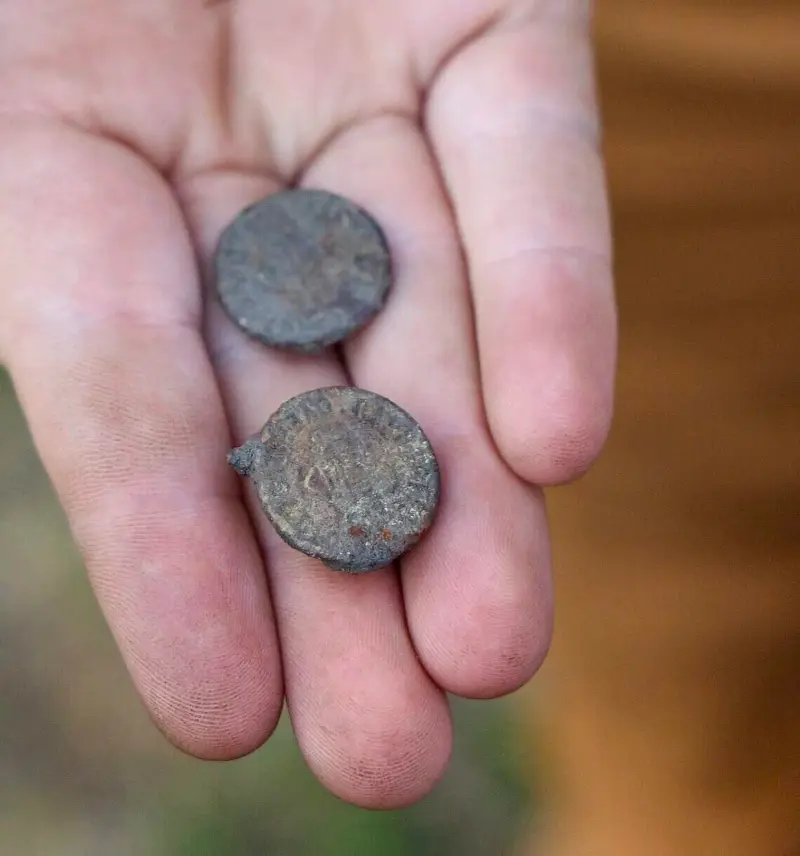
BOISE, Idaho — Buttons. Nails. A broken shovel. A shard from a ceramic plate.
The items read like contents from a landfill, but for archaeologists with the University of Idaho, they tell the story of an early farm near Boise in a way history books can’t.
The Dry Creek Historical Society asked professors and students from the university to visit the Schick-Ostolasa farm in the Foothills north of Boise recently to uncover this sort of history. The property is considered one of the oldest farmsteads in the Treasure Valley, and University of Idaho archaeology professor Mark Warner said oral tradition suggested a blacksmith building had once stood in what is now a grassy area near the historic farmhouse and other structures.
The historical society hoped researchers would discover details about the building so it could create a replica for its exhibit, which includes a barn, granary, woodshed and more.
The project, which included volunteers and University of Idaho graduate students, is part of the Idaho Public Archaeology program, a collaboration of U of I professors who try to include everyday people in their archaeological discoveries.
Warner said Idaho Public Archaeology, which has had around 400 volunteers and 5,000 visitors to various projects over the years, serves multiple purposes. It allows students the chance to get hands-on field experience, catalogs local history and dispels the idea that archaeology is “this exotic thing that you have to go to Egypt for.”
“Archaeology is in your own backyard, and history’s in your own backyard right beneath your feet,” Warner said. “It’s just a matter of figuring out how to get at that.”
Boise-area dig site yields ‘invisible history’
For a week, Warner’s students and volunteers uncovered history centimeter by centimeter in a corner of the quiet Hidden Springs community. One group scraped the earth where the blacksmith shop was believed to have once stood. Another group explored an area near a post-and-rail fence where workers had hit a large rock structure when installing posts.
Both sites proved rich with artifacts.
“Once you become an archaeologist, it’s sort of like reading a book — only the book’s the ground, and you look and try and piece together what has happened in the past through what you see,” Warner said.
The group located what appeared to be some foundational stones of a building where a descendant of the homesteaders said the blacksmith shop once stood. Careful inspections of the layers of soil in the area were packed with items — 280 artifacts in the first two levels of soil — that included homemade square nails, farm equipment blades and buckles that may have belonged to saddles or other farm items.
The rocks near the fence yielded about as many questions as answers. Large stones were piled in some sort of structure, but the purpose of that structure is still unclear. Some stories implied the area was used as a “chicken plucking station,” though Warner said the level of effort put into the rock structure seems excessive for that activity.
Archaeologists found charcoal, animal bones (none of them chicken bones), Carhartt buttons dating back to the first half of the 20th century and a shovel head that appeared to have been re-riveted by hand multiple times before it was discarded.
“That’s not a Home Depot shovel,” Warner said. “Someone tried to fix it, and they didn’t fix it so they finally said, ‘Let’s throw it out.’ ”
The professor called these kinds of finds “invisible history” — a story that’s closer to the truth of how people lived than the consciously crafted narratives in history books. The objects may appear mundane on the surface, but archaeologists can learn a lot from them.
“The trash that you throw out tells a story about how you live in a way that you don’t think about very often, and is almost certainly dramatically different from the public presentation of self,” Warner said.
He noted that a previous Idaho Public Archaeology project at the Cyrus Jacobs/Uberuaga House, an 1860s boarding house on Boise’s Basque Block, revealed “toothpaste jars from London” and materials from Scotland and France, despite the relative geological isolation of the frontier town at the time.
Warner said people can contact Idaho Public Archaeology if they find areas or artifacts they think warrant a dig. He encouraged people to contact local Native American tribes first if they find items associated with Native American lifeways.
Idaho archaeology site offers student experience, excitement
On a quiet Thursday morning, at least one Hidden Springs neighbor had walked past the archaeology dig and stopped to ask questions.
Warner said those interactions can be valuable in teaching students how to present their work and their field to the public in addition to the hands-on dig site training they’re getting.
Jade Payne finished her master’s in the spring and joined the dig as a volunteer. She said the limited timeframe of the project introduced some challenges that forced the archaeologists to be strategic about how they spent their time as they explored the mysterious rock area. Payne said the Dry Creek Historical Society indicated that it intended to leave the area uncovered for visitors to explore — something that doesn’t often happen for archaeologists, who are used to burying their work.
Blake Palmer, an incoming graduate student, said she found the prospect exciting, especially if the community brings its own ideas about what the structure may have been.
“It can be frustrating to not have a solid perception or idea of what this might have been, but I think the continued effort just to be able to examine it, that is really cool,” Palmer said.
Even the smaller discoveries, like the shovel found in the rock area, provoked the kind of reflection that Idaho Public Archaeology hopes to spur.
“It could have lived many lives,” Palmer said. “It would have been so much different.”