



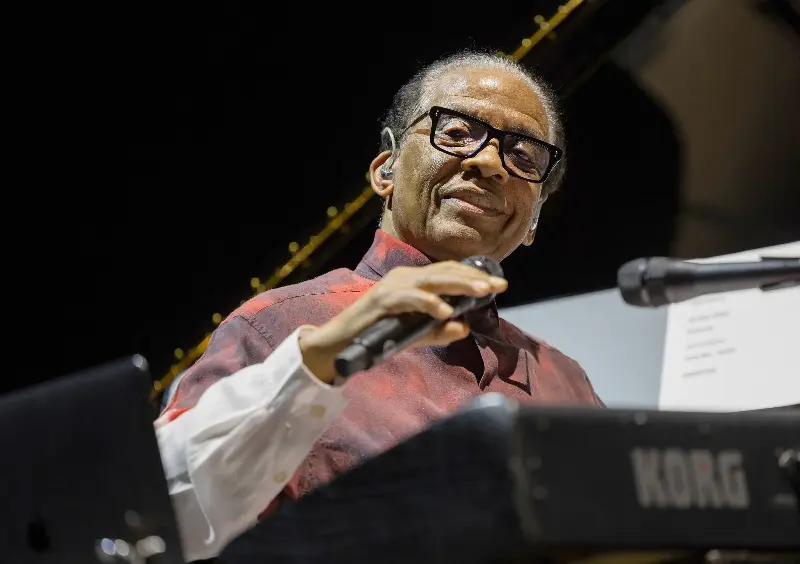
BALTIMORE — Jazz icon Herbie Hancock remains exactly where he always has been — at the forefront of his field, observing, innovating and asking unnerving questions of himself and everyone he encounters.
At 86, Hancock has been performing music and composing it for a very, very long time. Seventy-four years to be exact, if you count the former child prodigy’s debut playing piano with the Chicago Symphony Orchestra in 1952 at age 11. (Why wouldn’t you?)
Along the way, he has won numerous accolades, including 14 Grammy Awards — and in particular the Lifetime Achievement Award in 2016. He even picked up an Academy Award in 1987 for composing the best original score for the film “Round Midnight.”
Over the decades, he has discovered path-breaking musicians (he launched Wynton Marsalis’ career) and influenced others; in 2013, Snoop Dogg public credited Hancock with “creating hip-hop.”
Moreover, Hancock is still touring; he comes to Joseph Meyerhoff Symphony Hall for one night only on July 28 under the auspices of the Baltimore Symphony Orchestra and its jazz-loving music director, Jonathon Heyward. (Hancock will perform with his own band, not Heyward or the BSO.)
During a recent 30-minute phone chat, ideas poured out of Hancock nearly as rapidly as musical beats cascade from his piano: the travails — and unexpected gifts — of aging; why he still composes and tours; his belief in the potential of artificial intelligence. And about his five-year collaboration in the 1960s with the legendary Miles Davis.
The following conversation has been edited for length and clarity.
Q: What will you perform at the Meyerhoff? Will you talk to the audience like you usually do?
A: I’m putting the set list together now. I recently changed a few pieces. I may play a little bit of “Maiden Voyage,” and then sort of morph into a version of “Watermelon Man,” but not the original. This is an arrangement I used to play several years ago. There isn’t always a 4/4 beat. It varies a lot. It will start out at 4 and then jump to 7 and then 6 and 5.
I do like to talk to the audience. I tell them they’re like the sixth member of our band, because even though we play the same songs every night, each performance is different. The audience affects the music, and I want them to know that they are important. The other thing I tell them is, they are like family to me because they really are. We’re all the same species; we all came from the same egg.
Q: You’re 86, and you’re still touring the world. Isn’t that exhausting? I get tired just thinking about it.
A: Everybody I know that has retired has died, and I don’t want to go yet. That’s why I keep working. It keeps my mind going, keeps me creating, keeps me alive.
Q: What musical problem are you working on these days?
A: How to think when I’m playing and how to not think at the same time. I have to use my intellect, but I can’t rely on that alone. It’s just one aspect of what I do. There’s also what I’m feeling.
Performing isn’t ever something I want to be totally comfortable with. I want to keep challenging myself.
The most difficult part of aging is losing some of your physical abilities. It’s harder for me to remember names, numbers, how to do certain things. But the best part is that you actually continue to have new realizations and understandings. Life is a process of learning, and you learn from living.
Q: Tell me a Miles Davis story.
A: In 1963, I got a call from Miles asking me to come over to his house the next day. Until I heard that raspy voice — Miles had problems with his vocal cords — I never dreamed I might get to play with him.
He took us down into his basement, and there was a piano with some music on it, and he asked us to play it. He would give some instructions, but didn’t say much. After just a few minutes, it seemed like he got mad. He … threw his horn on the couch and went upstairs. He told [bass player] Ron Carter to take over.
What I didn’t know is that Miles went up to his bedroom and actually listened in on his phone as we were playing. [Drummer] Tony Williams was just 17, I was 23 and Miles felt that Tony and I were intimidated by him. He thought that once he got out of the room, we would be freer. The next day, he asked us to come over again, but this time he played with us.
This was maybe a Friday or Saturday, and he told us to meet him on a Monday in May at the Columbia Recording Studio in Manhattan.
I said, “Miles, does that mean I’m in the band?” He said, “That means you’re making a record.”
I still didn’t know I was in the band until after the recording session, when he told us to show up to play a gig somewhere north of New York.
That was a defining moment in my life.
Q: You are interested in music and ethics. What is your take on AI?
A: I’m an old techie, you know, so I’m actually looking forward to AI’s development. Maybe someday I could play a duet with myself, or a duet with AI.
I don’t worry about AI replacing musicians because AI doesn’t have feelings, not like we do. I don’t know whether it will have a realization of itself at some point. But the thing is, it has not lived a life.
I always tell the audience that when I use Siri on my iPhone, I say “Thank you, Siri, I appreciate what you said,” because I think we need to try to make AI our friend.
You saw the “Terminator” movies, right?