



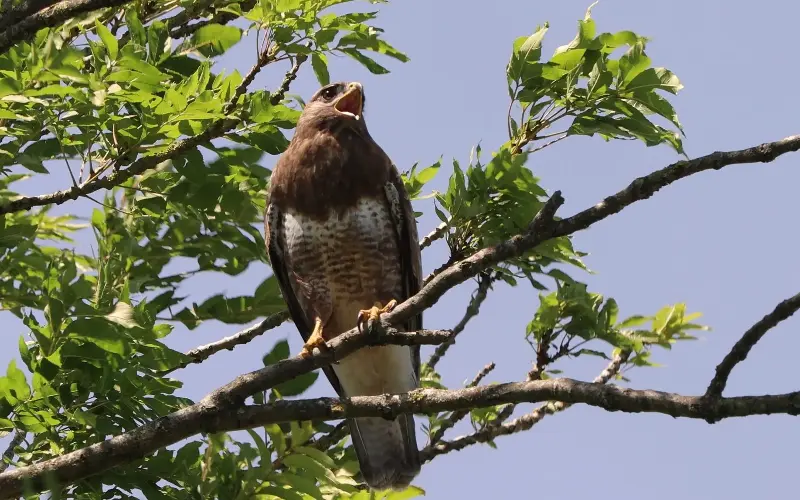
Perched atop a dead tree, a bird of prey looks down upon a valley and lets out a long, piercing screech.
The buzzard, known as Boris the Blade, has been terrorising the small village of Coleorton in Leicestershire for years, swooping down and attacking people’s heads with its talons.
Villagers have been living in fear of the bird, which is protected under the Wildlife and Countryside Act 1981.
Some have even resorted to arming themselves with pool cues or umbrellas for protection when leaving the house.
The bird of prey targets a stretch of footpath that leads to Gelsmoor Restaurant, a popular destination in the village.
Last month, a walker was left with long, deep cuts on his head after Boris “went for him” when he risked a trip down the path.
The Telegraph understands that Boris’s reign of terror has lasted at least five years. But his attacks have intensified in recent weeks, with the bird expanding its range into more densely populated areas.
Pete Sibson, a local falconer, said that Boris was “one strong bird” and that he was shocked by its “standout intelligence”.
“He comes in for an attack from behind,” Mr Sibson said, impressed by the bird’s swooping dives. “Brilliant flyer – that bird is one bright spark.”
Frances Carpenter, 70, said people in the town were “living in fear”. “It flew by our bedroom window the other morning. It cast a huge shadow and gave us quite a fright,” she said.
Buzzards have wingspans of more than 4ft and can weigh up to 1.4kg. And while buzzards are only known to eat animals as large as rabbits, Ms Carpenter said that she was scared to let her “dopey but a sweetheart” black labrador Berty out into the garden in case he was “carried off”.
Buzzards are among Britain’s most cherished native birds but were on the verge of extinction by the end of the Victorian era, having been shot in large numbers by gamekeepers.
The species has since become one of the great successes of the country’s conservation movement, with numbers ranging from 57,000 to 79,000 breeding pairs.
Many villagers suspect Boris is protecting a nest, probably located somewhere near his favourite old dead tree, as his aggressive behaviour tends to start with the onset of summer each year.
Several locals said that they had formed “something of an emotional bond with Boris”. The owner of Gelsmoor Restaurant said Boris was “actually great for business”, bringing in bird-lovers eager to catch a glimpse of the famous buzzard.
But others worry Boris has “developed a habit” of his swooping attacks, claiming the behaviour has worsened each year.
Daisy Stewart, a 19-year-old waitress at the restaurant, believes she was one of Boris’s first victims, having been attacked two years ago.
“It was a normal day. I was heading to work with headphones in, and all of a sudden I felt this big thud on my head and a big talon crack across my forehead.
“It was a forceful grab; he fully grabbed my head,” she said.
James Geary, 32, who works as the restaurant manager, said when staff first started reporting the incidents, he hadn’t believed them.
“I remember when one pot washer came in and said it; I thought they were lying,” he said.
“It was kind of one of those ‘a dog ate my homework’ things. I mean, really? You’re late because a bird was attacking you?”
But last week, Mr Geary himself was targeted by Boris.
While Mr Geary said that he was “fond” of the bird and had been “thrilled” to see an example of British wildlife flourishing, he said that the buzzard could be “menacing” and was “not to be messed with”.
Recalling the worst attack the area has seen, Mr Geary described how a man had come into the restaurant “with blood coming all down him”.
“As he came in, you could see the claw marks on his head, and I just thought, ‘My God!’,” he said.
That man, Ben Storer, a 50-year-old local designer, had to get the gashes left by Boris’s talons glued at the hospital.
Mr Storer said that Boris had “swooped for years” but that this year he had “upped his game”.
An RSPB spokesman said: “Aggression can often be caused when birds feel threatened or are protecting their young.
“When faced with a bird showing aggressive behaviour the best thing is to give them space, avoid the immediate area and even take an alternative route.”