



Dozens of parish councils claim to represent the oldest “town” in the UK, but which are the most serious contenders? When does a town stop being a settlement? Can you compare a town of, say, the middle of the first century – when London was founded – with one in the 21st century, or a much earlier Iron Age community?
By Roman times, towns had sprung up in many parts of Britain. However places such as Calleva Atrebatum in Hampshire later dwindled or disappeared. Dunwich in Suffolk was a Saxon town with more than 2,000 residents; today it has just 189 (2021 census). Even the Domesday Book of 1086 is unreliable: Lancaster is recorded as having no population at all.
As late as the early 18th century, the North West of England had no towns with populations exceeding 5,000, according to some sources. Others claim that Chester had 7,500 inhabitants.
Selecting which settlement really is the oldest town is therefore fraught with difficulty. But here are the 10 likeliest candidates.
Amesbury
Close to Stonehenge, the Wiltshire town is purported to be Britain’s oldest settlement, dating back to 8820BC according to a project led by the University of Buckingham. It was probably a transport hub for traffic on the Avon. Culinary evidence has been found, including frogs’ legs and fish bones, dating from between 6250BC and 7596BC.
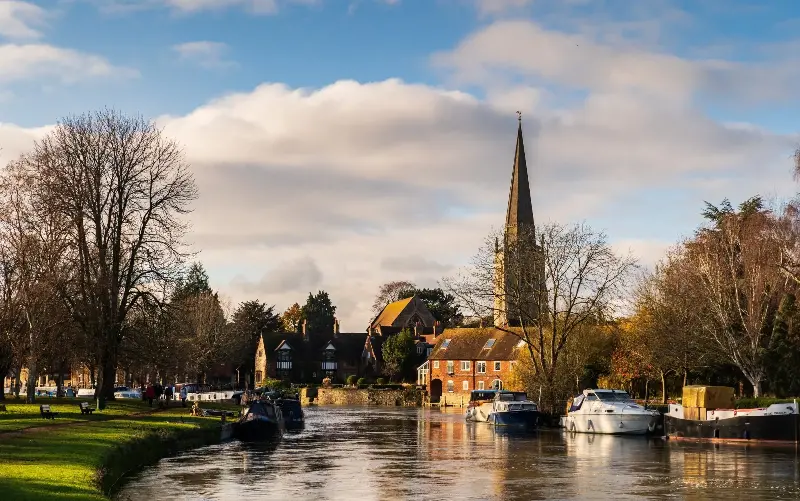
Abingdon
Historically in Berkshire, now in Oxfordshire, Abingdon claims to be the oldest town in Britain in continuous settlement. Remains from the Stone and Bronze Ages have been found, and an 82-acre Iron Age enclosure was found underneath the town centre in 1991, which has been carbon dated to 200BC. The Romans continued to use Abingdon as a town, as did the Saxons.
Colchester
The Essex city claims to be Britain’s oldest recorded town. This is based on a 77AD reference made by Roman author Pliny the Elder to Camulodunum (the name at the time) as “a town in Britain”. It’s claimed this is the first known reference to a named settlement in Britain, though coins minted almost a century earlier also refer to Colchester by its Celtic name – Camulodunon, an important tribal capital. Some 800 pieces of Neolithic and Bronze Age pottery have been found in the town. Colchester became Colonia Victricensis in 49AD, a Roman provincial capital and the only place to merit the honour of Roman citizenship. Its town walls, constructed between 65AD and 80AD, are the oldest Roman town walls in Britain.
Ipswich
The claim here verges on linguistic jiggery-pokery. Ipswichians point out that it wasn’t an Iron Age or Roman town, but is the oldest town to have been established and developed by the English, with continuous occupation on the same site. So, while York and London evolved into Viking or Anglo-Saxon cities, the densely inhabited, non-rural town of Ipswich came into being only when the speakers of what we now call Old English created it.
But there are records of William the Conqueror destroying large parts of Ipswich (which disgruntled locals lean on to explain the rise of rival Norwich); how much of a town needs to survive to say it remained occupied?
Thatcham
Said to be the oldest continuously inhabited settlement in Britain, Thatcham can trace occupation back to a Mesolithic hunting camp. Strong evidence indicates people settled in Thatcham in the Mesolithic Age (10,000BC to 4,000BC). It was subsequently settled by the Romans and Saxons, and appears in the Domesday Book and, more importantly, in past editions of the Guinness Book of Records.
Worcester
An outlier, with fewer advocates, Worcester’s history nonetheless stretches back around 5,000 years. As recently as the late 1600s it was the largest town in the Midlands. In the late 1960s, aerial photography revealed evidence of the earliest habitation of the area about 5,000 years ago. Philip Barker, an archaeologist who lived in the city, unearthed evidence of strongly fortified settlements of the late Bronze Age or early Iron Age.
Great Urswick
Bones dating back 11,000 years, unearthed in 2023 at Great Urswick in Furness, were recently confirmed as being the remains of a small girl. Initial studies of the “oldest Northerner” suggested they belonged to a man, but further analysis by the University of Lancashire showed the bones belonged to a female child aged between two and a half and three and a half years old – now known as the “Ossick Lass”. Stone walls indicate a substantial hamlet by the Iron Age. Was the site where the remains were found, Heaning Wood Bone Cave, close to a proto-town?
London
Roman Londinium was built on open country, not a pre-established Iron Age site. Founded around 50AD, it expanded rapidly but was partly depopulated and devastated by Boudica’s rebellion of 60–61AD. It quickly recovered and by the middle of the second century the city boasted a population of 20,000–30,000 and an array of fine public buildings. This was the island’s first town if we see a town in (modern, arguably anachronistic) terms of numbers alone. It declined later, and very few people lived there by 400. By 800, however, some 10,000 citizens called London home.
Canterbury
Once we get into the subject of pre-Roman “cities”, the floodgates open. Canterbury – the site of the UK’s oldest church, St Martin’s, built in the sixth century – was a Celtic tribal hub and population centre. So was St Albans. And Wroxeter. And Carmarthen. Possibly Mirfield, and Fleetwood, too. More than 20 major tribes ruled over large areas (as well as smaller tribes and sub-tribes) and wherever people farmed and fought, settlements emerged. Ask a Druid and they’ll tell you at length about Caer Odor and Caer Don and all the other Caers: strongholds-cum-townships.
Thetford
How many people make a town? In 1086, when the Domesday Book was compiled, London had somewhere between 10,000 and 18,000 inhabitants – a modest settlement by modern standards. But then again, there were only one or two million people on the British Isles and the whole of Europe had fewer people than the present-day UK. Wallingford had as many as 3,000 people in 1086 and Thetford, with perhaps 4,000, was the sixth most populous place in Britain. The five places above it are now cities, so perhaps Thetford is our oldest town, and with 25,000-plus people today it still is very much a town.