



In 2015, the year before Adrian “AA” Gill died, he published a wonderful memoir, Pour Me: A Life. The book told of his teenage descent into alcoholism before he sobered up at 30, and turned his spare energy to writing: first for Tatler and then for The Sunday Times, where he stayed for three decades. Gill reviewed restaurants and TV with such murderous wit and grace that the formats have barely recovered, let alone the restaurants and programmes that lay wrecked behind him.
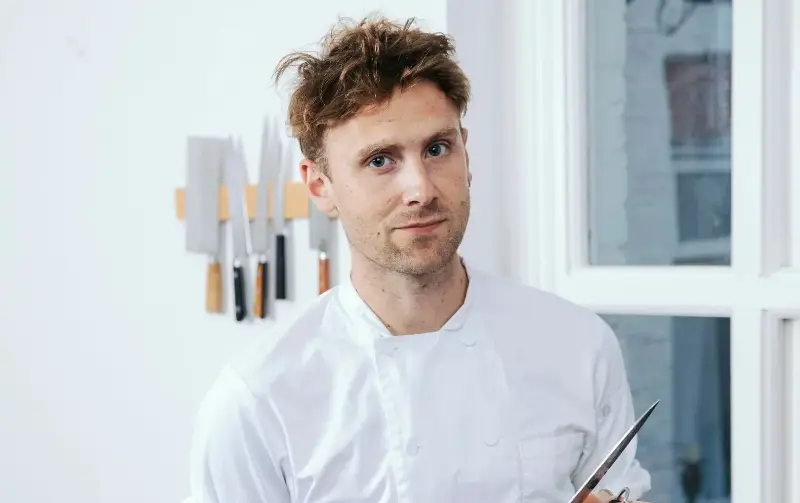
Now Gill’s son Alasdair, Ali, a chef, one of two children of Adrian and his second wife, Amber Rudd, has written his own addiction memoir at just 33. Knives and Spoons relates Gill’s powder-heavy life in various London kitchens before his own rock-bottom and eventual sobriety. At the outset he describes a typical start to the day: “I swigged my Irish coffee and laid out the morning’s mise en place – a place dusted with two neat piles: coke on the left, ketamine on the right.” And so it continues in that vein: each chapter is structured around a dish that was significant to him at different points in his life.
Tall, good-looking and extravagantly tattooed, Gill embodies a certain stereotype of a “bad-boy” chef. He dropped out of school young, turned to substances, and worked in kitchens wherever he could. In one early passage he’s dismissive of a colleague for being “painfully posh”, which, considering that Gill’s mother was a Tory home secretary is, much like Roquefort with port – a bit rich.
Apart from his parents, the figure looming over Knives and Spoons is Anthony Bourdain, whose Kitchen Confidential is the ultimate booze-and-drugs chef memoir. While other young chefs knew Bourdain only through his writing or TV work, Gill met “Tony” when he was staying with Adrian. “I was sniffing so hard from a particularly savage few days – fuelled by cocaine by the grills and unknown houses – that Tony commented on my blocked nostrils. ‘Sounds like a chef,’ he smiled through a crooked alligator grin.”
Where the hedonistic excess in Bourdain’s books served a broader purpose, illustrating the precariousness of the work and the unstable figures who are drawn to it, too often in Knives and Spoons the drugs feel like they are there for the sake of it. Then there’s the prose. Gill Senior’s best images remain imprinted on the reader decades later. So perhaps it’s inevitable that the similes of his father weigh on Gill Junior, who never uses a simple sentence if he can avoid it.
On passing out in a strip club, he writes: “I opened my eyes to find myself on the sticky carpet of Cork’s most aromatic gentleman’s establishment, which boasted both the overwhelming stench of mildew and abandonment issues… The cab back stank of regret and cut-price Prosecco – the kind they clearly give for free in the private rooms.” In small doses, this stuff is vivid and entertaining, but after 200 pages, the reader is punch-drunk.
Other passages are blighted by that peculiarly frictionless style that has emerged online in recent years. There are endless “quiets”, and lists of three, and “it’s not X, it’s Y” formulations. “Eating well wasn’t nourishment, it was posture.” Baking “wasn’t chemistry. It was controlled art”. A menu for rich people “wasn’t feeding them; it was flattering them, a quiet way of saying their c--k was not only girthy, but impeccably seasoned, well-travelled, well-reviewed and confidently swung across the world’s finest tables”. These tics stick in the mouth like flecks of shell in a crab linguine.
There are moments where Knives and Spoons flirts with becoming a more soulful and introspective book. Friends die on Ali, as well as relatives. The sections that deal with Adrian’s “full English” of cancer, as Gill Senior described it, are all the more moving for their humour. (“Had a little moment?” Gill Senior asks his son, who has had to leave the room after seeing his father, so formidable in health, wired-up and frail.) Alasdair’s uncle Nick, who had been one of Britain’s most brilliant, but pressurised, young chefs, vanished in 1998; Alasdair cannot help but draw parallels with himself.
But apart from these passages, there’s little reflection or detail on Gill’s childhood, or how he came to be in this fix in the first place. He presents himself in media res, where the res is sniffing and cheffing with the piratical mates and colleagues he picks up along the way. His saintly mother dips in to rescue him and send him to rehab. Elsewhere his sister Flora, a journalist, pops up as a more strait-laced foil.
His father’s ghostly presence is everywhere, but it comes into full view when Gill Junior, in rehab in Scotland, finally opens a copy of Pour Me. “He was gone, but he’d left something behind – a map drawn in his own wreckage, one last bit of guidance. It was proof that survival, somehow, was hereditary too.” The book ends with Alasdair, five years sober, and his partner in a maternity clinic, where he confesses his history of substance abuse and worries about his readiness for fatherhood.
I craved more of this, and less getting high. Surely every self-respecting son of a Tory minister has a drug problem. Consumption itself is only interesting to the consumer. Everyone else craves context.
Knives and Spoons is published by Macmillan at £20. To order your copy, call 0330 173 0523 or visit Telegraph Books