



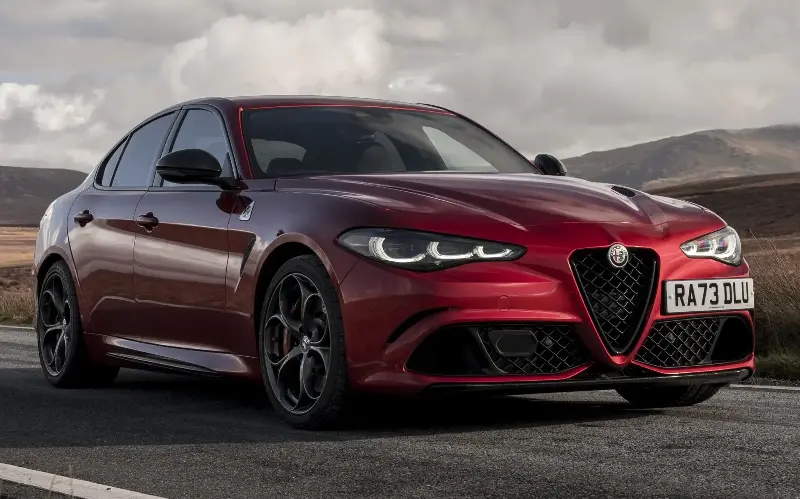
It’s more than 10 years since Alfa Romeo unveiled the Giulia saloon. Its gestation had been long and fraught, but the gleaming red Giulia Quadrifoglio at the launch presentation looked terrific – the range-topping model, with a 2.9-litre twin-turbocharged V6 engine developing more than 500bhp. Alfa was back and meant business.
That same Giulia Quadrifoglio is still on sale, lightly revised but otherwise largely unchanged. In fact, it was due to bow out, making way for an electric replacement, but Alfa Romeo reopened the order books after confirming that production will continue into 2027.
The Quadrifoglio is now the elder statesman of the current crop of super-saloons. How does it compare with newer, high-tech rivals?
Pros
- Glorious engine
- Exhilarating yet forgiving handling
- Easy-going on longer trips
Cons
- Starting to feel dated inside
- Languorous touchscreen
- Expensive given its age
Small change
The visual tweaks may be minimal, but power increases to 513bhp from 503bhp and there’s a new mechanical limited-slip differential, which Alfa Romeo says is derived from the utterly bonkers Giulia GTA.
An active front splitter, meanwhile, can adjust to control the flow of air beneath the car, while a fruity-sounding Akrapovič exhaust can also be specified..
Is this enough to keep the Giulia in the fight against younger, fresher and fitter opposition? Don’t forget that the new Mercedes-AMG C63 has been lumbered with an almost universally unloved hybrid powertrain in an effort to satisfy increasingly draconian emissions rules.
BMW’s seminal M3 is still purely combustion-powered, although complication and cost have increased – at just shy of £90,000 it is no longer the accessible super-saloon it once was. Yet its astonishingly configurable chassis means it still has a vast repertoire, from cruiser to barnstormer.
Inside story
From within, the Alfa certainly feels its age – although that’s not such a bad thing. Because while there is a touchscreen, it doesn’t dominate the interior; instead it cowers beneath the sweeping hood that spans the Giulia’s dash.
This means your eyes are free to take in the lovely dials. Yes, the instruments are now digitised, but Alfa Romeo didn’t simply plonk a screen on the dash, instead taking the time to provide faithful replicas of the gauges at the end of each deeply scooped cowling.
Beneath the air vents sit physical knobs for the climate control. They aren’t the slickest in terms of quality, but they’re easier to use without taking your eyes off the road than a touchscreen. And surely that should be the point in a saloon with such performance?
The rest of the interior follows the same trend. It doesn’t match the best for fit and finish – some of the plastics, in fact, are decidedly questionable in a car of this price, while the touchscreen is rather slow and laggy. But it lacks the usability foibles of many more recent cars.
Yes, the price. It’s £86,885. If you’re thinking, “But that’s not far off the cost of an M3 Competition,” you’d be right. It’s also an above-inflation price rise for a car that cost a little over £62,000 when it arrived in 2017 – a bold pricing strategy for a model that’s long in the tooth.
But from within the Giulia you can – almost – forget about the price. There’s a general sense of wellbeing that’s lacking in the German rivals, which are hell-bent on carbon bucket this and gloss-finish that.
Take the seats, for example. Where a BMW M3’s buckets thrust a welt of hard, carbon-backed leather between your legs like some sort of vaguely menacing codpiece, the Giulia’s seats are more forgiving, gentler – their centre panels trimmed in beautifully quilted, horizontally fluted suedette, with soft, contrast-stitched leather surrounds. These are seats you would want to spend time in – not ones in which you fear you’ll feel beaten up after an hour.
As a result, the Giulia feels like a cocoon inside, where you can relax and savour a long cross-country journey.
On the road
So you dive into the immense, thumping torque from the twin-turbo V6, so deliciously accessible no matter which gear you’re in. Near the top of the rev range there’s a sonorous, multi-layered wail, warmer in tone, more inviting and more mellifluous than its rivals’ – and more genuine, since the exhaust note is unimpeded by the sort of electronic amelioration that’s become commonplace.
The gearbox is terrific, too. It’s ZF’s much-used eight-speed automatic, famed for its whip-crack changes; Alfa Romeo has set it up to allow you to hit the rev limiter, which means you never pull for an up-change just as the gearbox does, thus ending up in a ratio higher than you wanted.
This is a fast car, then, but it remains forgiving – friendly even. The Giulia always feels as though it’s working with you, helping out without nannying you.
It also has a relaxed character. Where an M3’s stiff suspension tries to pulverise you, even in its most benign setting, the Giulia feels as though you could cross a continent in a day, its supple suspension eating up the bumps as you aim for fine weather and finer roads.
That suppleness provides an approachability and benevolence you might not expect from a rear-wheel-drive car of this potency. The Giulia communicates with a delicacy that belies its age – a relic of an older, more analogue time, before cars felt just a little too much like computer games.
That means you feel more confident making full use of its power, its deliciously sweet turn-in and its grip – and yes, its tail will slide out under provocation, but it’s always easy to gather up, making you feel like a hero.
The Telegraph verdict
The Giulia Quadrifoglio may be old, but it actually makes a virtue of its advancing years. Is that enough to justify its price? Not quite. But if you were considering an M3 or a C63, you’d be mad not to try it.
Sure, the German rivals have all the technology and equipment, yet the Quadrifoglio’s age means it has a purity they have lost. It’s not that it has got better with time – after all, it was always pretty good. Rather, it’s that the world has changed around it. And the Quadrifoglio is a very welcome reminder of the way things used to be.
The facts
On test: Alfa Romeo Giulia Quadrifoglio
Body style: Four-door saloon
On sale: Now
How much? £86,885 on the road (range from £43,750)
How fast? 191mph, 0–62mph in 3.9sec
How economical? 28.0mpg (WLTP combined)
Engine & gearbox: 2,891cc six-cylinder twin-turbo petrol engine, eight-speed automatic gearbox, rear-wheel drive
Maximum power/torque: 513bhp / 443lb ft
CO₂ emissions: 229g/km (WLTP combined)
VED: £4,680 first year, £620 next five years, then £195
Warranty: Three years / unlimited miles
Spare wheel as standard: No (not available)
The rivals
BMW M3 Competition
523bhp, 28.0mpg, £89,635 on the road
The M3 can be all things to all people – twiddle a few knobs and its character changes according to the chassis settings selected. But it is unrelentingly aggressive and hard-edged; the Giulia feels more old-school but it’s also more forgiving.
Mercedes-AMG C63 S E-Performance
671bhp, 26.9mpg, £103,345 on the road
This may have the most power – by a considerable margin – but the four-cylinder turbo lacks the sort of heart beloved of C63 owners. A return to a V8 under the bonnet is pending, but until its arrival the Alfa’s brio will carry the day.