



Welcome to the controversial rose-pink Jaguar. I know this car isn’t pink, but it (or one like it) was when it was displayed at Miami Art Week last December. Resplendent in Barbie satin fuchsia, Jaguar’s Type 00 Concept became, for a while at least, the most talked about four-wheeled conveyance on the planet.
The polarising Type 00 was also the first news out of Jaguar since the company announced a major rebranding and the cessation of production of all its current models (although I understand that F-Pace SUVs have continued to trickle into the market to maintain Jaguar’s status as an extant car-maker).
Jaguar, founded by Sir William Lyons in 1922 and famous for its “Grace, Space, Pace” tagline and keen pricing, has abandoned almost all of its existing customers in a wager on an all-electric, luxury future at a time when rivals are questioning such involvement in that rarefied EV market.
Then there was that “Copy Nothing” advert overseen by Gerry McGovern, chief creative officer of Jaguar owner JLR, in which androgynous models wafted around with not a car in sight. Everyone had an opinion on that advert; it even made the national TV news. And then, depending on who you believe, McGovern was sacked, or left the company of his own accord, or disappeared in a devilish puff of smoke…
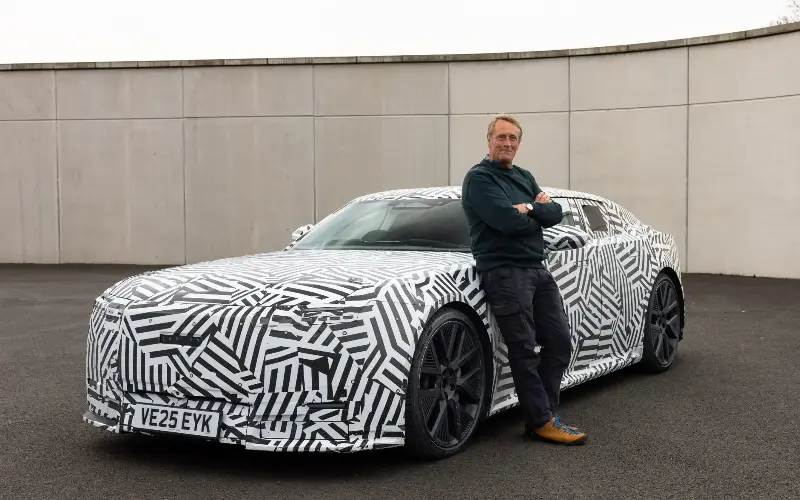
Controversy, not necessarily of the good sort, has dogged this car’s development. At what stage is the project? I visited JLR’s headquarters at Gaydon, in Warwickshire, to drive the heavily disguised prototype on the former RAF aerodrome used for testing and development by JLR and Aston Martin.
Here’s what I learnt…
Under the skin
It’s a dramatic-looking four-door gran turismo (as if anyone did a grand tour these days), with a lithium-ion battery, four-wheel drive and a three-motor (twin rear, one front), 850-volt drivetrain. It’s expected to provide 1,000bhp and a range of about 430 miles with room for four adults to sit in luxury along with their luggage. It’s also huge, well over five metres long, with a 50:50 per cent weight distribution, and is apparently the stiffest Jaguar ever made.
You don’t need a huge bonnet area for an electric car, but style is as style does and the Type 00 called for a long bonnet with a large gap between the 22in front wheels and the door pillar – Jaguar ickily calls it “the Luxury Gap”. To use that space was essential and the company’s engineers came up with a neat solution: packing it with control electronics and batteries, thus allowing greater range and more power. In the event of a frontal collision, the electronics are protected, with crash forces channelled upwards and to the sides.
Prices are expected to start at £100,000, rising sharply from there. The competition consists of the Porsche Taycan and Audi e-tron GT, both of which haven’t been an unalloyed success, Mercedes-Benz EQS and Tesla Model S Plaid, plus new arrivals from Polestar and Xiaomi. Hybrid combustion-engined rivals include Bentley, with its Continental GT coupé and Flying Spur saloon.
Rekindling the spirit of Jaguar
Everyone has their favourite Jaguar, but some of the engineering and marketing team are young enough not to have been around when some of the firm’s greatest models were new. So while last December’s introduction to the Type 00 concept was very much “throw away the past”, things have changed subtly, even if it’s only the messaging. We’re told they haven’t benchmarked any current rivals, which is clearly not true (how could they afford not to?), but the past has been a major guide as well.
Jon Darlington, chief engineer, and his lieutenants wanted to know what made a Jaguar, well, a Jaguar. “It was an interesting question, as some of the cars are 60 years apart,” he says. “But we were interested in the feeling they ultimately gave you, from the 50-yard handshake [appearance, stance and proportion] to the 50-yard drive [engineering guru Richard Parry Jones’s famous test of any car]. These were subjective rather than objective measures.”
The cars presented as yardsticks were an XK120, E-Type, Series 1 XJ saloon, an XJ-C V12 coupé (their favourite) and an XJ-S. I drove some of them before the Type 00, but it’s difficult to pinpoint absolute characteristics in cars that might have been rebuilt with modern suspension bushing and damping, using modern tyres. The E-Type felt fresh out of the paint shop, for example, the XJ-C nicely run in.
What the engineers did identify, however, was Jaguar’s renowned rebound-heavy damping, the magic-carpet ride, the driving engagement and the fluid way the body moved, all qualities they wanted to bring to the four-door electric GT.
What is it like to drive?
Impressions garnered from prototypes can be very misleading, which is why we don’t drive them very often. Darlington says that the car we drove is 100 per cent finished in terms of the hardware so the air suspension, four-wheel steering, active damper systems and electric motors, inverters and control electronics are as they will be in production.
All good news. But then he said that the car was only 70 per cent finished in terms of the software which controls everything. Therefore the behaviour of the car, its steering, ride quality, dynamics and performance aren’t necessarily how they will end up.
Open the huge door and the narrow sills allow easy access; the low-mounted seat feels accommodating. That’s mainly because Jaguar has split the battery to allow the rearmost seat mountings to be lower and the seat base to be canted at an extra six degrees from horizontal. That, combined with the enormous flat bonnet, means they must be on the limits of legal sight lines for the driver, but I’m assured all is well in that regard.
There’s a grand feeling to the driving position partly as a result of the high scuttle (the panel between the base of the screen and the tail of the bonnet), but also the width of the screen and the three-metre-long centre console running from front to rear.
The impression is of a large car but one that doesn’t hamper negotiation through tight spots, although much of that is down to the rear-wheel steering and the variable ratio steering rack. The steering feels a bit notchy while adjusting its settings as you speed up, which is an area that Darlington’s team will be working on.
That said, the low-speed steering feels lovely, with a precise action as you turn from the straight ahead and a positive and communicative quality, which allows you to dial in just the right amount of lock before a corner – certainly a Jaguar trait.
It rides beautifully, taking bumps and broken surfaces at speed that only minutes before had the acclaimed old XJ6 creaking. It’s soft but well controlled, with a lovely breathing sensation as the body adjusts on long waves, but a nicely limited body-roll in corners. Again, there were occasions where the air suspension was pumping up and down too forcefully across the car, but the engineers are still working on this.
Of course it’s fast, but unlike rivals, it allows you to control that power thanks to a long-travel accelerator pedal which has a gently progressive action. I’ve driven a number of cars with four-figure power outputs recently and the intensity of the acceleration can be highly disconcerting. So I hope Jaguar keeps the accelerator as it is.
What happens next?
That’s it for the moment. The next we’ll see of the car will be the official launch in the autumn. It goes on sale soon after, with deliveries in the first half of 2027. There was some corporate folderol about how much the high-net-worth folk of America loved it and intended to buy one, but those people will buy anything new, especially if it’s pink.
It’s the people who don’t want an electric limousine who Jaguar are going to have to convince, and that’s going to be tricky. Bridges have been burned with the firm’s loyal old customers, even if there were never quite enough of them, and this “difficult market” is a new frontier for Jaguar. Let’s hope its electric adventure is remembered for all the right reasons.