



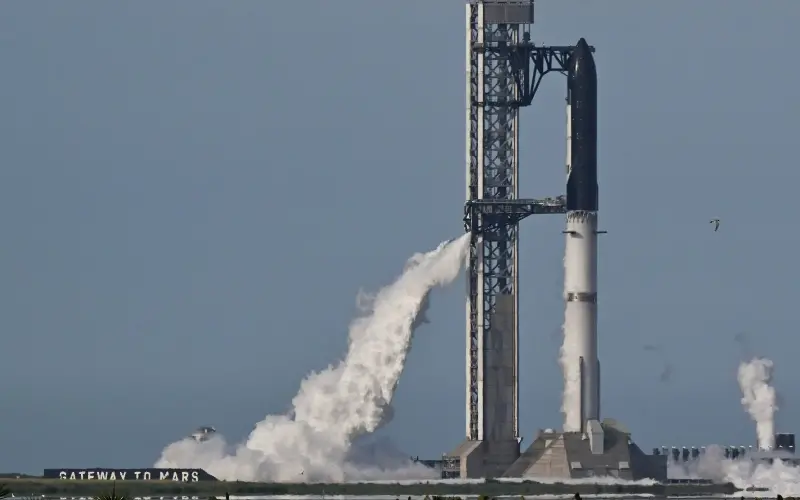
Elon Musk’s SpaceX abandoned a planned test rocket launch at the last minute on Thursday, just hours after revealing plans for a record-breaking $1.75tn public listing.
The company, founded by Mr Musk, the world’s richest man, has been testing the rocket that he hopes will one day carry a million people to Mars.
Known as Starship V3, it had initially been scheduled to launch from Starbase, Texas, at 5.30pm local time, before being delayed twice to 6.30pm.
It spent several minutes at T-40 while the SpaceX team worked through issues. The launch was abandoned at around 6.45pm local time, with plans to try again on Friday.
Mr Musk said on X that “the hydraulic pin holding the tower arm in place did not retract”.
“If that can be fixed tonight, there will be another launch attempt tomorrow at 5:30 CT,” he said.
The abandoned launch came just a day after SpaceX filed plans for a blockbuster float. SpaceX said it needed to raise tens of billions of dollars in order to protect humanity against the “non-zero probability of extinction-level events” by colonising other planets.
“We do not want humans to have the same fate as dinosaurs,” the company said in its prospectus. The filing detailed SpaceX’s ambition to one day build a colony of one million people on Mars.
Rapper and Donald Trump’s “number one fan” Nicki Minaj made a surprise appearance on the company’s livestream of the launch.
“Elon, thank you for everything you’re doing for humanity,” she said, before abruptly walking off camera.
Thursday’s launch was supposed to be the 12th test mission for Starship, a 400ft-tall rocket that Nasa plans to use for its Artemis Moon missions in 2028, which are intended to return humans to the lunar surface for the first time in more than 50 years.
It would have been the debut of a redesigned version of Starship, known as V3, launching from an entirely new pad. The rocket itself features redesigned heat shields and more powerful, lighter Raptor engines.
Like past test flights, Starship is made up of two stages – a 237ft Super Heavy booster and a 171ft second stage intended to carry humans into space.
On this mission, the Super Heavy booster is planned to splash down in the Gulf of America. In future missions, it will perform a mid-air flip before landing at a catching tower, which features a massive pair of “chopsticks”.
The Starship spacecraft will travel into space. On this flight, it will release several dummy satellites. For this particular test, SpaceX has also deliberately removed a heat shield panel to test the durability of its design on reentry.
The failed launch is not likely to have a significant affect on share price when Mr Musk takes the company public next month, but it is not a good look.
Ahead of the planned launch, Phil Scully, general partner at the space investment firm Balerion Space Ventures, was asked by CNN about the risks of a potentially “suboptimal” test flight so close to the SpaceX’s IPO.
“Of course, the optics matter,” he said. “But Starship is still just one piece of a very large pie. And people who are interested in backing SpaceX know that it’s built its reputation on rapid iteration and learning through testing.”
Mr Musk’s SpaceX plans to raise as much as $75bn at a valuation as high as $1.75tn.
In a prospectus filed with US regulators on Wednesday night, the company also disclosed some of its financial details publicly for the first time.
The filing revealed SpaceX had racked up total losses of more than $40bn (£30bn) since its inception.
It also showed that SpaceX posted a net loss of $4.9bn last year on revenues of $18.7bn. It has spent billions of dollars on its Starship programme so far.