



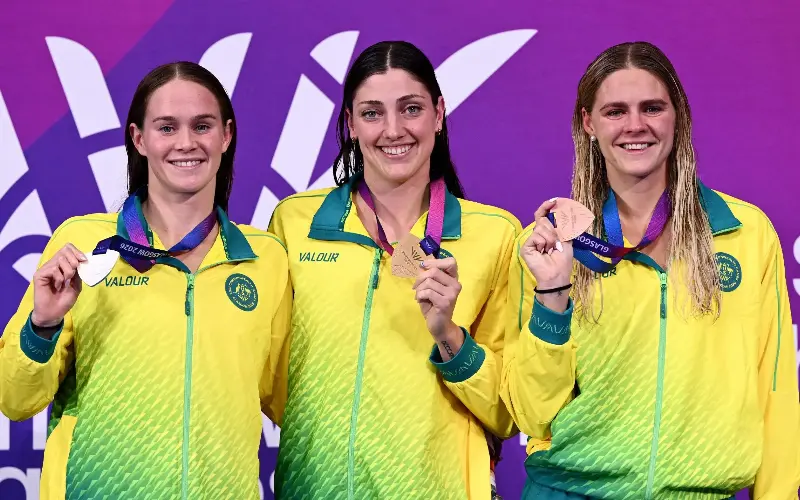
The Commonwealth Games medal table tells a stark story of Australian dominance. A total of 70 gold medals, more than double England’s 29, after performances that were comfortably the best not just in the swimming pool but also across athletics and track cycling.
While British medals are naturally more thinly spread between the various home nations in the Commonwealth Games than the Olympics, the direction of travel is also unmistakable. England were closer to Australia in Birmingham four years ago with 58 gold medals to 67 and just three fewer than their overall tally of 179. Australia, with its population of 28 million, also climbed back above Team GB in the Olympic medal table in Paris for the first time in 20 years. So what explains the Commonwealth rout?
Money, of course, is a significant part of the answer. Victoria’s fears over the financial rationale behind hosting a Commonwealth Games are not shared in the elite athlete funding programme which, as well as a record A$513m (£268m) investment ahead of the home Games of Brisbane in 2032, has been boosted by exceptionally wealthy individuals.
In swimming, Australia’s richest person, Gina Rinehart, gifted more than A$1m (£520,000) in bonuses to the Commonwealth Games squad in Glasgow, putting up incentives of A$20,000 (£10,500) for gold, A$15,000 (£7,850) for silver and A$5,000 £2,620) for a bronze. Rinehart is the 72-year-old mining magnate, the current executive chairman of the mineral exploration and extraction company Hancock Prospecting that was founded by her father, Lang Hancock. According to Forbes, Rinehart’s worth soared to A$29bn (£15.1bn) in 2012, making her the world’s richest woman. Nowadays her fortune is said to be valued at A$35.58bn (£18.62bn), though she is no longer the global leader she once was.
Such has been the success that 30 Australian swimmers, who between them won 37 of the 57 gold medals, have won in excess of A$10,000 (£5,240). Did it help? Well, it would certainly seem to discourage no-shows and it was the most medals that any swimming team have won at any Commonwealth Games.
Equally impressive has been Australia’s all-round strength in athletics where, certainly compared to the English, the best athletes have not just competed but also taken part across multiple events.
Next week’s European Championships have clearly been a factor in the unavailability of some British athletes. Only Josh Kerr among the star names has prioritised the Commonwealth Games, partly because of the superior mile field but also because of his desire to compete in front of a home crowd and give something back to Scottish athletics.
Commercial factors are also relevant according to some inside the sport. The Australian system rewards those sports financially who have performed best at the Commonwealth Games and the event is regarded as a major staging post in the Olympic cycle, not just for athletes but also support staff. The disparate nature of the British nations at a Commonwealth Games can create rather different priorities, especially once you throw in other major international competition.
The broadcasting contract to Australia is also hard to ignore. The Commonwealth Games have been live and free-to-air on Channel Seven over the past 10 days, reaching more than 11 million viewers in what have been record numbers. The Australian athletes are acutely aware of the buzz that their performances creates.
Precise broadcast numbers have not been released in the UK, but we do know that they are a fraction of past Commonwealth Games, which had been screened by the BBC since 1954. With coverage moving to TNT Sports, there has been concern among British athletes that medal-winning performances over the past week have lost their past reach, with one former Commonwealth Games champion telling The Telegraph that it could directly impact sponsorship and scholarship opportunities.
The Australian Olympic Committee (AOC) has actively also been offering retirement grants worth around £17,000 in an attempt to attract the best athletes to Olympic sports like swimming, athletics and track cycling. “Our Olympians are doing this for the love of the Olympic Games, for the love of the sport they’re involved in,” Mark Arbib, the AOC chief executive, said.
“But what we do want to do is make sure that when our Olympians finish, there is money there in their bank accounts so they can get on with their lives.”