



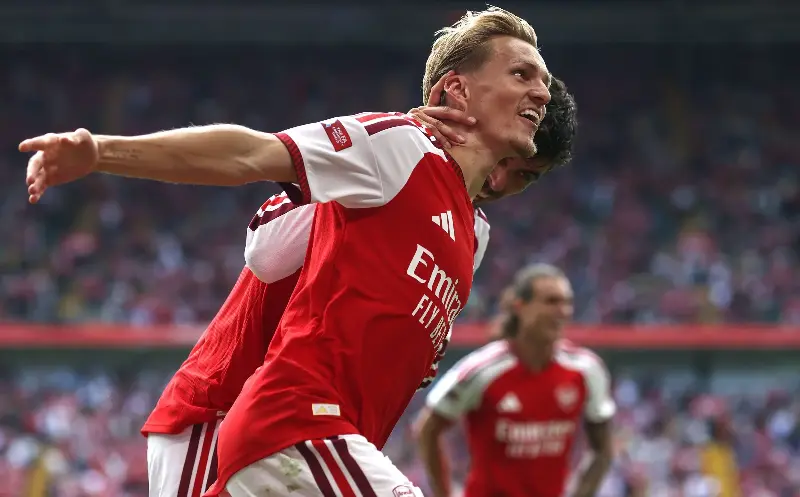
The ball was not yet in Manchester City’s net, but there was already a smile on Martin Odegaard’s face. The Arsenal captain had done all the hard work, bursting through midfield and deceiving City goalkeeper Gianluigi Donnarumma, and he took a brief moment to savour the feeling before rolling in his finish.
The goal, Arsenal’s third in their Community Shield thrashing of City last weekend, captured so much of what makes Odegaard a special player. The timing of the run, the delicacy of the touch, the imagination of the finish. This was the Norwegian at his best and, for all associated with Arsenal, it was the most encouraging of sights.
Odegaard comes into the new Premier League season, which begins when Arsenal host Coventry City on Friday night, with a point to prove. That may sound unusual, given his newfound status as a title-winning captain, but last year was a strange one for the 27-year-old. The club’s most successful campaign of his time at Arsenal was also the most frustrating one for Odegaard as an individual.
In total, Odegaard missed 30 matches for club and country through injury last season. In the Premier League, he featured in only 35 per cent of Arsenal’s campaign. For so long the central figure of Arsenal’s attack, Odegaard was instead forced to watch from the outside for most of the season. Even when he did play, he was often not fully fit.
The consequence was that Odegaard rarely seemed as free or confident as Arsenal have come to expect since his arrival in 2021. His season ended in glory, but it was massively draining, mentally and physically, and Odegaard’s repeated injuries prevented him from ever finding his usual rhythm. Only on a few occasions, such as in the December victory over Aston Villa, did he truly look like himself.
Odegaard’s lack of form and fitness was the single biggest explanation for Arsenal’s stodginess in attack in the second half of last season. Similarly, his brilliance against City on Sunday was the single biggest explanation for Arsenal’s exceptional and inventive performance. It is a rule of Arsenal under Mikel Arteta’s management: when Odegaard flows, the team flows.
Much has been made of Arsenal’s pursuit of a new elite-level forward this summer, with the champions failing in their moves for Morgan Rogers and Vinícius Júnior, but it might not require a big-money signing for their attack to be transformed from last season. A fully fit and content Odegaard should do the trick.
“Last year was a really big struggle,” Odegaard admitted earlier this week. “A lot of difficult moments.”
His apparent revitalisation can be explained in three ways. First, and most obviously, he is not carrying any injuries. Second, the mental burden of chasing the club’s first league title in 22 years has now been removed.
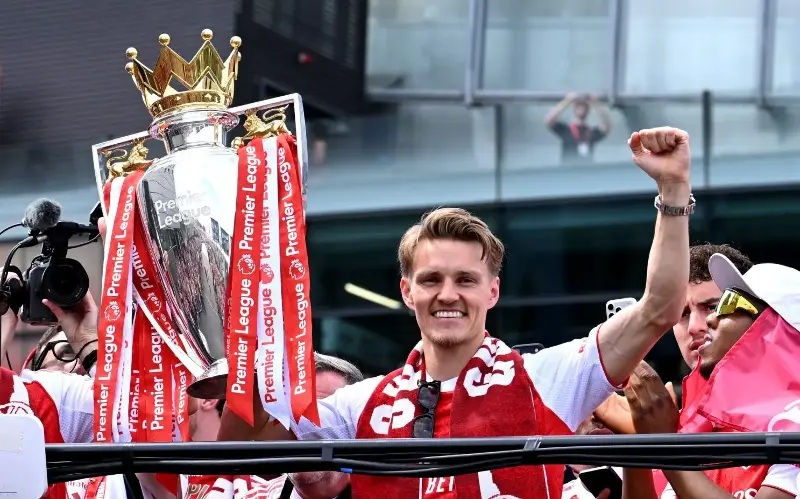
As the club’s captain since 2022, Odegaard had felt that burden more than most. There was also a personal burden, which he has carried since his days as a much-hyped teenage prodigy in Norway and at Real Madrid. Only by winning a major title could Odegaard fulfil his talent and justify the enormous expectations of him.
Third, there can be no doubt that the World Cup had a restorative effect on Odegaard’s mindset. Norway’s run to the quarter-finals, where they were beaten by England, delighted the nation and was enormous fun for the players. As captain, Odegaard was the leader of the squad and the man who conducted the “Viking row” after victories.
There was a clear contrast between the pressure of Arsenal’s title challenge and the enjoyment experienced by Norway. Arsenal’s hunt for the title had gnawed away at the players for multiple seasons, as had the relentless demands of Arteta. It was a gruelling struggle, especially in the spring.
Norway, on the other hand, went into the World Cup with only one goal: making it out of the group stages. Once they had done that, they had nothing to lose. Dramatic knockout victories over Ivory Coast and Brazil made it a truly glorious occasion for Norwegian football, and Odegaard revelled in it. No wonder he now appears to be a man transformed.
“I sensed from the first day that he joined [in pre-season] that he has something else in the belly that he wants to prove and show,” said Arteta.
It helped, too, that Odegaard was able to completely switch off from football during the summer. Rather than booking a holiday in a glitzy party destination like most footballers, he spent the break at his family home in Norway and kept fit by using the facilities at a local school.
A fresh season, a new challenge and a liberated mind. The Odegaard of old could now be back, and that will only make the champions even stronger as they look to defend their crown.