



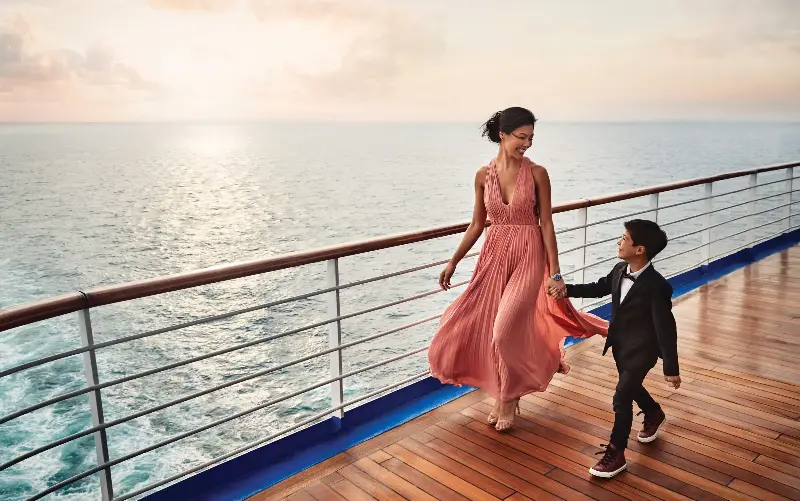
Let’s be honest, it’s hard enough worrying about what to wear in our daily lives, let alone on holiday – so fretting about cruise ship dress codes isn’t ideal.
However, assuming you’re only going on one cruise at a time, once you get the low-down on any themed nights on the itinerary or the level of evening formality required, it becomes a lot easier to pack.
On most cruise lines, some basic rules apply – none of which will surprise you. Flip flops, casual clothes and swimwear are all fine around the pool, but once you move into any adjacent on-deck restaurants it’s a good idea to cover up.
The same goes for moving between the deck and your cabin. However, it’s the interior of the ship – and in particular the dinnertime restaurants and bars – that need more consideration. Let’s break it down.
What is the history of dressing formally on cruise ships?
Since the early days of cruising for leisure, dressing up was key to creating a sense of occasion, with formal-wear evenings incorporated into every sailing for decades.
Fast forward to the 1970s however, and things had become somewhat more relaxed. Now we’re firmly in the post-Covid age, when most people’s wardrobes consist of athleisure, and the thought, for some, of having to squeeze into a tux or ballgown instils a distinct feeling of dread.
How have modern cruise lines adapted?
As a result, even cruise lines known for expecting formal wear in their main restaurants have been forced to change. Jason Montague, chief luxury officer of Oceania Cruises and Regent Seven Seas Cruises (RSSC), said it best in a video update last year: “We’ve decided to expand our elegant casual evening dress code to reflect today’s wider interpretation of sophisticated fashion. [...] We now welcome refined denim and dress sneakers in all public areas in the evenings in all our restaurants.”
What does ‘smart casual’ mean in practice?
In 2026, most major cruise lines (think Celebrity, Viking, MSC Cruises) have followed suit, advocating for a simple “smart casual” dress code in their restaurants after dark. In practice, this means men can wear trousers or very smart jeans with collared or polo shirts, while women can wear trousers, resort dresses and smart tops. Think “what would I wear to dinner at a smart restaurant for a friend’s birthday?” and you can’t go (too) wrong.
What should I look out for on the itinerary?
That being said, many cruise lines are still aware of something we claim to have forgotten – that dressing up is good for the soul.
As a result, brands including Virgin Voyages, which hosts a Scarlet Night (be sure to pack something red) on every sailing, Azamara and NCL have all settled on a clever middle ground: the theme night.
On a recent Nile sailing with TUI River Cruises, a Galabeya night meant having the option to dress up in traditional Egyptian garments, which were available at local bazaars and in the boutique on board.
What about stated ‘formal nights’?
Sailings longer than seven days on board the likes of P&O Cruises and Princess almost always still include one or two “formal nights” – an evening that requires men to wear suit jacket and tie, and women to wear elegant dresses or gowns.
If a formal or “dressy” (as Holland America Line terms it) night falls on your cruise and you don’t want to be part of it, you can opt to dine in one of the ship’s casual buffet restaurants instead or order room service.
Does anyone really care whether I join in?
Not really, but if you’re the kind of person who arrives at dinner and then spends the next two hours wishing you’d worn something different, it’s best to plan ahead.
In general, dressing conservatively and stylishly (accessories always help) is still the safest way to go on most sailings.
How can I find out more information ahead of time?
The best thing you can do is check the cruise line’s website in advance. Silversea, for example, has a very clear dress code page, including details on what time dress codes start (6pm) and what not to wear indoors after this time (jeans, shorts, hats, caps, trainers, flip-flops and so on).
The luxury line’s permitted evening wear falls into two distinct categories: elegant casual and formal optional, with the latter generally referring to the need for men to wear jackets at dinner.
Are there any uncompromising formal-wear cruise lines still going?
With 180 years of history behind it, Cunard makes a deliberate effort to lean into its “golden age of sailing” identity, so those looking to join in the elegant fantasy are expected to dress accordingly on board. And why wouldn’t you?
Meanwhile, some smaller and more exclusive ships, such as Hebridean Princess, also require guests to dress formally for dinner – which means jacket and tie for men and the equivalent for ladies. The stately 48-passenger ship, which caught the eye of the late Queen, hosts two gala dinners on each seven-day cruise, which require you to kick it up yet another notch.
It pays to do your research beforehand but most cruise lines are more relaxed than you think. And even though you may not jump at the prospect of dressing up when booking your trip, once you’re on board and in the spirit of things, you’ll likely regret not joining in.
About our expert
Sarah Keenlyside
A travel industry veteran, Sarah discovered her sea legs after almost two decades specialising in shore excursions for adventurous sea-goers in Asia. She’s now a convert to the “unpack once” lifestyle and the luxury of visiting different destinations on cruises.