



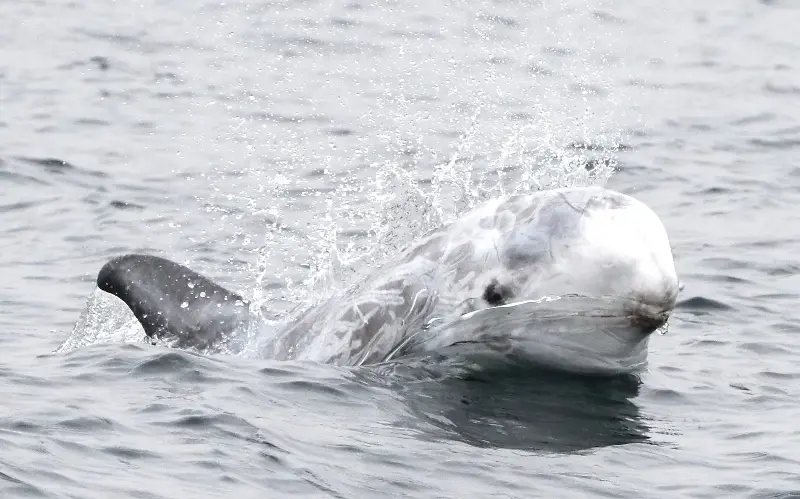
Britain’s Risso’s dolphins can be found across the British Isles, from the Outer Hebrides to the Isle of Man.
But despite their extensive range, Risso’s dolphins have remained genetically distinct from their cousins in the Mediterranean and the Azores, a study found.
Scientists who studied the DNA of dolphins stranded in England, Scotland and Wales from 1992 to 2016 discovered that they had not mixed with other Risso’s dolphins from further away.
Nicola Hodgins, a co-lead author from the Maritime Area Regulatory Authority (Mara), said: “The results support the notion of Risso’s dolphins in British waters having been isolated from other populations for some time.”
The study showed no significant genetic differences between the animals around different sections of the British Isles, but found that the dolphins may remain or return to specific areas and groups around the British Isles over their lifetime.
Recent research suggested that Risso’s dolphins display a significant preference for particular areas with less than 3 per cent of them in Scottish waters matched on the west and northern coasts of Scotland.
The study said that further research with more genetic samples was needed, including comparisons from regions such as Norway, the Celtic Sea, the south-west English Channel and the Bay of Biscay.
More advanced DNA techniques could also be used to add resolution and provide better quality photos of the links between groups of Risso’s dolphins around the British Isles.
Risso’s dolphin is a large, scarred and beakless species found worldwide that mainly eats deep-sea squid. There are an estimated 9,000 British Risso’s dolphins compared with 2,000 in the western Mediterranean.
The populations are physically similar but genetically isolated and do not interbreed, leaving the UK population with lower genetic diversity.
Risso’s dolphins can also be seen along the Pacific coast and in the Asia-Pacific region.
Bottlenose and harbour porpoise dolphins are the most common types seen around the UK coast. The bottlenose can be found in Cardigan Bay in Wales and the Moray Firth in Scotland while harbour porpoises, known for being small and shy, are found around most of the coastline.
Risso’s dolphins could be recognised as a sub-population by the International Union for Conservation of Nature after it classified the Mediterranean sub-population as endangered.
Ms Hodgins added: “Good conservation requires habitat-specific management. While Risso’s dolphins are managed as a single UK population, local populations can face different threats and use habitats in different ways.
“Effective protection must therefore focus on safeguarding important habitats and addressing pressures at a local scale, where conservation measures can have the greatest impact.”
The research team comprised the Mara, Nova Atlantus, Environmental Investigation Agency, Whale and Dolphin Conservation, Zoological Society of London and the universities of Exeter, Glasgow, Zurich, Western Australia and Taiwan.
Samples used in the study were collected by the government-funded stranding programmes, the Scottish Marine Animal Strandings Scheme and the Cetacean Strandings Investigation Programme.
The study was published in the Journal of the Marine Biological Association UK.