



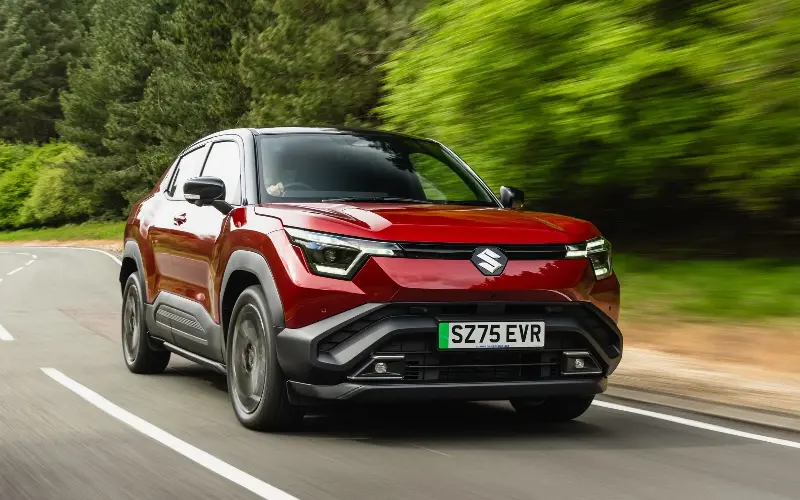
Is there a better illustration of the mixed-up world of UK motoring than Suzuki’s Vitara? Since 1988, though five generations, it has been a vivacious presence in the non-premium medium-sized SUV market, especially where low prices and running costs plus reliability trump absolute-go-anywhere ability and a posh badge.
But that’s not what the Government wants you to buy, and it has legislated to make that happen. The ZEV mandate inherited by the incumbents means that this year, for example, for every two petrol-powered Vitaras Suzuki sells, it needs to sell one of this new electric version, or face a penalty of £12,000 per non-compliant car.
Partly as a result of this mandate, sales of the Vitara mild hybrid fell from 6,500 in 2023 to 3,300 last year. Suzuki has been desperate for an EV to minimise those potential fines in spite of the fact that it makes some of the world’s most competent small cars, which have tiny environmental footprints overall. Bonkers, isn’t it?
New versus old
So, enter the first of four new fine-evading EVs, the e Vitara. The petrol hybrid Vitara is still listed in the UK, though, priced from £25,499 for the 4x4, six-speed manual, 1.4-litre, 48-volt mild hybrid. It delivers 129bhp and 173lb ft of torque, a top speed of 111mph, 0-62mph in 12.2sec, CO2 emissions of 128g/km and fuel economy of about 53mpg.
This battery-powered model, introduced last October, is based on a different floorpan to accommodate the 61kWh lithium-iron-phosphate (LFP) battery, which gives a claimed range of 245 miles (264 miles if it’s two-wheel drive). It’s a blade-type battery purchased from a subsidiary of Chinese car maker BYD. There’s also a 49kWh option for two-wheel-drive models.
The 4x4 has twin AC synchronous electric motors; 171bhp at the front and 64bhp at the rear to give a total output of 180bhp and 226lb ft. The top speed is 93mph and 0-62mph in 7.4sec, with a claimed efficiency of 3.7m/kWh. It costs £34,049 as tested, including a £3,750 importer supplement, which conveniently mirrors the maximum Government EV grant.
Charging
I’m not sure what the deal with BYD was, but it certainly leaves the e Vitara owner spending a fair bit of time umbilically attached to a charger. Fast charging is limited to a maximum of 70kW, which means a 10-80 per cent charge will take about 45 minutes. On a 7kW AC charger, a 10-100 per cent charge takes nine hours.
In practice and over many recharges, I never saw more than 50kWh going in and never spent less than an hour at a charger. And by the time the charge reached 70 per cent, the Suzuki’s air-conditioning was kicking up a storm as it tried to prevent its 120 charging LFP cells from overheating. This is poor and prevents the full use of the range, which in practice (in 9C on A-roads) turned out to be 170 miles against the published 245 miles, a reduction of just over 30 per cent. So my 250-mile, 4.5-hour journey home was extended to just under seven hours.
Inside job
In a word, it’s useful. Behind the squared-off steering wheel of this Ultra model, it feels quite grand, with squashy pleather-and-fabric seat covers, matte-black plastics all over and a large touchscreen that merges into the instrument binnacle.
There’s room in the back for three large adults with head and legroom to spare; the seats adjust 160mm fore and aft. They split 60/40 per cent and provide a decent and almost-flat load bed.
Closer scrutiny, however, reveals the storage bins to be unlined and rattly, the facia materials scratchy. The touchscreen needs a firm stab, sometimes several, to respond.
There’s also a weird control logic, such as the auto-release parking brake – which sometimes doesn’t – keyless entry that doesn’t recognise the key fob, a 360-degree camera system that won’t switch off and a tiny recharging indicator that isn’t visible if the ignition isn’t on. The “room mode” setting to keep the heater working during charging switches off after 10 minutes.
On the road
I picked up the e Vitara from Suzuki’s Milton Keynes headquarters with the battery fully charged. I soon appreciated the firm but positive ride quality on MacPherson-strut front and multi-link independent rear suspension. It corners nicely, too, with an old-fashioned weighting (if not feedback) to the steering and a softness to the chassis, although if you hit a large expansion joint or a mid-corner bump the front wheels fire into the air as if you’d driven into a skip full of space hoppers.
The accelerator pedal is nicely worked, though, with a good progression. Similarly, the powerful brakes are easy to modulate for smooth stopping.
The Telegraph verdict
Built in India and with a tie-up with Toyota (expect an identical Urban Cruiser this year), Suzuki’s e Vitara seems well-built, with decent equipment levels, including a standard heat pump. The interior feels cheap in places, but the main complaint is the range: it’s terrible – and the slow charging speed is even worse. And if you use public chargers, that makes it very expensive to run.
How expensive? Over a 550-mile round trip, I recharged at an average of 89p per kWh, at an average efficiency of 2.4mpkWh, which gives a total of £204 (plus a tax of 3ppm after 2028). To put that in perspective, with its WLTP consumption of 53mpg, the existing mild hybrid Vitara would have made the same journey for about £63.
I sometimes wonder what the weather looks like from the windows of the Environment Secretary’s ivory tower. Permanently sunny, I’ll bet.
The facts
On test: Suzuki e Vitara Allgrip 4x4
Body style: supermini 4x4 EV crossover
How much? from £34,049 (£34,049 as tested)
How fast? 93mph, 0-62mph 7.4sec
How efficient? 3.7 miles per kWh; 2.4mpkWh on test
Range: 245 miles (WLTP combined); 175 miles on test
EV drivetrain: 61kWh net (60kWh usable) lithium-iron-phosphate battery, four-wheel drive via twin AC synchronous electric motors
Charging time: 10-80% in 45 minutes on a DC charger up to 70kW
Maximum power/torque: 181bhp/226lb ft
CO2 emissions: zero at tailpipe, 27.4g/km well to wheels
VED: £10 first year, then £200
Warranty: three years/60,000 miles with automatic renewal on completion of a manufacturer service up to 10 years or 100,000 miles; 10 years/100,000 miles on battery
The rivals
Ford Puma Gen-E, from £26,245
This front-drive, 166bhp/214lb ft EV has a top speed of 99mph, with 0-62mph in 8sec. The range is quoted at 251 miles, but with no heat pump, that will drop well below 200 miles in cold weather. Nice to drive and the huge luggage box in the front is practical.
Dacia Duster 1.2 TCE 4x4 Expression, from £24,095
With 129bhp and 170lb ft from the 1.2-litre, three-cylinder petrol mild hybrid set-up with a six-speed manual gearbox and 4x4, this Romanian-built SUV has 47mpg economy and CO2 emissions of 135g/km. Good to drive and practical, but the ride isn’t fantastic.