



Spring is the season I look forward to most as a gardener. After the long inertia of winter, there is movement again. Light returns, stretching the days and casting long shadows across lawns and borders, the first leaves begin to unfurl, sap rises and buds loosen and there is birdsong everywhere.
Gardens feel full of energy at this time of year, alive with a thousand shifting shades of green. While all hold a certain kind of magic in spring, some feel especially transporting: Ancient trees surge back into life, meadows are scattered with tulips and fritillaries, fledglings dart in and out of the hedgerows. Below, I’ve chosen 10 gardens where the sense of spring renewal is at its most vivid.
The Lost Gardens of Heligan, Cornwall
Before the First World War, Heligan employed 22 gardeners. Only six returned. The garden, untended, slipped slowly into ruin, and it lay hidden for decades, until its rediscovery and restoration in the 1990s.
Today, it is the jungle that captivates most: Ferns unfurl in electric green, palms press overhead and rope bridges sway above a valley thick with growth. Gunnera leaves rise to vast, umbrella-like forms, large enough to walk beneath, lending Heligan a faintly prehistoric feel. On a damp May morning, with mist clinging low and leaves still opening, it retains a sense of something lost.
Insider tip: Seek out the Camellia japonica ‘Alba Plena’, flowering in March and April at the top of the Ravine, which is thought to date from the 18th century.
How to visit: The nearest train station is St Austell, followed by a 20-minute bus journey to the gardens. By car, Heligan is easily reached from Newquay, Truro or St Austell. Adult tickets cost £28.80. For an overnight stay, The Nare is less than 10 miles away.
Rousham House, Oxfordshire
Rousham is one of the purest surviving examples of early picturesque landscaping style – a garden designed to feel natural despite being carefully composed. Paths dissolve into lawns, trees close in and the wider Oxfordshire landscape seems to slip seamlessly into the design. Classical statues emerge from the greenery, alongside stranger memorials, including one to Faustina, an ill-tempered shorthorn cow who died in 1882.
In spring, snake’s head fritillaries scatter the meadows, while pink and white foxgloves reach skywards.
Insider tip: There is no gift shop or café at Rousham, so be sure to bring your own refreshments.
How to visit: The nearest station is Heyford, roughly a 15-minute walk away. The Bear & Ragged Staff in nearby Cumnor has cosy rooms from £140 per night, and is a short drive away from Rousham. Tickets to the garden cost £20 and are available on arrival. Children under 15 are not permitted.
Bodnant Garden, Conwy
Perched above the river Conwy, Bodnant unfolds in gardens and terraces with wide views across the valley to the mountains of Eryri (Snowdonia). Spring is its most generous season, with flowering daffodil meadows alongside magnolias, camellias and rhododendrons in the woodlands.
But it is the 140-year-old Laburnum Arch that draws the crowds. Stretching for 55 metres, it becomes a tunnel of hanging gold in May and June, each honey-scented raceme dripping with pea-shaped flowers. Timing is everything – a warm spring can bring it on early – but when it comes into flower, few garden moments in Britain feel quite so enchanting.
Insider tip: Leave the Laburnum crowds behind and head to Llanberis, where a heritage train climbs to the summit of Yr Wyddfa. This is a landscape steeped in myth – the setting for many of the tales of the Welsh Mabinogion.
How to visit: Entry is free for National Trust members. For non-members, adult tickets start at £19. Opening hours extend during peak Laburnum season, so check ahead before travelling. Stay at the Olif hotel from £159 per night in nearby Betws-y-Coed, a 20-minute drive from the garden.
Crarae Woodland Garden, Argyll
Set above the banks of Loch Fyne, Crarae is one of Britain’s finest Himalayan-style woodland gardens, created in the early 20th century by Lady Grace Campbell. Plant hunter Reginald Farrer, her nephew, supplied it with treasures from China, Nepal and Tibet.
In May, follow the Crarae Burn as it tumbles through a shaded gorge, where damp air and cool conditions allow Himalayan blue poppies to thrive. Among them stand Wollemi pines, once thought extinct but rediscovered in Australia in the 1990s. Their prehistoric forms, unchanged for millions of years, lend the woodlands an otherworldly atmosphere.
Insider tip: Look out for Crarae’s collection of champion trees – some of the tallest or broadest of their kind in Britain. Pick up a trail map and see how many you can find.
How to visit: Crarae Woodland Garden is 10 miles south of Inveraray, just off the A83. Citylink 926 buses run from Glasgow (around two hours) and will stop outside on request. Rooms at the charming Creggans Inn (just a hop across the water) are from £196 per night. Adult tickets cost £10.
Mount Stewart, County Down
On the shores of Strangford Lough, Mount Stewart feels improbably lush, its planting protected by a mild, frost-free microclimate rare in Northern Ireland. In the 1920s, Lady Edith Londonderry reshaped the grounds into a series of distinct garden “rooms”. In the shamrock garden, topiary takes the form of figures from Irish mythology, while in the Mairi Garden, a fountain is ringed with bells and cockle shells, drawn from the nursery rhyme.
Spring is the most exuberant time to visit. Rhododendrons and magnolias flood the surrounding woodland, with pink, purple and pale lemon blooms flashing above drifts of daffodils and erythroniums.
Insider tip: The Vinery, which is undergoing a long-term restoration project, is home to the “White Syrian” grape vine. It’s one of the oldest vines in the UK, planted in 1769, just a year after Lancelot “Capability” Brown planted the Great Vine at Hampton Court.
How to visit: Mount Stewart is 15 miles south-east of Belfast, and Bangor train station is 10 miles away. Rooms at The Old Inn in nearby Crawfordsburn are from £320 per night. Adult tickets cost from £16.
Lowther Castle, Penrith
On the edge of the Lake District stands Lowther, a vast, roofless castle slowly being reclaimed by plants. Once one of England’s grandest estates, it fell into decline in the early 20th century, its fate sealed by the spendthrift Hugh Lowther, founder of the Automobile Association, who left it empty in 1936.
Today, under the guidance of Dan Pearson and head gardener Andrea Brunsendorf, the ruins have been reimagined. In spring, hellebores gather in the shadows, while flat-headed hydrangeas and Japanese forest grass unfurl into the light, softening the stone and blurring the line between garden and ruin.
Insider tip: Look up. Within the ruins, climbing plants like fragrant jasmine and chocolate vine scramble skywards, catching the light where the roof once stood.
How to visit: Penrith is the closest train station to Lowther Castle. Adult tickets start at £15, and you can hire bikes to explore the wider grounds. For an overnight stay, try The Brackenrigg Inn, with rooms from £180 per night.
Iford Manor, Wiltshire
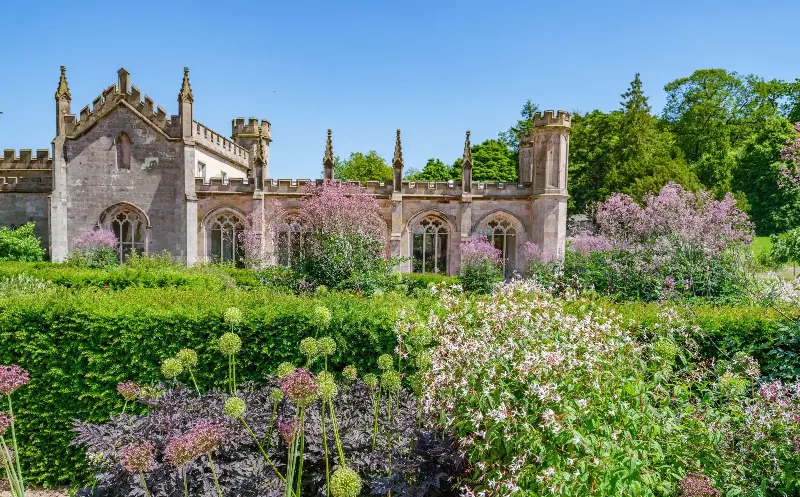
Cross the narrow bridge over the river Frome and you arrive at Iford Manor, tucked into the folds of the valley below. April and May are its moment, when wisteria spills across the house in thick, twisting limbs, the lilac flowers heavy with scent.
Much of what you see today is the work of Harold Peto, who transformed the garden in the early 20th century into a collector’s sanctuary. Terraces unfold like stages, softened by tulips, foxgloves and fritillaries, and daisies spill down the main stone staircase. Look closely for sigils and symbols worked into the stone, alongside classical reliefs and sculptures – evidence of Peto’s magpie eye for collecting.
Insider tip: Tucked into the far corner of the Great Terrace is the Casita, Peto’s “little house” – my favourite spot to sit and take it all in.
How to visit: Iford Manor is a 20-minute drive from Bath or a 25-minute walk from Freshford Station. Tickets for a tour of the private walled gardens (including entry to the main garden) cost from £28. Historic hotel Homewood is located nearby, with rooms from £265 per night.
Aberglasney Gardens, Carmarthenshire
Set within the Tywi Valley, Aberglasney Gardens is being carefully brought back to life. At its heart sits the Elizabethan cloister, with stone arcades framing a geometric garden that catches the light beautifully.
In the woodland, follow Bishop Rudd’s Walk beneath oak and yew, where candelabra primulas rise from damp leaf mould and ferns gather along the stream. I spent time gardening here one winter a few years ago, dividing plants in the rain, and still remember the valley with fondness.
Insider tip: Seek out the glass-roofed Ninfarium, which is home to a range of warm-temperate and subtropical plants inspired by Italy’s Ninfa gardens. Check out the National Botanic Garden of Wales too, which is only a stone’s throw away.
How to visit: Aberglasney is open to the public daily with no need to pre-book tickets. Adult tickets cost £15.50. For a local Carmarthenshire hotel, try the highly-rated Jabajak, with rooms from £132 per night.
Greencombe Gardens, Somerset
Greencombe appears to have simply happened – a moss-softened woodland of gnarled branches and winding paths – but it is, in fact, the result of decades of exacting care. Created by Joan Loraine from the 1960s on a steep, north-facing Somerset hillside, and maintained with the same sensitivity since, it is a masterclass in patient, attentive gardening.
In spring, erythroniums emerge through the leaf mould, their pale flowers nodding low beneath the canopy. Everything here depends on the soil, built up over years with organic matter, feeding not just these woodland plants but a broader tapestry of rhododendrons, shrubs and trees. It feels ancient, but every detail is considered.
Insider tip: Visit early in the morning when light filters through the canopy and picks out the different shades of oak, holly, conifer and sweet chestnut above.
How to visit: Open April to July in 2026, Saturday to Tuesday (2-6pm). Closed Wednesday to Friday. Adult tickets start at £7, children: £1. Dunkery Beacon Country House is found in the idyllic Exmoor National Park, a 10-minute drive from Greencombe Gardens, with rooms from £149 per night.
Helmingham Hall, Suffolk
Set around a moated Tudor manor, Helmingham’s gardens are formal and composed, with meadows, parterres, knot gardens, rose gardens and a productive kitchen garden unfolding around the house.
The Apple Walk is spring’s main attraction. Here, a long green lawn is lined with old apple varieties, forming a kind of floral holloway that hums with bees. Bulbs scatter the banks – daffodils, tulips and fritillaries – while early herbaceous perennials begin to rise through the borders.
Insider tip: For those visiting with children, the new Guildenacre adventure playground is set within the estate woodland – a thoughtful addition opening in 2026.
How to visit: Helmingham Hall is open seasonally from spring to autumn, Sunday to Thursday. While the garden is closed to general admission, an annual membership (£50) gives you unlimited access from May to September. The Bell at Saxmundham is a classic coach house, an approximately half-hour drive from Helmingham, with rooms from £187 per night.
The Garden Through Time, by Thomas Rutter (Hachette, £25), brings 45 of history’s greatest gardens to life in rich storytelling and illustration. It will be published on May 14, available to pre-order now.