



It rained on November 15 last year in Saarlouis, western Germany, where, after a 27-year run, the final Ford Focus rolled off the production line. Tears of remorse, perhaps? The demise of Ford’s combustion-engined family hatchback was a bellwether for the mass desertion from this once all-conquering market sector, which has been taken over by sports utility vehicles (SUVs) and their close sister, the crossover, along with a plethora of battery-powered models.
But the combustion-engined family hatch is not dead. There are still about 15 rivals in Europe, with cars such as Volkswagen’s Golf, once Europe’s best-selling vehicle and with a production run of more than 37 million, still hugely popular.
This new Kia proves the point. Built in Pesquería, Mexico, this replacement for the Ceed is a “world car”, designed to satisfy most major markets rather than, say, only Europe or the US. It’s the first non-European or Korean-built model to be sold in the UK.
In these days of tariff wars and actual wars, this is a high-risk strategy; rising fuel prices for shipping can severely erode your profit margin as well as extend delivery times.
And world cars are risky in themselves; what works in downtown São Paulo or Athens might not be so suitable for Croydon. Ford’s Mondeo world car (the clue is in the name), which cost $6 billion to engineer in its original 1992 form, never sold in solid numbers outside Europe. When it ceased production in 2022, Ford said it was earning more from licensing its model names to Lego, than it did from the Mondeo.
The range
The K4 comes initially in hatchback form, as tested; an estate and a hybrid drivetrain arrive soon. It joins the Kia range alongside the electric EV4 hatch or saloon, as well as the XCeed crossover.
It’s a simple range, with Pure, GT-Line and GT-Line S trims, with petrol engines dependent on the grade level. Prices start at £26,045 for the 113PS Pure 1.0-litre T-GDi 48-volt hybrid manual gearbox model, rising to £36,865 for the 130mph, 177PS GT-Line S with a 1.6-litre turbo engine and a seven-speed twin-clutch (DCT) gearbox. All the cars are front-wheel drive.
It’s relatively large for the class. The platform it shares with the Kia Niro and Kona brings all-independent suspension, MacPherson struts at the front and multi-link rear suspension.
I tested the upper-middle GT-Line 1.6-litre, its four-cylinder engine delivering 147PS (145bhp) and a useful 184lb ft of torque. It’s likely to be the most popular UK model and costs £31,345 OTR.
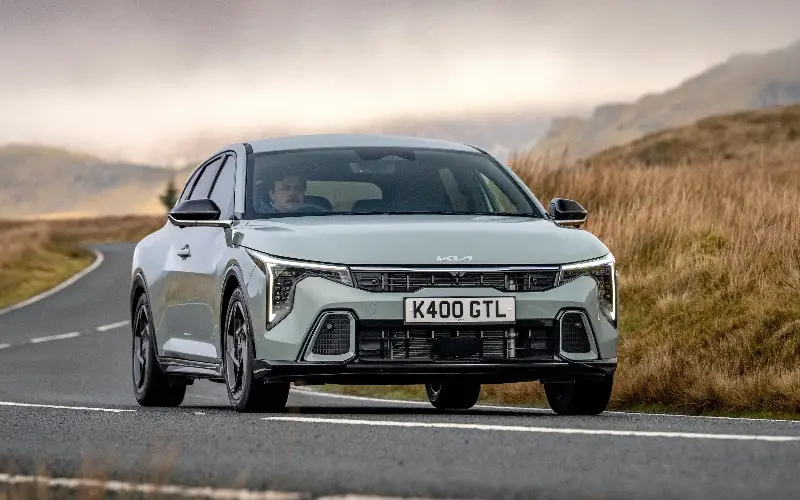
It looks good, especially in the warm green-grey paint called Moonlight Mint (a £620 option), shown in the pictures. Visually, the roof is extended by a rear window spoiler, giving the impression that the K4 is longer and lower than it really is. Aerodynamically, it has a 0.27Cd coefficient – respectable but not exceptional. It weighs 1,487kg, which seems on the high side for a car without a battery.
Inside job
It looks classy, with seats trimmed in a black fabric with a starry effect and old-school, white piping. The artificial leather side panels are squishy and unpleasant to the touch, however. The overall effect is comfortable and pleasingly low-set compared with the EV equivalents, in which you are effectively sitting on the battery in the floor.
There’s plenty of room inside, with lots of storage space. In the back the seat bench gives head and leg room to spare for a couple of six-footers, although three abreast will be a squeeze. The seat backs fold 60/40 per cent and the load bed is heavily stepped. Boot space is 438 litres and 1,217 litres with the seat backs folded.
The fascia consists of a long, oblong glass screen with the centre section acting as the touchscreen, with the portion in front of the driver being the instrument binnacle. There’s also a small centre screen displaying heater settings, but since it’s obscured by your hands on the wheel, we’ll ignore it.
Kia goes through periods of inspired touchscreen design and then not. This belongs in the latter category; it takes some learning and there’s a not-particularly-obvious route to access even quite well-used functions. A row of separate buttons operates more frequently used functions including the heater and an AI chat function (summoned by saying “Hey Kia”, if you seriously don’t value your spare time).
On the road
The engine feels lively with a rorty exhaust note, although it gets a bit cacophonous when revved hard. The key to the performance is the seven-speed twin-clutch gearbox, which isn’t the acme of modern two-pedal motoring you might expect. The clutches seem set very tightly and the shifting strategy is fast and short, so it fairly scorches off the line. Or it would do if the Nexen tyres had more grip, but the body squat and lack of traction means it’s often easy to spin the wheels emerging from a junction, leaving you looking like a hooligan. And when the tyres do grip, there’s a fair bit of torque steer as the tyres tug the steering wheel, under even medium acceleration.
There’s also a bit of a delay for the system to take up drive and when it does it’s in a hurry, so low-speed manoeuvring can be tricky, with some lurching.
It’s better as you speed up, while you can override the system with the small gear-change paddles behind the steering wheel.
On a route across the Wiltshire Hills, the suspension never feels as though it is using more than the first third of its travel. The K4 bounces along, fidgeting like a young puppy, and feeling over-sprung and under-damped. Roads with heavily worn edges cause your head to toss from side to side and the steering has a quick response, almost too immediate. It’s certainly sporty, but feels slightly wayward, although, during longer journeys on smoother roads and motorways, the chassis is calmer and the decent noise insulation makes things less hectic.
I thought the brakes were well judged, with a decent grab on first application and a progressive action all the way to a halt.
The Telegraph verdict
All car prices have risen in the last few years, and a whisker over £30,000 for a sporty, if not exactly sporting, petrol model is pretty good compared with rivals.
Kia has set down a marker with the K4 due to its price and sheer existence, which indicate that whatever Ford told us, rumours of the demise of the petrol-powered family hatchback have been greatly exaggerated.
The facts
On test: Kia K4 hatchback GT-Line 7-speed DCT 147PS
Body style: five-door family hatchback
On sale: now
How much? £31,345 on the road
How fast? 127mph, 0-62mph in 9.1 seconds
How economical? 43.6mpg (WLTP Combined), 38mpg on test
Engine & gearbox: 1,598cc four-cylinder turbo petrol engine, seven-speed dual-clutch gearbox, front-wheel drive
Maximum power/torque: 145bhp/184lb ft
CO2 emissions: 148g/km (WLTP Combined)
VED: £560 first year, then £200
Warranty: seven years/100,000 miles
The rivals
Volkswagen Golf R-Line e-TSI mild hybrid, from £33,815
Still the hatchback by which others are judged in this market and sells well. Expect 54mpg, about eight seconds to 62mph and a highly accomplished chassis.
Honda Civic, from £33,795
The 2.0-litre hybrid-powered Japanese hatchback is fast (0-62mph in 7.8sec), economical (60mpg) and good to drive. And like (most) Hondas, the extra you pay will be recouped when you sell.