



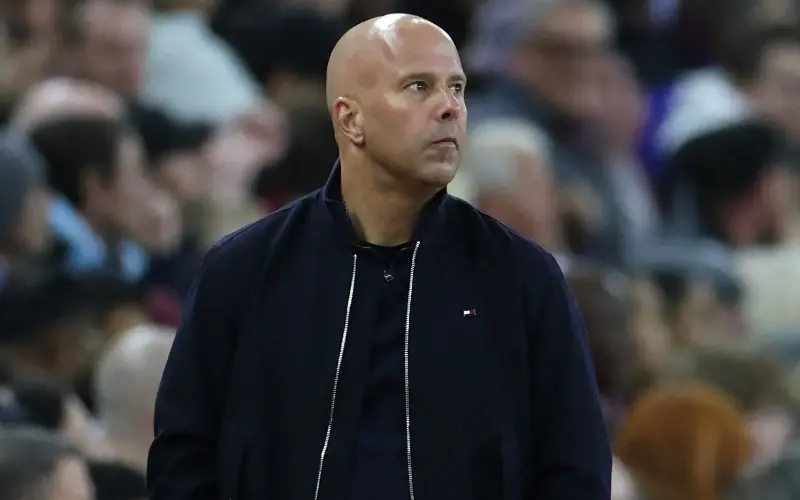
Arne Slot repeated his theory on Friday night that Liverpool, like so many other clubs that have fallen away suddenly, are only one corrective transfer window away from a return to form. You could make the case that both Manchester City and Manchester United have done that in the last 18 months but the question for Liverpool is whether Slot can do so in the little time left that it seems supporters are prepared to grant him.
The swiftly ebbing support for Slot, within Anfield and elsewhere, has been such a notable feature in this season, because it is such a rare phenomenon in the club’s history and it in turn then becomes a factor itself in a manager’s future. No man can survive in charge of a club where the people who pay to watch demand him out – but Liverpool’s ownership seem determined to test that theory.
Fenway Sports Group has proved itself adept at the big strategic decisions. How much investment it could bear as an owner; the profile of manager and squad that it sought to build; the speed at which it could be done. At that it has been a success but then there are factors which are harder to control: the willingness of the club’s support to believe in that plan, and more pertinently the man entrusted to carry it out. The less easily quantifiable feelings that gather a momentum all of their own. Hard to express on a spreadsheet but you feel them everywhere.
In the last 15 years no big Premier League club has turned fortunes around like Liverpool, with such a confidence in its own grasp of data analytics and, as a result, the kind of pragmatic player trading designed to get more from its financial resources. That it was the earliest adopter in the previous decade meant that the returns were that much greater as others in its peer group scrambled to close the gap.
Which is why FSG, and its key figures – like Mike Gordon, Michael Edwards and the rest – have that confidence that they are right. They are used to being right. There is much that is admirable in sticking to a plan in the face of such opposition. But sometimes it is the opposition in itself that undoes it. If Anfield does turn on Slot then it becomes a self-fulfilling prophecy.
By staying the course with Slot, who seems to carry so few of the Liverpool public with him now, FSG are about to test the notion that a manager can be rehabilitated in the eyes of the supporters. After that defeat to Aston Villa on Friday night, it certainly feels like appointing Slot was a much less contentious decision than staying with him into a third season, despite the fact that he is one of only two 21st century Liverpool managers to have won the Premier League. This is fresh territory for a club of Liverpool’s size.
There has been much discussion of a dressing room that is deeply unhappy. Mohamed Salah, who plays his last game at Anfield on Sunday, launched another attack on what he saw as the club’s failing standards on Saturday afternoon – and it was not hard to divine that Slot was the intended target. The last act of Salah’s exit from the club comes on Sunday and it will be hard, one suspects, for him to resist one last post-match invective. Slot, on the other hand, currently lacks the political capital to say what he feels about Salah. That will be easier once the latter has gone.
In the week that Xabi Alonso has begun addressing the finer details of his Chelsea agreement, the most obvious contender for Slot’s job has slipped out of reach. FSG would have appointed Alonso post-Jürgen Klopp but that Alonso turned down Liverpool, and then waited another year for Real Madrid to become available, seems to have made a profound impression on FSG. They have, it is understood, made no plans to replace Slot this summer.
Either way, it is hard to remember such a divide between the ownership and the fanbase of a big club that have had major success so recently. If one was to look for a parallel then it might be as far back as Alex Ferguson’s disastrous 1988-89 season at Old Trafford when the team dropped from second place the previous season to an 11th-place finish in May 1989. As the team’s poor form continued into 1989-90 the infamous banner demanding his removal was hoisted in December 1989. But the opposition to Ferguson was not as universal then among United fans as it now feels for Liverpool with Slot.
Just at the point all his lives had been extinguished, Ferguson, three years into the job by then, survived long enough to win the FA Cup. Slot is a Premier League title winner and his team are fifth, not 13th. But this is a time when managers, even title-winning managers, can be considered much more temporary.
No manager can continue forever against the backdrop of a fanbase in outright rebellion and also, it should be said, Liverpool have not yet reached that point yet. It would be right to say that for the club and for Slot the season’s end cannot come sooner. The mitigation is still persuasive. There is the death of Diogo Jota last summer. The injuries to the likes of Alexander Isak, Alisson Becker, Conor Bradley, Giovanni Leoni and many others over the course of the season. In spite of a collapse from champions to 20 points currently behind the leaders, they remain in command of their own Champions League destiny. But confidence is such a fragile commodity and very hard to recover.
If Slot does survive and prosper, it will be a watershed moment in English football – when an ownership faced down its support and was proved right. It will be a race against time, however, because if Liverpool supporters choose to make Slot’s position untenable they, like all fans, have that power.