



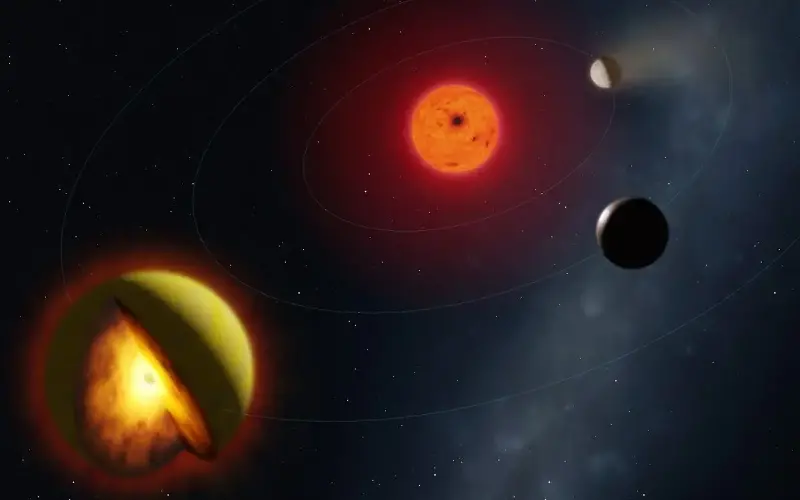
A new type of planet has been discovered that appears to be composed of molten lava.
Orbiting a red star 35 light-years away, the planet is about 1.6 times the size of Earth and has an unusual atmosphere containing large quantities of sulphurous gas.
Until now, small planets have been placed in two categories, but the new findings suggest L 98-59 d is the first of a broader population of planets releasing sulphurous gas from seas of magma that are thousands of miles deep.
Using advanced computer simulations combined with observations from the James Webb Space Telescope, a team at Oxford University reconstructed the planet’s five-billion-year history.
They found that its lava cover allowed the planet to store extremely large amounts of sulphur that would usually be lost to space over time, potentially providing clues about the atmosphere on Earth billions of years ago.
“In general, the planet is like molasses,” said Dr Harrison Nicholls, explaining that the planet’s core is probably molten too. “The whole thing is in this mushy state and that’s what enables gases to go from the atmosphere to the mantle.
“This discovery suggests that the categories astronomers currently use to describe small planets may be too simple.
“While this molten planet is unlikely to support life, it reflects the wide diversity of the worlds which exist beyond the Solar System. We may then ask: what other types of planet are waiting to be uncovered?”
Traditionally, planets of this size have either been classified as a rocky “gas-dwarf” with an atmosphere of hydrogen, or a water-rich world made of deep oceans and ice.
To test whether L 98-59 d belonged to an entirely new category, researchers compared the telescope observations with advanced computer simulations of the evolution of rocky planets, helping to understand the exchange of gases between their interiors and their atmospheres.
The study found that the planet’s mantle – the layer between the surface crust and the outer core – is probably made of molten silicate, which is similar to lava on Earth.
The deep molten reservoir stores extremely large quantities of sulphur deep inside the planet and acts as a blanket, locking in sulphurous gases that would usually escape as they interact with X-rays from the red dwarf star it orbits.
These have been released for billions of years, combining with hydrogen gas to give the planet, first identified in 2019, its unusual atmosphere.
The computer simulation found that, like all rocky planets, it started life as a magma ocean and shrank over billions of years as it gradually cooled. However, its very large atmosphere creates a greenhouse effect, preventing too much heat from escaping and thereby maintaining its lava surface.
“What’s exciting is that we can use computer models to uncover the hidden interior of a planet we will never visit,” said Prof Raymond Pierrehumbert.
“Although astronomers can only measure a planet’s size, mass and atmospheric composition from afar, this research shows that it is possible to reconstruct the deep past of these alien worlds and discover types of planets with no equivalent in our own Solar System.”
While this molten planet is unlikely to support life because its surface is so hot, the interactions between gases released from the lava and its atmosphere act as a “laboratory in the sky”, indicating what might have taken place on Earth when it first formed, Dr Nicholls said.
“By doing this, we can now start to address some unsolved questions about Earth’s first atmosphere,” he said, including the balance between carbon dioxide and hydrogen and the sorts of life it sustained.
The research was published in the journal Nature Astronomy.