



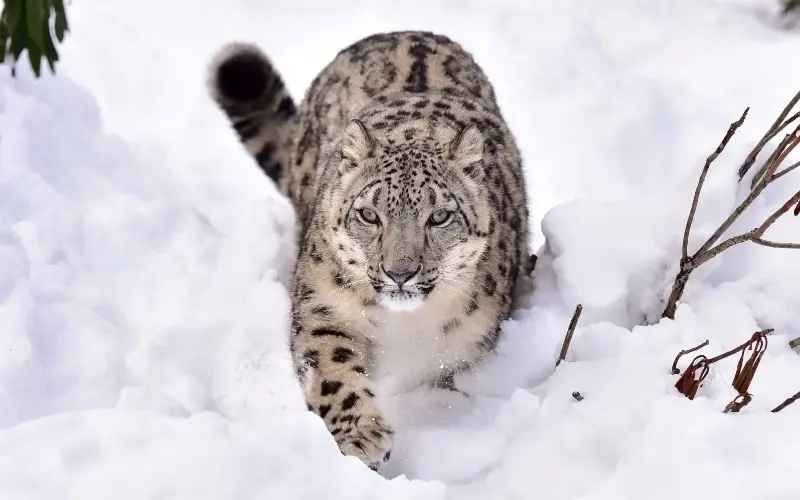
Twenty years ago, very few people had seen a snow leopard in the wild. In India, Kulbhushansingh Suryawanshi was beginning work on a PhD thesis about the Himalayan livestock that the big cats consumed. His supervisor assured him that he would “never” see a snow leopard himself, and might struggle to obtain enough data on them. Luckily for us, that professor would be proven very wrong.
Snow leopards are some of the most enigmatic animals on Earth. There are roughly 4,000 of them, living in 12 countries: Afghanistan, Bhutan, China, India, Kazakhstan, Kyrgyzstan, Mongolia, Nepal, Pakistan, Russia, Tajikistan and Uzbekistan. But their population density is extremely low: their habitat, mostly Himalayan, covers more than a million square miles. Even that “4,000” figure is an estimate, and it might be too high: some governments could be overstating their numbers to attract tourists who dream of seeing those mysterious cats for themselves.
Himalayan locals had known of snow leopards since time immemorial, but the species was first described scientifically in 1777, by the German naturalist Johann Christian Daniel von Schreber. For a long time, scientists had only skins to go on: they couldn’t spot the animals in the wilderness. It wasn’t until 1970 that George Schaller took what’s believed to be the first photo of a snow leopard, eating a goat with her cubs nearby, high in the Hindu Kush. The image was published in National Geographic. Schaller later returned to the mountains with the author Peter Matthiessen, who wrote of the trip in his bestselling book The Snow Leopard (1978), and described his failed attempts to see one as a spiritual experience.
Five decades later, the cats are studied by a new generation of scientists, filmmakers and conservationists, many of whom have worked in the Himalayas for years and have never seen a snow leopard either. But Suryawanshi stayed in their habitat for long stretches, roaming with their prey, learning their ways. He became able not just to see the cats, but to watch them for days on end, track them, even trap and collar them. Not only did he earn that PhD, and become country director for India of the Snow Leopard Trust, but he has now written The Ghost of the Mountains, a beautiful and heart-wrenching book, for Western readers who can only dream of visiting the frozen peaks.
Suryawanshi sees his first snow leopard in the Spiti Valley of northern India, two months into his fieldwork. He spots her from a distance through a scope set up on the roof of his abode; she’s “swimming in the deep snow”, with a cub alongside her. He rushes out, accompanied by his friend and interpreter, and the teacher of the local school, and they all watch from 200 metres away as the mother basks in the sun, and the cub plays with her tail. Then a male snow leopard enters the scene. “The cub’s movements softened; he crouched, belly brushing the floor, almost disappearing into his surroundings. He became a shadow of his mother.” (Males often attack and kill cubs that are not their own, then mate with the bereaved female.) For the next five hours, Suryawanshi and company watch in silence. The male stays hidden in a crevasse; the female ignores him and lies on the snow; the cub cleaves to her.
Growing darkness and falling temperatures drive the watchers back to the village, where the sighting is viewed as an opportunity to celebrate “like a wedding or a birthday”. Suryawanshi buys a sheep to cook, and everyone feasts, crowding around him to see the pictures he has taken. He’s interrogated by an ancient lady from the next village along, who only speaks Spitian, a local dialect. She asks to see his pictures, telling him, with tears in her eyes, that she has lived on the river gorge, tucked under the mountain, for her entire life, and she has never seen a snow leopard herself.
One reason for the cats’ ghostly reputation is the lack of traces they leave. You might come across a few pug-marks on the ground, but the snow leopard will be so successfully camouflaged that it will appear to have vanished into thin air. More often, they make no marks at all. One night, staying with a herdsman in a yak-hair tent after a long day of mountaineering in Ladakh, Suryawanshi is kept awake by his companion’s flock of sheep, which he can hear moving around mysteriously “as if pushed by an invisible hand”. The guard dog, too, seems restless and alert. In the morning, everything seems normal, but further down the path, the men find a dead argali (a mountain sheep), surrounded by pure, unmarked snow.
Today, snow leopards are categorised as “vulnerable”, and underpinning The Ghost of the Mountains are the major issues of conservation: how do we measure the number of snow leopards in the world? How do we protect their habitat from the encroachment of mines, dams and solar plants? How do we ensure that they can survive in areas where they may also massacre the livestock on which herders depend? For, as silent and near-invisible as they might be, living with these creatures is a difficult business for the villagers of the mountains and plateaus.
When you make dumplings, says Takpa, Suryawanshi’s host and research assistant in the Spiti valley, you must make sure that the neighbours don’t find out. If they do, they’ll come over and eat the dumplings, and you’ll be left eating soup. Suryawanshi’s insight: snow leopards prefer wild herbivores such as blue sheep, but if there are more cats than the blue-sheep population can support, the predators will fill in the gap with domestic livestock – which only increases the population of hungry snow leopards further.
Suryawanshi hears these complaints for himself. As he begins his research, a young woman tackles him: “Why don’t you marry one of your snow leopards?” She relays how her only cow was killed by a snow leopard when her son was young, leaving the boy without milk, while the compensation given to her husband by a conservation programme ended up spent on other things.
Another woman, the oldest in the village, describes how the yak she’d painstakingly hand-reared through the winter, in temperatures of -30C, was killed by a snow leopard too. As Suryawanshi so refreshingly makes clear, the herders – often the same ones who’ve shot the snow leopards in the past and might be viewed by starry-eyed westerners as “villains” – need to be consulted about conservation efforts. (We have much to learn in Britain, where farmers are too often considered part of the problem.)
By contrast, he views some international conservation organisations as lazy and ineffective. It’s in the interests of the World Wildlife Fund, he argues, to keep hunting for “good news stories” to show that the money you give them works. And the “vulnerable” status of the snow leopard remains highly controversial: they had been “endangered”, but were downgraded in 2017 by the International Union for Conservation of Nature, to the dismay of many conservationists. In Suryawanshi’s opinion, that change has only opened huge tracts of Himalayan land to commercial exploitation.
Some people write books about a world they have made, some about a world they have observed. Very few manage to walk through the world observing things few other people have seen, influence it at an international level, and after 18 years write a book like The Ghost of the Mountains, a spectacular chimaera of observation and action, philosophy and science. “I had found my personal mountain,” Suryawanshi writes, “in the form of the snow leopard. It was not an animal that I wanted to conquer, but one that I wanted to understand.” He ends with the introduction of his daughter to the mountains, and gives us a beautiful image: a nine-year-old girl, looking at her first snow leopard, as it tears strips of meat from the carcass of a blue sheep.
★★★★★
Harriet Rix is the author of The Genius of Trees. The Ghost of the Mountains is published by Granta at £16.99. To order your copy, call 0330 173 0523 or visit Telegraph Books