



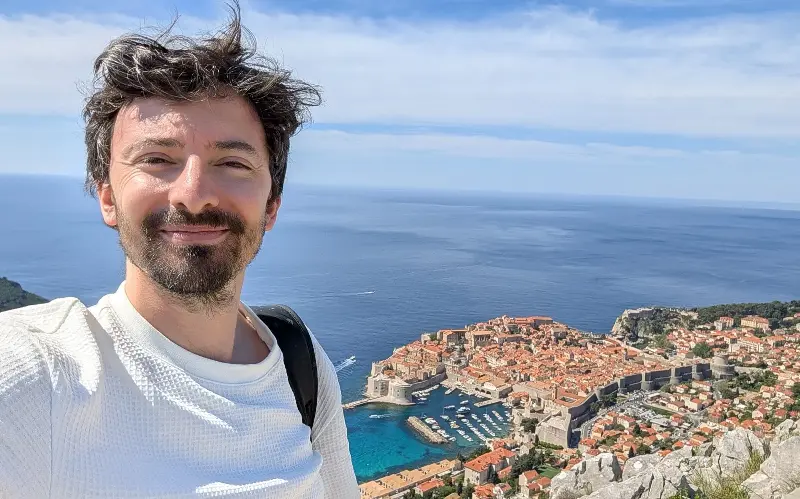
A woman sat alone on a pier just outside the city walls. She took a piece of bait and methodically threaded it on to her fishing line, before sweeping it into the Adriatic.
A few feet away, another woman erected a portable tripod. She placed her phone into its grip, before walking a few strides. She faced the city’s fortifications, straightened her neck, and then turned to her phone with a pout. Out of frame, a queue of tourists waited to get the same shot.
This is a familiar tableau. Eight years ago, I filmed a documentary for The Telegraph investigating whether tourism had killed Dubrovnik. Back then, the city was a playground of tacky souvenirs, Game of Thrones crowds and tourist-trap restaurants.
Now, the mayor of Dubrovnik, Mato Franković, says things have changed. Can a city really reverse its fortunes in less than a decade? I visited to find out.
‘People said that someone is going to kill me’
“I have people saying that I’m crazy, that I do not know business,” says Franković. He looks sharp, dressed in a crisp blue suit for our meeting in Dubrovnik City Hall, surrounded by portraits of past mayors. “But I saw that the only way was to push, and to be hard.”
Since coming to office in 2017, then aged just 35, Franković has introduced a number of measures to combat the “miserable” overtourism situation that he inherited. In 2016, with tourists outnumbering locals 27:1 in the old town, Unesco said it would strip the city of its World Heritage status if it did not take action.
At Dubrovnik’s lowest ebb, as many as eight cruise ships would arrive in a single day, creating scenarios where thousands of tourists would flood the city at once. Now, cruise ships are capped at two per day, and they must stay for no less than eight hours to avoid unmanageable bursts of arrivals.
Much of Franković’s work has been organisational. Coach tours must now book a parking slot in advance, or not come at all. There is a new traffic control zone which means drivers require a permit to enter; in six months, it reduced the traffic around the Old Town walls by 300,000 cars. A new park-and-ride system is in development, and as of 2026 you must now book in advance to walk the city walls using the new Dubrovnik Pass.
“When we cut the tables and chairs by 30 per cent, people said that someone is going to kill me,” says Franković, referencing his mission to clear the streets of restaurant terrace clutter. “The streets were also covered with souvenir stands. There are some, where it’s not in the way, but this is one per cent of what it was.”
One of the mayor’s mantras is “a city without citizens is just a museum”. Acting on this, new rules around short-term rentals have made it less desirable for people to let their homes to tourists. The city is also purchasing old buildings to rent out to local families as affordable housing. In total, 116 families have been rehoused and another 12 will move into the Old Town this year.
After bidding farewell to Franković I met Kornelija Smolcić, who has recently moved into a Old Town apartment with her husband and three children. Their home is small, but rent is lower than €200 (£170), compared to the typical rate of €600 to €800.
“It feels amazing. Everything is near,” she said. Her young children attend a new primary school nearby, set within an old palace. The number of pupils is growing each year.
“Seven years ago we had too many tourists. The traffic is much better with the new special zone. The mayor is really trying to do everything better. But it’s hard, because Dubrovnik lives from tourism. And tourism must come here.”
Still ‘living in Disneyland’
I met Marc Van Bloemen outside his son’s ice-cream parlour, tucked down an alleyway close to the harbour. It was filling up, so he saved an outdoor table by plonking down his smartphone before leading me inside for a scoop.
“Aren’t you worried someone will steal your phone?” I asked, as dozens of tourists squeezed along the alleyway. He peered his head out of the shop.
“I know who the bad guys are in Dubrovnik,” he said, scanning to see whether he could spot them. “We’re OK.”
Marc’s family moved to Dubrovnik in 1972, and he has since spoken out against the ills of mass tourism in the city. When we met in 2018, he said he was “living in Disneyland”. I asked if things have improved since then.
“No. More people have moved out,” he said. “After the pandemic, I thought they’d learn that you shouldn’t put all your eggs in one basket. But everything is back to normal.”
Marc, who also rents out rooms in his home to tourists, believes it still takes far too long for ambulances to reach the Old Town. Anchoring cruise ships dig up the sea bed, he says, destroying the flora. Hotels used to be locally owned. Now, they are foreign-owned and are stocked with foreign-made products.
“Everything costs more here than everywhere else. Even the chain stores. There is a television advertisement saying that a product from the bakery costs a certain amount. But there will be a little star... ‘except in Dubrovnik’. What is that? Is that – what does the mayor call it? – ‘sustainable’ tourism?”
A funeral for the city
I boarded a boat to Lokrum, a small, car-free island 15 minutes from Dubrovnik. On the way, a tourist asked whether he could photograph my son, three, who “looked cute”. I politely declined.
Lokrum is home to noisy peacocks who strut and bark territorially. I was meeting Tea Batinić, a highly regarded local guide, author, artist and gallery owner who lives in Dubrovnik’s Old Town.
“The noise around where I live is so strong that we sleep with closed windows and I have ear plugs. They are not regular ear plugs, either: they are for divers,” she said, digging around in her bag to show me.
“Often I go downstairs in the middle of the night, and there is a group of drunk, young people. Semi-naked girls and body-building boys. They buy drinks from the supermarket, they stay on the street, they shout and they drink.”
Seven years ago, Tea organised a gathering in the Old Town. She describes it as a performance rather than a demonstration.
“I put on my Facebook: tomorrow will be the funeral of the shop window,” says Tea. She had observed that the main thoroughfare in Dubrovnik had become overrun with ATMs. Banks were paying shop-owners sums north of €8,000 (£6,920) to install these in their windows, but Tea refused the offer for her store, Artur Gallery.
“The next day, professors, lawyers and painters appeared. We brought a lot of flowers for the procession, but we would not touch the properties,” she said. “Our message was that shop windows are the eyes of a town. If you blind your main street, there is no light.
“The mayor supported us. He reacted and he accepted the arguments. He had the power to help us, and he did. The shops were forced to put the machines indoors. In the town, you will see I succeeded.”
Back in the Old Town, I took a lap of the city’s cobbled streets. Let us have no illusions. There are still shops selling Game of Thrones souvenirs. There remain tourist traps: one bar sold me two bottled beers and an apple juice for €18. Cruise ships still come. There are still many, many tourists, and bottlenecks do form, particularly outside Pile Gate, where looking lost with an ice cream is the thing to do.
No city as beautiful as Dubrovnik will ever be perfect. But things do seem to be moving in the right direction. Perhaps it is time that we – the day-trippers, the selfie-takers, the odd photograph requesters, the late-night drinkers – consider how we can help to improve matters, too.
How to have an authentic weekend in Dubrovnik
For a unique stay
For something truly authentic, shop around for one of Dubrovnik’s forgotten Renaissance villas. In past centuries, before the era of slick hotels, a number of elegant aristocratic country retreats were built on the outskirts of Dubrovnik’s city walls.
One particularly magnificent villa, a five-minute walk from Pile Gate, has recently undergone a transformation alongside the Croatian Ministry of Culture, with restored ceiling paintings inside. There is a pool, boules and resident tortoises in the tiered garden, which is lined with lavender and bougainvillaea. The wonderful Lana is on hand daily to prepare fresh breakfasts, with bread sourced from local bakeries.
Old Town Villa Dubrovnik is listed on Oliver’s Travel and represents an excellent option for a group, with prices starting from £920 per night (sleeps 8–14). The friendly owners have similarly impressive renovated villas on the nearby island of Sipan.
For a proper Croatian meal
Possibly the most hyped new restaurant in Dubrovnik is LOCAL, which offers an immersive four-hour dining experience centred around traditional Croatian hospitality. Chef and owner Marija Papak’s menu specialises in peka, a Croatian dish of slow-cooked meat (typically lamb) and vegetables cooked on an open flame. Expect the conversation, and grappa, to flow.
For a souvenir
For a unique souvenir, head to the HQ of the non-profit Maritimo Recycling in the creative neighbourhood of Gruz. Each pair of Floaties sunglasses (starting from €60) is made up of 10 recycled bottle caps, reclaimed from the sea. You can book a session to make a pair yourself. The excellent Red History Museum is just around the corner.
For a day trip
There are three ways to gain elevation in Dubrovnik: take the cable car up Srd Mountain, walk (around 1hr 15m each way), or a newer option: board an electric tuk-tuk. The family run Eco Tuk Tours Dubrovnik runs lively trips from €40 per person.