



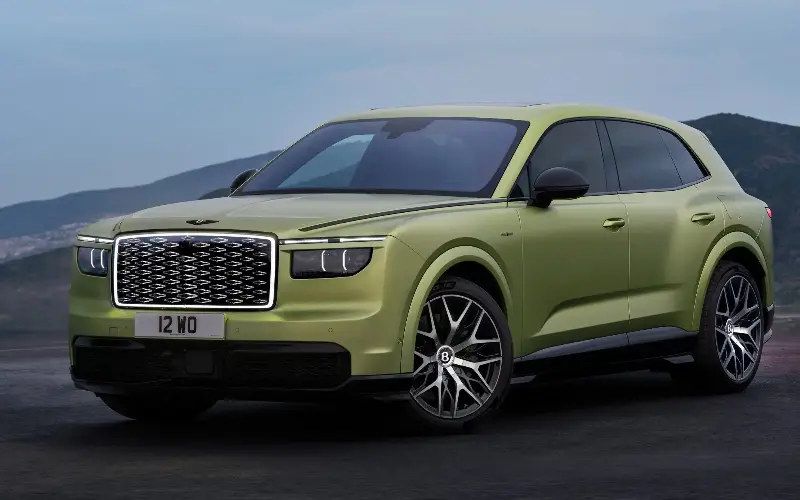
The great car designer Ettore Bugatti said of his rival Bentley in the twenties and thirties: “They just make fast lorries.” This ceased to be true in the early fifties when the Bentley R-Type Continental established a standard of lithe industrial beauty not yet surpassed.
But now Bentley returns to its old inclination towards monumentalism: the new all-electric Torcal is named after a mountain. Some may find it difficult to look at. Beauty is a fugitive commodity and has, seemingly, run its course in car culture.
A trend towards uglification began with the Porsche Cayenne of 2002. This malformed lardy lump was a travesty of Prof Porsche’s principles of lightness and efficiency. Of course, it became a best-seller. As H.L. Mencken knew, you never go bust under-estimating the public’s taste.
The Rolls-Royce Cullinan, meanwhile, is a pharaonic SUV and qualifications for ownership include not only high net worth, but also a lack of taste plus a mild anti-social psychosis.
But it is electric cars in particular that are decidedly hideous in this modern age of ours. Today’s electric BMW 7-series is a crass whale of a car which looks at home outside a de luxe Hong Kong bordello, whereas its predecessors were distinguished by German Gute Form: Bauhaus restraint.
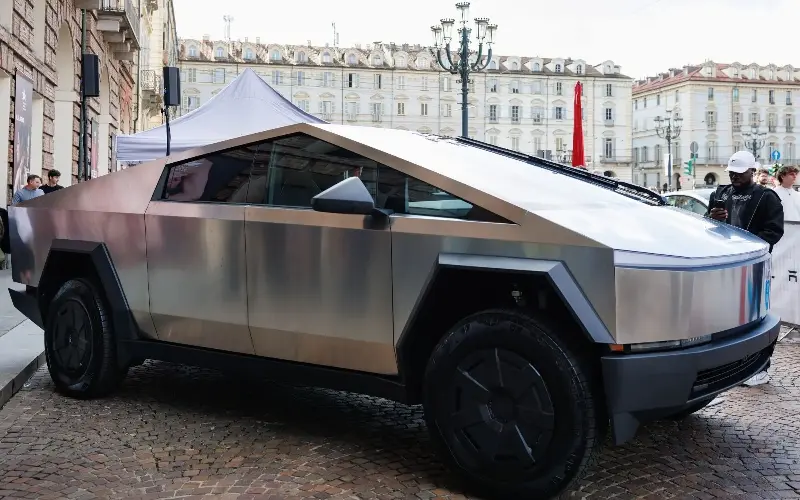
As for the Tesla Cybertruck, it is an affront to all notions of good sense and, like its proprietor, irrational, sociopathic and predatory.
Even Ferrari is guilty. No other manufacturer has a historic record of such metal gorgeousness, yet the new Luce EV is poorly proportioned and has as chilly an interior as a Jony Ive-designed man-cave. The Pope was inveigled into the official press launch. God may well be in the details, but when you have to put Leo XIV in the driving seat, you are in trouble.
Something about electrification is the root cause. The very first EVs from Toyota and Honda were deliberately odd-looking to give them a visual point-of-difference to make explicit their unusual drive-trains. They looked like a child’s bath toy. And no-one really wants to drive a rubber duck. Their successors are not much improved, artistically speaking.
There seems to be an international conspiracy against beauty. And this tells us something about our contemporary psychological condition. We perhaps have a collective guilt about what the car has done to our cities and that guilt might be expiated by owning something remarkably maladroit and ugly, rather than something beautiful and gorgeous.
And in the absence of gorgeousness, EV designers resort to absurd light-shows front and rear. Garish strips of diodes on the boot seem mandatory, as tail fins once did. So too are illuminated badges and grilles that look like an explosion in a stardust factory. This is to demonstrate that your Volkswagen iD5 is powered by electrons, not carbon. The silliness of it is a form of public penance.
Beauty, Stendhal thought, is the prospect of happiness. In a world where embodied pleasures are either alien or forbidden, no such prospect exists. In this context, Porsche’s current advertisements – frankly infantile – are a great curiosity. They don’t show Porsche’s technically impressive EVs, but classic cars that are not for sale. How we long for that beautiful past.
Fact is, no-one has made a beautiful car since about 1990. For much of the last century the car threatened to usurp “art” in its hold on popular dreams and desires. No more. The uglification points to the end of the road for the automobile.