



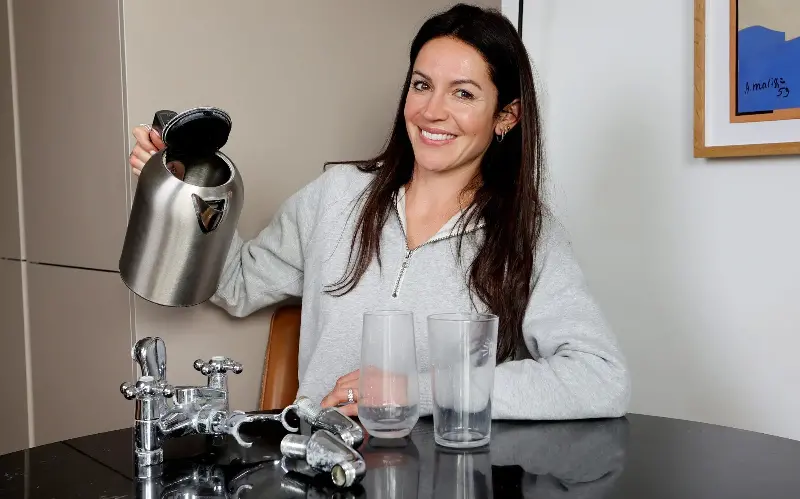
As someone who has an incessant need to keep everything spotless, limescale is the bane of my life. My kettle, shower screen and taps are all victims of the hard, chalky, creamy deposit. Meanwhile, the glasses that run through my dishwasher usually come out cloudy, rather than clean.
Living in London, where the water is hard, only makes the situation worse. Hard water contains more calcium and magnesium, the minerals which form limescale.
It’s not just an eyesore. According to British Water, every one millimetre of limescale on a heating element such as a boiler, adds seven to 10 per cent to its energy consumption because the appliance has to work harder to heat.
So it’s no surprise there’s a whole wealth of products dedicated to eradicating limescale. They tend to all work in the same way, by dissolving the calcium carbonate and magnesium carbonate. Yet many contain harsh, acidic ingredients which can often feel toxic.
My usual go-to works fantastically, yet the chemical smell does concern me a little.
Research published in the journal Environment International found that when volatile organic compounds (VOCs) and other reactive chemicals are sprayed or used on warm surfaces (such as kettles, taps or shower heads), these chemicals can evaporate and linger in the air. Especially if there’s limited ventilation.
Some acids cause itchy skin and burns. Swedish research in the journal Healthcare found that cleaning products pose the most risk to eye health (54 per cent of products), compared with 34 per cent which pose a hazard to skin and five per cent pose a risk for respiratory irritation.
There’s also concern about the environmental impact of these chemicals, including air pollution and damage to aquatic ecosystems.
Natural alternatives are becoming more popular, although I usually assume that they won’t work as well. But with a flat that’s filled with chemical-based products, I felt it was finally time to find a natural limescale solution.
As I discovered, natural solutions do work, but knowing how to use them and at times, being prepared to put a bit more elbow grease in, makes all the difference.
Also good for: Kettles and toilets
Despite being an “acid”, this is less aggressive than other acids and it’s also far less pungent than vinegar. Citric acid is common in cleaning products but typically in much smaller amounts than when you use it in its pure form.
I paid £5 for a 1kg bag on Amazon, which should last me a good while.
“Mix one to two tablespoons of citric acid powder with 500ml of warm water. Spray or soak items with a cloth and leave for up to half an hour before rinsing well,” says Anna Louisa, a cleaning expert and author of The 5-Minute Clean Routine.
“Letting the acid sit is key, which is why it’s best to soak rather than scrub. Time does the work, reducing the need for abrasive scrubbing that can damage finishes,” she adds.
I chose to descale my water glasses, leaving a cloth soaked with citric acid inside the glass while I carried on with my morning. The result? Zero cloudiness. A quick polish left my glasses immaculate and far more appealing to drink from.
Lemon juice for my kettle
Best for: Very light limescale and shine
My kettle, which is awash with London water from the moment I wake to when I pour myself a “sleepy tea” before bed, is developing the tell-tale scaly white deposits around the rim. So, I was keen to see if a citrus-based cleaner would work and avoid anything chemical in something I boil water in.
Anna Louisa recommends either fresh lemon juice or bottled lemon juice. “Apply directly, leave for 10 to 20 minutes, then rinse and buff dry. This is great for maintenance cleaning too and leaves a fresh scent.”
Did it work? It ever-so-slightly loosened some of the build-up, but it really just felt as though I’d wasted a lot of expensive lemon juice, which would have been better used in a lemon meringue pie. Lemon slices dipped in salt work well as a tap polisher, however, if you are keen on a naturally citrus-scented home.
Instead, try citric acid descaling sachets for inside the kettle. White vinegar works well for the rim, or as a descaler. Fill the kettle with an even mix of white vinegar and water, bring to the boil and then let sit for 30 minutes. Then pour out the liquid and boil fresh water to remove the vinegar smell.
White vinegar for my showerhead
Best for: Taps, showerheads, glass and tiles
Before the rise of specialist descaling products, many households relied on humble vinegar. Thanks to its natural acidity, white vinegar dissolves mineral deposits.
Supermarkets often don’t stock white vinegar, but I did eventually find a one-litre bottle in my local hardware store for £4.99.
According to Anna Louisa, it’s best to use undiluted white vinegar or a 50/50 mix with warm water for lighter build-ups of limescale.
“Spray directly onto the area or soak a cloth, then wrap it around the limescale area. Leave for 15 to 30 minutes or up to an hour for heavy limescale. Then, gently scrub with a soft brush or cloth, rinse thoroughly and dry. In hard-water areas, use this weekly.”
I went all-in and used it undiluted, soaking one of my showerheads, metal shower taps and faceplate in vinegar.
After 30 minutes, the limescale hadn’t shifted, but it was loose, and I could easily brush the limescale off my showerhead with an old toothbrush. A polishing cloth returned my shower taps and their faceplate to looking practically brand new.
I recommend keeping windows open as you clean, however, to avoid the chip shop aroma lingering in the air.
Bicarbonate of soda for my shower screen
Best for: Shower screens and taps
Although bicarbonate of soda is alkaline, and limescale requires an acid to dissolve, Anna Louisa says it works well as a follow-up after using an acidic cleaner. “Make a paste with a little water and gently scrub away any remaining residue,” she suggests.
For thick, stubborn limescale, she suggests mixing bicarbonate of soda with white vinegar to create a fizzy paste that lifts grime.
I mixed one part bicarb to two parts white vinegar and soaked my shower screen with the homemade formula. An hour later, I returned with a fresh cloth and scrubbed. After putting my arms through a fairly intense workout, the limescale had disappeared and my shower screen was see-through again. I usually turn to Viakal, the classic top-tier limescale remover, for cleaning my shower screen. But this mixture did just as good a job, without the strong “choking” smell that Viakal emits, which is thanks to active acids and perfumes.
Since then, I’ve mixed bicarb and vinegar in a spray bottle to give my shower screen a weekly clean. It’s just as effective as Viakal and considerably cheaper too.
WD-40 for my taps
Best for: Very stubborn, thick limescale
Water Displacement 40th Formula, the long-winded name for WD-40 is a petroleum-based spray that’s been going since 1953. Its main job is to displace moisture, which prevents corrosion.
While it’s not natural in any way, shape or form, a quick Google led me to discover that WD-40 is often used to remove tough limescale from taps, sinks and showers.
I have some taps which have been severely hit by limescale. To the point where I thought they were unsalvageable. So I thought bringing in the big guns would increase my chances of limescale-free taps.
I sprayed a light coat of WD-40 onto my taps and let it sit for two hours. When I returned, the WD-40 had loosened the limescale so by using a vinegar-soaked cloth, I could gently scrub the limescale right off.
Aside from the obvious benefits, including lubricating hinges, WD-40 can be used to remove permanent marker pens from walls and furniture; ideal for families with young kids. It also helps to remove stickers such as price tags, without leaving any residue.
Preventing limescale in the first place
In an ideal scenario, we wouldn’t need to remove the limescale, as it wouldn’t be there in the first place. If you live in the South of England however, preventative measures will save you so much effort later down the line.
Anna Louisa suggests rubbing a candle on your taps to create a temporary water-repellent barrier. “Water beads run off, which helps prevent new limescale forming and makes taps look shiny. It should only be used sparingly and buffed in thoroughly.”
Whether you use a candle or not, always dry surfaces after use.
“A quick wipe of taps, glass and tiles removes water droplets before minerals can settle. Avoid letting water sit around plugholes, taps and rims too,” she says.
“Keep a squeegee in the shower and wipe down glass and tiles after every use to keep on top of limescale forming. A 30-second wipe-down of the other surfaces in your bathroom a few times a week saves hours of scrubbing later.”
A limescale-reducing showerhead or water filter can also help to soften water and save time and elbow grease in the long run.
“To keep glasses cloud-free, add 150 to 250ml of white vinegar to a small dishwasher cup or bowl and place it upright on the top rack,” suggests Anna Louisa. “Then run a normal hot cycle. This is to be used alongside the normal dishwashing tablet.”