



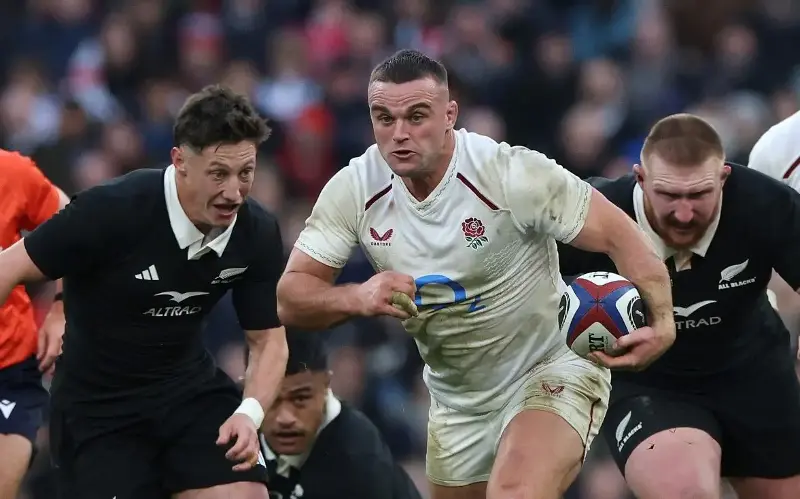
Maro Itoje, channelling his inner Jack Nicholson, was unequivocal after his side’s record victory over New Zealand on Saturday: “We don’t want this to be as good as it gets for England.”
Thankfully for the captain, England have an immediate chance to prove they will not rest on their laurels: they will feature in the second vs second final next Saturday, taking on the All Blacks for the second time in a week, and have a chance to make history. No England side has ever beaten New Zealand three times on the bounce.
Throughout the unbeaten November, however, England have looked like a side totally transformed from the one which registered its worst ever Six Nations finish. Under Richard Wigglesworth, the defence, as Telegraph Sport has outlined, suddenly looks a force with which to be reckoned; certainly, head coach Steve Borthwick was quick to offer the plaudits to his senior assistant coach on Saturday evening.
But, England’s attack looks far better, too. There is a personnel factor here: only Immanuel Feyi-Waboso and, at late notice, Tommy Freeman, were missing from what the England coaches believe is their best starting back line. But picking the right players is one thing; them delivering on the biggest stage, missing two of their most threatening strike-runners, is another.
Here is where England’s attack clicked in that record win over the All Blacks.
Swifter starts
Last week, Borthwick could not have expressed his message more clearly. “I want the players to jump into this game. There are too many times I’ve seen the players watch, metaphorically, the start of the game. One of the most pleasing things is the way the team has started these games and I want that this weekend.”
The head coach is referring to how, before this year, his team were poor at the beginning of matches. Notably, nothing showcased this more clearly than last year’s fixture against New Zealand. Although England eventually ran out comfortable 33-19 victors, after 19 minutes the hosts found themselves 12-0 down.
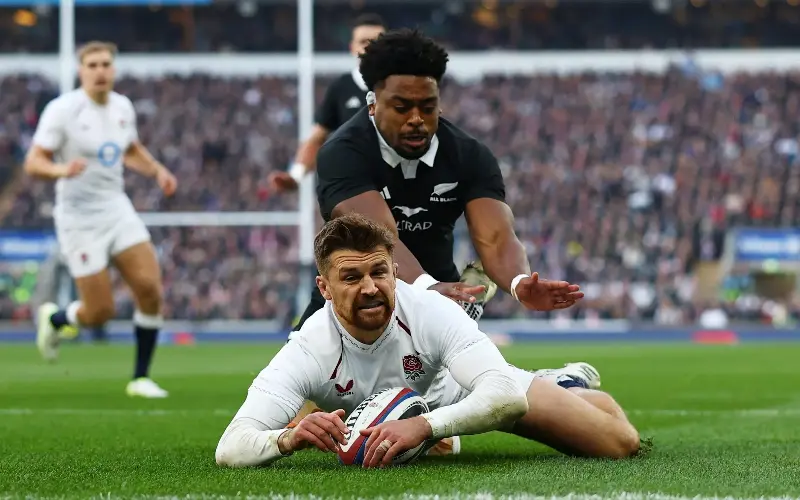
This was a trend that continued for Borthwick’s charges until it was righted in the hammering of Fiji in July. It would be fair to point out that the Pacific Islanders did not offer England their sternest challenge that day in Liverpool but since then England have been 19-3 up at half-time against Los Pumas in Argentina; 19-10 up against Australia at Twickenham after having had a try ruled out after a minute; streets ahead against Japan at the same venue before leading the All Blacks 19-5 last weekend. On a couple of those occasions, England should have been further ahead; regardless, England have sought to address their poor openings to matches.
Back-row beasts
Ben Earl carried the ball 33 times in victory over New Zealand and, to put that in the most simplistic terms, that is almost once every two minutes in a game of rugby. That figure, almost certainly a world record in the men’s game, is extraordinary in itself but this was by no means quantity over quality from Earl. The Saracen is not the most heavy-duty No 8 in the world but his pace is his USP, as are his brains, over the traditional brawn.
Earl was undoubtedly the player of the match at the Allianz Stadium on Saturday but another on the back row, as well as a couple of others, ran him close. Ollie Chessum has matured into a world-class operator on the blindside; Borthwick’s decision to drop the Leicester forward after the Ireland loss in the Six Nations, before what became an historic defeat to Italy, now looks foolish in the extreme. Chessum and Earl are among the first names on the teamsheet and the former’s late tackle on Scott Barrett had the air of a serious power shift.
England have to go again, and do it again next weekend, but last Saturday Barrett’s magnanimous facial expression after he had been floored by Chessum told its own story. The duo are touching world class - consistency is key for them - while at openside there are few in England who could have foreseen in October that Ben Curry would have had the impact he has. Injuries, including to his twin brother, opened the door, but he has mightily impressed.
Bench bullies
This one comes back to availability. In the summer, and the Six Nations, Borthwick had to dig quite deep for replacements, particularly among the forwards. Although the Prem offers plenty of depth and options in most positions, those replacements are not always world-beating Test class. Just as last year, however, with a slight refresher in newcomer Greg Fisilau, Borthwick has found a Pom Squad to be reckoned with.
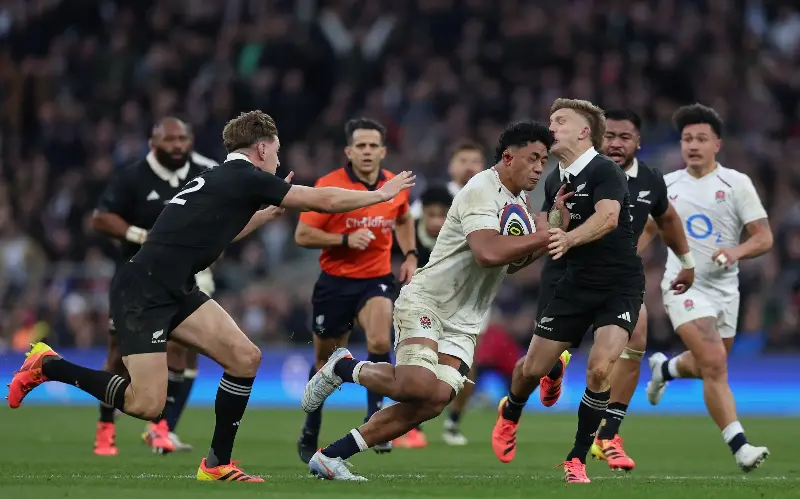
Ellis Genge, Luke Cowan-Dickie, Will Stuart and George Martin are a quartet of front-five replacements who would be the envy of most nations. Against Australia and New Zealand, in particular, the bench’s arrival signalled the arrival of the match’s playground bullies: brutal, belligerent, boisterous. Adding in the dynamism of Fisilau and Henry Pollock, they might not have the raw heft of a South African bomb squad, but they are not far off adding as much materially.
Midfield melodies
Borthwick’s post-match comments on England’s attacking progress were intriguing. The head coach cited the 2025 Six Nations, when England finished second, a point behind France, as the start of the offensive revolution. That was also the campaign when Fin Smith was trusted to take over the No 10 jersey from principally Marcus Smith but also George Ford.
“The attack has been building well for a period of time,” Borthwick said after the victory over New Zealand. “In 2025, we were second for tries scored in ‘tier-one’ rugby and that Six Nations is where it built from; it was the second-highest tally England had ever scored in the championship, that year.”
Evidently, Borthwick believes the foundations were laid in 2025 but, if that were the case, they were dug up in the 2026 Six Nations – until the championship’s latter stages. England looked like they had regressed with the ball after the highs of the past 18 months but now, particularly in the midfield, they look like a side reborn.
Fin Smith, Seb Atkinson and Henry Slade have only started a handful of Tests together but their relationship already looks symbiotic. Fin Smith’s pass selection is as good as any in the world game; Slade’s timing and instinct in attack are similar. As a trio, Atkinson ties it all together with muscularity and a deft touch.
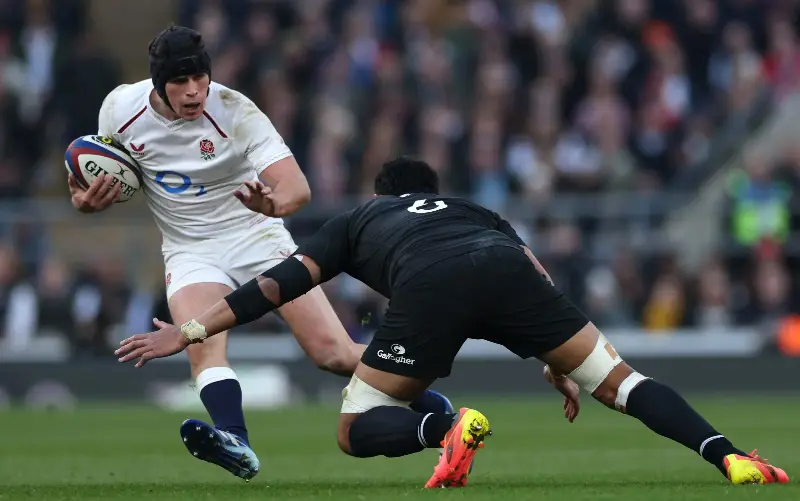
The jury had still been out on whether the Gloucester centre was the man to wear the No 12 shirt for England but his display against the All Blacks, opposite the great Jordie Barrett, more than quelled any doubts. There was one piece of Atkinson handling, early on, with England on the attack, which must rank as his finest moment in an England jersey.
Borthwick is pleased with England’s attack, citing the 2025 Six Nations as the genesis of its development. While that might be true, Lee Blackett, the current attack guru, did not join full-time until six months later.
Blackett blueprint
Borthwick deserves credit for identifying talent. On the 2025 England tour of Argentina, where a depleted squad whitewashed the Pumas in a two-Test series, the head coach summoned both Blackett and Byron McGuigan, now a defence coach with England, as temporary staff members.
Temporary quickly became permanent. Borthwick saw the effect the duo had on the squad, both on and off the training paddock, even with a host of talent missing with the Lions in Australia.
Blackett’s arrival was met with delight by England fans, but their impression during the 2025 Six Nations was that the attack coach was not being given enough time to work his magic. Sources close to the camp insist that those impressions were misplaced but, whatever the truth, England’s attack has started to sing this autumn.
The midfield harmony above, with Fin Smith linking so well with Atkinson and Slade on the wrap-around, to manoeuvre outside defences, has been inspired. Wings Will Joseph and Cadan Murley have slipped in seamlessly, too, without the injured Feyi-Waboso and Freeman, and George Furbank is a true virtuoso at full-back. Freddie Steward has looked like a different player for Leicester this season and is pushing Furbank all the way yet the Saint is still preferred.
With Blackett, often, the devil is in the detail.
“In the second half, we took our opportunities much quicker and better, restricting New Zealand’s opportunity to try and take our breakdown ball,” Borthwick said. “That was an adjustment the players made. Our carry was better in the second half. Our bench had a big impact – that was evident.”
Blackett has significantly influenced the direction and angle of England’s carrying. England want their carriers travelling in a way that forces the opposition defence to work hard around the corner, allowing their subsequent phases to quickly get on the outside. Those are the “adjustments” to which Borthwick might refer.
There is no doubt that England have taken strides forward this autumn but, next Saturday, against the same opposition, not only can Borthwick’s side make history, but they can ensure a 100 per cent November record in their final Southern Hemisphere challenge before next year’s World Cup.