



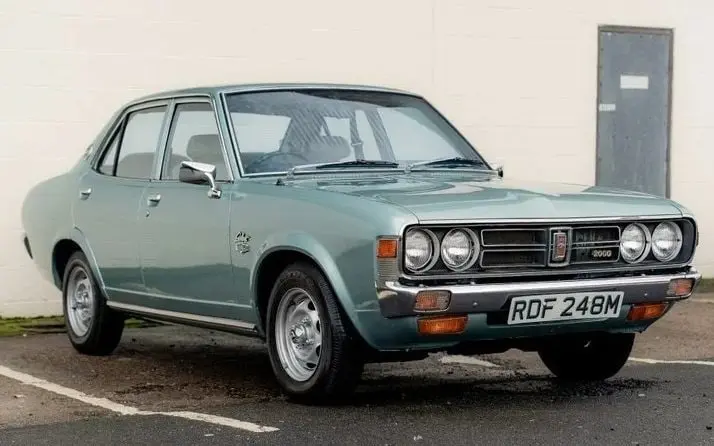
In the early 1970s, the increase in the number of Japanese cars on UK roads was causing alarm within the British motor industry.
By 1974, the Gloucestershire-based Colt Car Company hoped the Galant 2000 GL would tempt Ford Cortina 2000E owners into buying their first Japanese car. Now, 52 years later, the Tahitian Blue example listed for sale by owner, Ashley Bellamy, is believed to be the sole remaining.
In 1974, Michael Orr, formerly BMW’s national sales manager, undertook a fact-finding mission in Japan. On Sept 6, 1974, Mitsubishi announced that it would import cars to the UK. The concessionaire was jointly owned by David Blackburn, the former chairman of BMW GB, and Mitsubishi, with Orr as its managing director.
Visitors to the 1974 London Motor Show could see the Colt line-up on Stand 103. There were initially only two ranges sold in this country: the Lancer, to rival the Ford Escort Mk2 and the Vauxhall Viva HC, alongside the larger Galant competing in the Ford Cortina market sector. The concessionaire also dispensed with the Mitsubishi name for the UK market, as the public then associated the brand with television sets.
The original A50-series Galant debuted in 1969 as Mitsubishi’s alternative to the Datsun Bluebird and the Toyota Corona, followed by the second-generation A112-series in 1973. By then, it was assembled in Australia, a traditional overseas market for British cars, a further cause for alarm at British Leyland and Ford.
The Galant had a complicated range in Japan, but Colt imported only the saloon, in 1.6-litre or 2.0-litre forms, a 1.6-litre estate and a rather stylish 2.0-litre coupé. At 13ft 9in long, the Galant saloon was slightly smaller than a Cortina, although the brochure worryingly assured motorists that “if you get inside, you’ll stay there”.
However, Colt dealers faced two challenges with the Galant. Firstly, Mitsubishi was a comparatively late arrival in the UK market. Daihatsu may have had a false start in 1965 with the Compagno, but Toyota, Honda, Mazda and Nissan (using the Datsun brand name) were already well-established.
Secondly, by the mid-1970s, Sterling’s weak performance against the Yen made the Galant 2000 GL a fairly expensive car. At £2,097 in 1974, it cost £37 more than the Cortina 2000E, £18 more than the Humber Sceptre and £159 more than the Triumph Dolomite. As for other foreign cars, the Fiat 1800 GLS was £1,989, the Lancia Beta 1600 cost £1,963 and its Japanese rival, the Mazda 929, was far cheaper than the Colt at £1,699.
Against that, a Colt dealer could rhapsodise over the Galant 2000’s 105mph top speed and overhead-camshaft Astron engine. The sales copy boasted that it was “like nothing you’ve ever driven before”, implying that those who wanted something a little wilder should immediately book a test drive.
Then there was the Colt’s array of fittings, including a five-speed gearbox, adjustment for the steering column and driver’s seat tilt and lumbar support, rear head restraints and an overhead console containing map-reading lights and a radio. Not to mention “scientifically placed” instruments in a fascia clad in the finest woodgrain-effect plastic money could buy.
Almost all of such fittings would now be taken for granted on a family car, but 52 years ago a light to medium-sized saloon with a radio as standard was luxury indeed. Those who rant about the “good old days” conveniently forget the Pinteresque silences that punctuated a long car journey with no access to BBC Radio 4.
Colt Cars sold 2,980 vehicles by the end of its first year of trading and it had more than 150 outlets by early 1976. “The reason is very simple. We sell cars that people want to buy,” they said.
So, why not inquire about a Colt dealership in your locality, as “a chance in a lifetime doesn’t happen every day”?
Autocar, meanwhile, noted that Japanese cars had proved successful in Britain “more so, perhaps, than anyone would have predicted even as late as 1970”.
That year, the A120-series Galant (sold in the UK as the Sigma) replaced the A112. By 1984, Mitsubishi was using its own name in this country, and the car became a member of its heritage fleet. Bellamy praises its transmission and smoothness, although he finds that some people confuse it with other Japanese marques.
But then, a car with “scientifically placed” instruments was always going to be a vehicle for the cognoscenti.
It is for sale at Car and Classic.
We use howmanyleft.co.uk for stats on surviving examples, but some cars present more of a challenge than others, so the figures are rarely authoritative.
Some pre-1974 records were lost before the DVLA centralised the process, while some cars have their model type misnamed on the V5 registration documents.
A further issue is the omission of the exact model name or generation or distinction between saloon and estate body styles.