



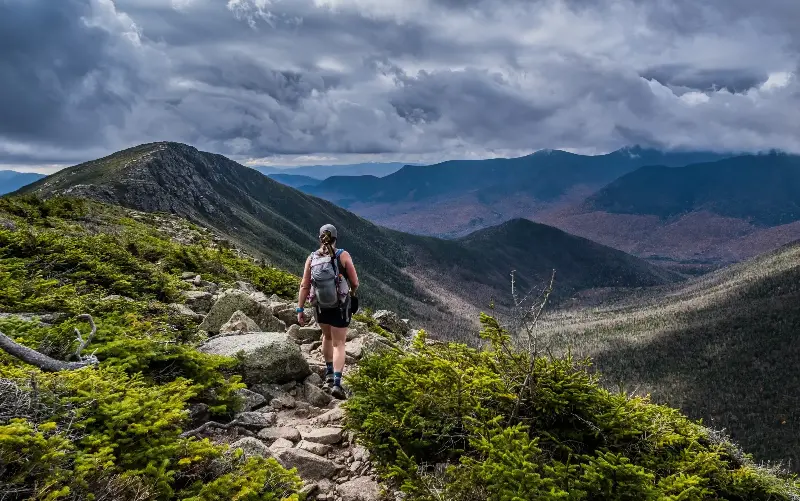
“I’m hiking and being stalked by deer,” I texted a friend while one of the creatures in question cocked an ear and fixed me with an intense stare. I then followed up with half a dozen photos of awe-inducing raptors and river rapids framed by the lilac blossoms of the paulownia tree.
I desperately needed some positive reinforcement from my pal because, after walking uphill continuously for two hours, I was close to giving up. Even the mosquitoes buzzing around my head couldn’t persuade me to keep moving. So I sat down on a rock at a crossroads, got out the turkey sandwich I’d bought that morning and checked into life at home.
Welcome to the Appalachian Trail, a gruelling footpath spanning 14 eastern US states that’s earned cult status thanks to its exceptionally difficult terrain. Distance is actually the least of it for the few thousand “thru-hikers” who attempt the whole 2,100-plus miles each year.
The trail runs along the ridge crest of the Appalachian Mountains, and navigating each climb and corresponding descent is equivalent to scaling Everest a whopping 16 times, says the Appalachian Trail Conservancy (ATC), dedicated to maintaining the route.
Depending on where and when you start, you might encounter both spring snowstorms and stifling summer heat in a single season. You might also encounter black bears, poisonous spiders and venomous snakes. All the while, you’re weighed down by clothes, camping gear and days’ worth of food and water.
I’m not hardy enough for all that, nor did I have the six months required to complete the trail. Still, I wanted a taste of the experience, which was how I came to be sitting on that rock, close to exhaustion, in West Virginia. The Mountain State’s stretch of the trail is just four miles long, but it’s considerably harder than it sounds.
Earlier in the day, I had started my walk in the flood-prone flats of Harpers Ferry, a historic town just an hour and a half by train from Washington DC. The settlement sits at the confluence of the Potomac and Shenandoah rivers, where it’s overlooked by bluffs from both sides. History buffs might know it as the place where Thomas Jefferson stood in 1783 and declared the view to be “perhaps one of the most stupendous scenes in nature”. It was also where John Brown, a radical abolitionist, tried and failed to start a slave rebellion in 1859, a catalytic event for the American Civil War.
As I followed the trail that cut through town and up to the rock where Jefferson made his announcement, I couldn’t help but hum John Denver’s 1971 folk classic Take Me Home, Country Roads, which describes the state as “almost heaven”. In that moment, it was hard to reconcile the gorgeous view of the Shenandoah in front of me with West Virginia’s portrayal in pop culture – which is almost always ghoulish.
Films such as the 2003 horror Wrong Turn, for example, present the state as deeply inward-looking, where outsiders might be stalked and attacked by hillbillies. Meanwhile, local legends of mythical beasts such as the Mothman, a winged humanoid creature that spells doom, have inspired numerous book and film franchises.
And then there are the TikTok videos in which Appalachian natives recount spine-chilling encounters in the woods and preternatural noises coming from the trees.
“Growing up in the holler, there are rules,” says content creator Allie Cheyenne in one of her videos. “If you hear someone call your name, no you didn’t; if you see something in the tree line, no you didn’t. And never whistle at night.”
The supernatural stuff is nonsense of course, but West Virginia is disturbingly remote. And once you’re in the woods, it’s easy to see why people become spooked. In the morning, the forest is alive with bird song, which slowly evaporates with the heat of the day. This is when you become aware of the noises the trees make, which sound like an amplified version of soft drink bubbles bursting. Sometimes the sound suddenly drops, and an unease creeps in with the dead silence that follows. More than once I heard a rustle in that silence, and clapped my hands like a mad woman in case it was a bear or another predator. It was always a startled squirrel.
There are plenty of other hazards for hikers, so I detoured to the ATC’s visitor centre for some advice before venturing into the forest. A couple of early-season thru-hikers were registering their progress when I arrived there. They dumped their kit outside, signed the visitors’ book, had their photo taken next to the ATC sign and then they were off. No one stuck around to chat. Later I learnt from David Tarasevich, the ATC’s visitor services manager, that people often raced through Harpers Ferry because of a four-state challenge where you hike the 45 miles or so connecting Virginia, West Virginia, Maryland and Pennsylvania in 24 hours.
There are many similar feats of endurance on the Appalachian Trail. A few days before my visit, Dale Sanders passed through Harpers Ferry on his way north. He was attempting his second thru-hike at 90 having completed his first at 82. It felt oddly reassuring. Less so was Karel Sabbe, the Belgian ultra-runner who completed the trail in record time in 2018 – just 41 days, seven hours and 39 minutes. It’s wild.
The funny thing is, when Benton MacKaye, a conservationist, proposed the Appalachian Trail in 1921, he never imagined that anyone would walk the whole thing. Instead, he saw the trail as a series of conservation areas where people could reconnect with nature. It was an antidote to that era’s rapid industrialisation.
But the idea had a powerful way of capturing people’s imagination. A group of volunteers worked to bring the trail to fruition. One of the most notable was Myron Avery, a lawyer who surveyed every single section of the trail and founded the ATC to secure its future.
Then, 11 years after the trail’s completion in 1937, Earl Shaffer, an army veteran, became its first thru-hiker. It’s a journey he would repeat twice more, inspiring a whole generation of hikers. In 2025, the trail celebrated its centennial, hitting a record 16.9 million visits. There’s also a wholesome community of altruistic “trail angels” who volunteer their time and resources to support hikers – something I imagine MacKaye would be rather proud of.
As for me, everything was starting to hurt, and checking in with friends just made me yearn for an armchair to flop into. I was about to pack up and go back to my hotel, when I saw someone speed-hiking towards me. I managed to flag him down long enough to ask whether it was worth continuing. “Yes,” he promised. “It’s just another 35 minutes.” I didn’t know it then, but it was just the motivation I needed to complete my hike.
Essentials
Qin Xie travelled as a guest of Travel South. Stay close to the trailhead at the hiker-friendly Quality Inn Harpers Ferry, where B&B doubles start from £66 a night, or at the more upscale Stonehouse B&B in town, where B&B doubles start from £110 a night. Lufthansa, Virgin Atlantic and British Airways all fly direct from London to Washington Dulles, with return fares from £536.