



The steamboat’s horn blasted out, and – our departure imminent – its passengers leapt up in a comically synchronised scramble. A cacophony of pensioners, families, hikers and tourists scattered across the deck like ants, hunting for seats, and as the Stadt Luzern pulled away from the pier, its paddles thrumming into Lake Lucerne’s dark waters, Swiss flags flapped and a toddler clapped.
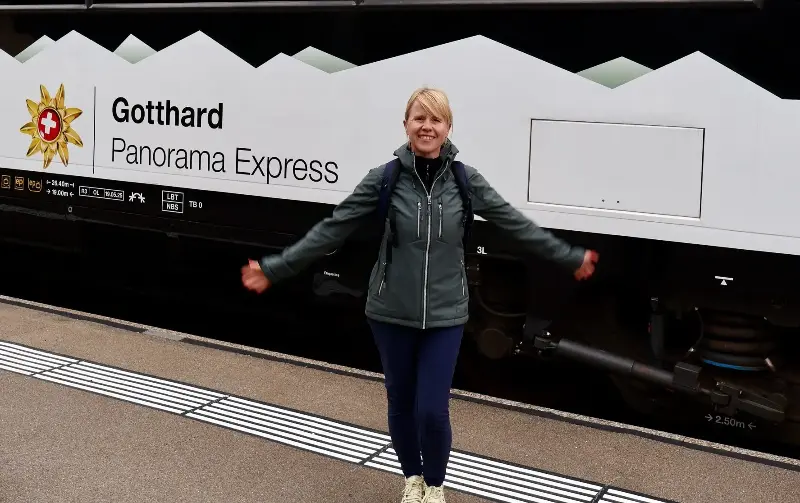
Most travellers dream of crossing the Alps aboard the Bernina or the Glacier Express, but both are so popular that tickets are notoriously hard to come by. With this in mind, I had decided to try an alternative, boarding the Gotthard Panorama Express – a journey that’s part paddle steamer, part train – and tracing an old route from Lucerne to Lugano in the Italian-speaking south. At five and a half hours, there’s nothing express about it – and on a journey with views like this one, that’s a huge plus point.
Gliding across Lake Lucerne, I joined a couple leaning over the rail as water sloshed against the hull. Nobody seemed interested in their phones; instead, fingers pointed towards forested slopes, lush meadows and wooden villages with slender church spires, the landscape unfolding at the pace of the boat. “Imagine living in this scenery,” someone murmured.
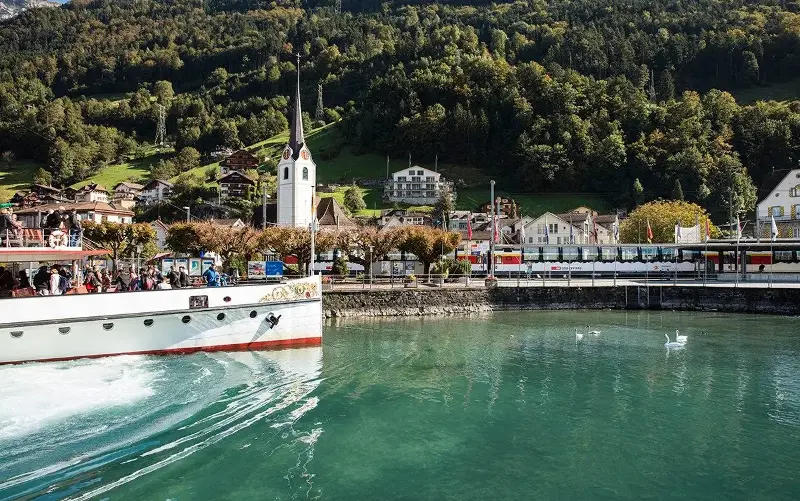
The boat calls at 11 lakeside villages, including Weggis – which Mark Twain described as “the loveliest place in the world” – where steep streets climb beneath Mount Rigi, to the top of which visitors can take a cable car or, instead, disembark at Vitznau’s belle époque pier to board Europe’s first mountain railway. I could easily have spent a day exploring each, but was content to watch them drift by.
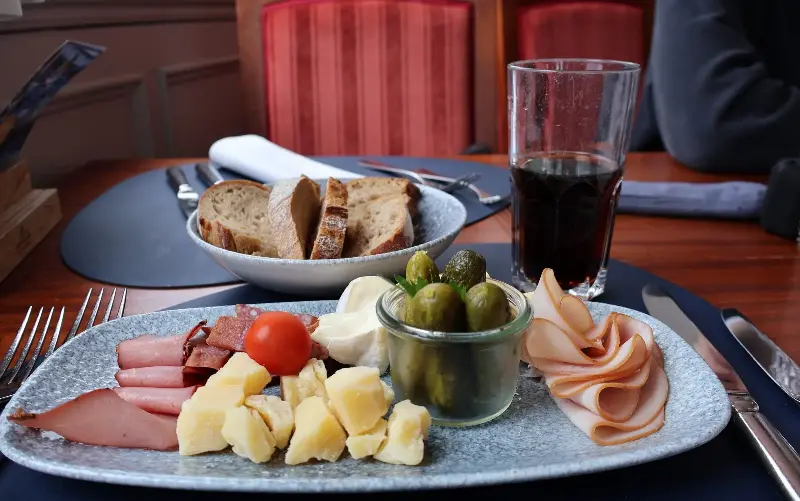
Starting to feel the chill, I followed two chihuahuas in puffer jackets indoors, my cheeks glowing as I paused to watch the boat’s pistons and paddles rise and fall. Their steady rhythm was hypnotic, and for a few moments I forgot about the view. This was impossible, however, when I reached the first-class dining area, sitting down to Swiss cured meats and cheeses (Landjäger sausage, creamy Sbrinz) as the windows around me framed increasingly dramatic scenery, mountains rising steeply from water that had become an intense turquoise.
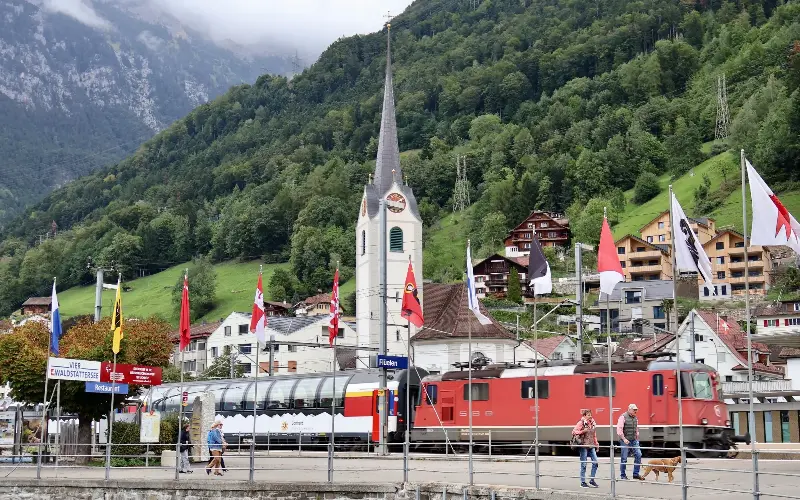
We passed a monument to Friedrich Schiller and a cliffside chapel honouring his hero, William Tell, the Swiss marksman whose story became one of the country’s enduring legends (the route itself was once known as the Wilhelm Tell Express, in fact), then finally came to moor at Flüelen.
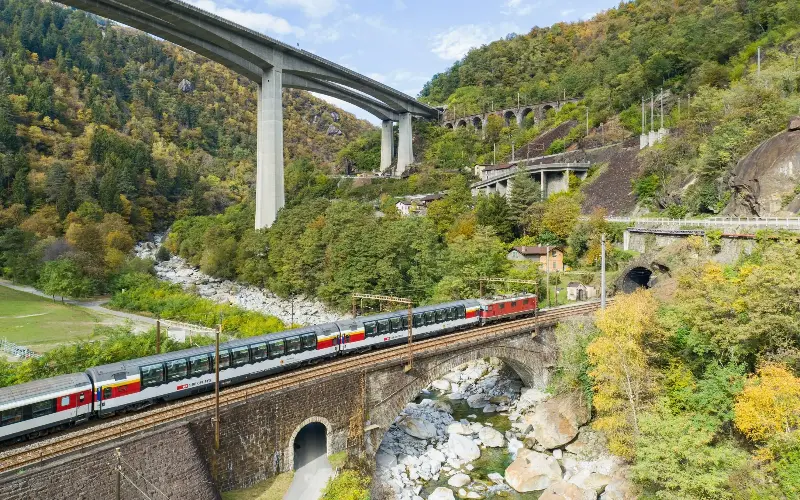
It was only as I disembarked when I realised how accustomed I’d become to the boat’s slow rhythm, one that had lulled me into a calm stillness – which was instantly broken by the loud rumble of the red locomotive as it rushed into the station. This was the next part of my journey: picking up passengers just steps from the pier, absorbing them into its first-class-only carriages filled with wide seats and curved windows, all the better for peering at vertical cliff faces.
Our guide, Eszter, showed me the photo carriage, a feature that the Bernina, crucially, doesn’t have. I couldn’t resist sticking my head out of the window, overjoyed to feel the wind in my hair as I listened to the gentle clickety-clack. Ralf, a rail enthusiast from Leipzig, stood beside me and sighed. “Ah, the sweet smell of the railway.”
All was calm until Eszter announced that Wassen’s famous church was approaching, triggering another mini stampede. The train looped through tunnels to gain height, wheels squealing, while passengers dashed from side to side to glimpse the church three times from three angles. I was so disorientated that I almost missed Xavier, a local standing beside the tracks and waving a Swiss flag as we emerged from the final tunnel.
At Göschenen, Eszter explained that the Gotthard Base Tunnel – the world’s longest, at 35 miles – ran 600 metres beneath us. The modern route from Lucerne to Lugano takes 100 minutes, but we were deliberately taking the old way.
The nine-mile tunnel ahead was completed in 1882, transforming an arduous mountain crossing into a crucial European trade route. Thousands of workers endured brutal conditions; almost 200 died in accidents. Its engineer, Louis Favre, died of heart failure before its completion.
Our train slowed as it entered the tunnel’s darkness, and a warm blast of air rushed through the carriage. All of a sudden, the once constant panorama was gone, and the focus turned inward, to historical footage projected onto the walls: workers wielding axes in the gloom, their labours echoing through the tunnel. Outside, a bronze monument commemorates those who died.
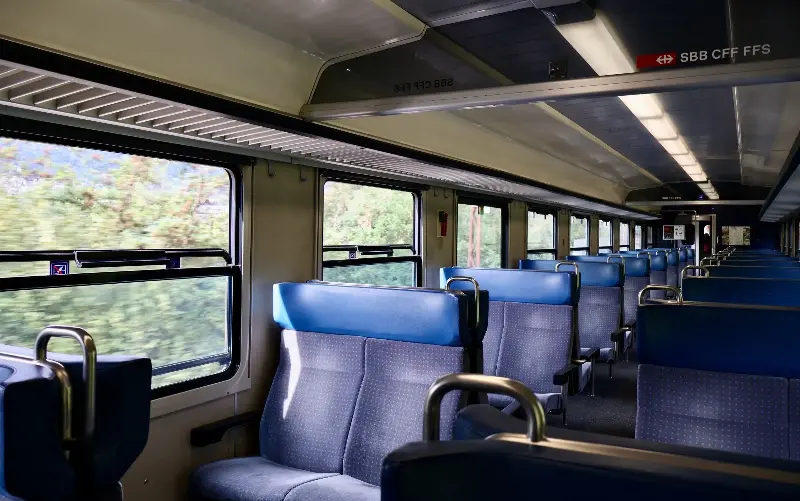
At Airolo, we emerged blinking into the warm sunshine and the valley widened as we descended towards Lugano. In a tunnel near Faido, Eszter hung a Swiss Army knife from the carriage ceiling and, as the train spiralled downhill, it swung outwards with centrifugal force. Yet sitting still, I could barely feel us descending.
Down in the valley the rock faces were streaked with waterfalls, as wooden houses gave way to stucco, and the clonk of cow bells drifted in through the train’s open windows. Then palm trees and Italian church towers announced Bellinzona, with its three medieval castles, before Lake Lugano appeared at last, cypress trees and a Renaissance chapel framing its glistening surface.
It was as if we’d leapt into another country.
At Lugano, a funicular ferried me down into town, where salami hung outside restaurants and cafés spilt onto old streets. I strolled beneath linden trees along the lakeside, watching boat taxis skim towards the Italian hills. After hours of being carried through the landscape, it was refreshing to be ambling within it, occasionally glancing back towards the mountains I’d left behind.
Soon enough I stumbled across a statue of William Tell, arrow in hand, his back to the lake and his gaze towards central Switzerland. I paused and stared up at him. Over the course of my journey, I’d gone from admiring mountains and lakes to thinking about the people who carved routes through them and left their stories behind. Taking the slow route through the Alps had proved there is much to be missed by taking the fastest route.
The Bernina may have snowy peaks and high-altitude views, but the Gotthard Panorama Express tells the story behind the scenery.
Essentials
Swiss flies from most major UK airports, with return fares to Zurich from £111. The Lubo Lucerne has doubles from 190 Swiss francs (£170); the Luganodante in Lugano has doubles from CHF230.
Booked in advance, a Saver Day rail pass with SBB costs from 88 Swiss francs; a mandatory Gotthard Panorama Express seat reservation costs an additional CHF24. Trains run daily from April to October.
Visitors can travel free on public transport and receive discounts at major attractions with a Ticino Ticket when staying overnight at participating hotels.