



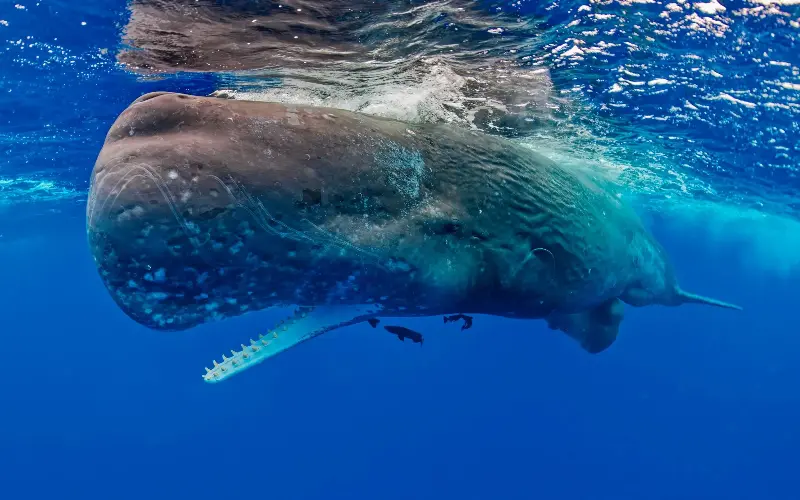
The sounds made by sperm whales are “one of the closest parallels” in the animal kingdom to the language of humans, a study has found.
Unlike humpback whales, whose portamento warble is popular for helping people to nod off, sperm whales communicate through rhythmic clicks known as codas.
Previous attempts to understand their meaning have focused on their timing, as if deciphering Morse code.
But scientists at Project CETI, a non-profit dedicated to understanding the animals, have found that the clicks come in different frequencies, similar to human vowel sounds.
‘Vowels’ come in two types
The vowels come in two types, known as a-vowels and i-vowels, that can rise and fall in pitch, as well as forming so-called diphthong double pitches within one syllable, mimicking languages such as Mandarin.
On the surface, [these vocalisations] sound like this alien, ocean intelligence that has nothing to do with us,” Gašper Beguš, the lead author of the study and a linguist at the University of California, Berkeley, which works with Project CETI, told Scientific American. “But when you actually look at it closely, you realise, ‘Oh, we’re way more similar.’”
Whales descended from creatures that lived on land, then moved back into the sea and last shared a common ancestor with humans around 90 million years ago.
The sperm whale’s brain weighs up to 20lb, the biggest of any species on Earth and around five times the size of a human brain.
Attaching small underwater microphones to 15 sperm whales, scientists collected thousands of recordings over a four-year period to test their linguistic abilities.
Using computer analysis to measure their sound waves on graphs, they identified a-vowels, which have a single resonance peak and tend to be shorter, and i-vowels, which have two resonance peaks.
Similar patterns are present in human speech too, such as Arabic, which distinguishes between vowels based on their length, meaning that delaying a vowel sound can change the meaning of a word.
Creatures may have regional accents
The findings, published in the journal Proceedings of the Royal Society B, suggest that the whales are deciding which type of click to use based on a “highly complex” linguistic system. Although the basis for it remains a mystery, the scientists speculated that the combinations are “highly suggestive” of a language carrying meaning.
Different whale pods also use different types of clicks, suggesting regional accents may exist within the marine mammal community.
“We demonstrate that sperm whale codas not only resemble human vowels acoustically but also pattern like them,” the study said. “[The patterns] have close parallels in the phonetics and phonology of human languages, suggesting independent evolution.
“Sperm whale coda vocalisations are thus highly complex and represent one of the closest parallels to human phonology of any analysed animal communication system.”