



Few airports capture a city’s “vibe” quite like Savannah/Hilton Head International. Step off the jet bridge, and rather than the usual bland hoardings and moving walkways, you’ll see travellers in rocking chairs eating ice cream like they’re on their front porch.
Walk further along the concourse and there are ornate lampposts and indoor park benches, in what looks more like a pretty garden square than a busy air hub. Like the sci-fi gardens that greet visitors to Singapore’s Changi Airport, they hint at the city beyond the terminal, which in Savannah’s case is quaint, welcoming and – like the walk from my plane seat to the taxi rank – easy to navigate on foot.
Though largely unheard of in Britain, this historic harbour town is routinely voted one of America’s best cities by the readers of US publications like Travel + Leisure and Condé Nast Traveler, with its “walkability” frequently cited as one of its unique selling points.
If you’ve ever been to America, you’ll know it can be a faff without four wheels. Even cities with decent public transport (New York, Miami) can be difficult to navigate, while other walkable ones, like New Orleans, are so sprawling you end up cabbing between attractions to avoid blisters.
Savannah, by contrast, feels more like visiting a small British town. Which, of course, it once was.
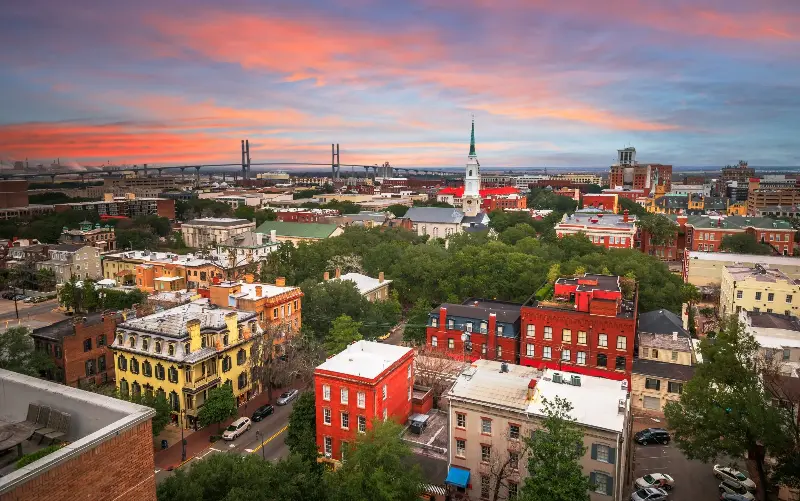
Founded in 1733 as the then-capital of Britain’s thirteenth American colony, Georgia, it still sits on its original checkerboard of garden squares and oak-shaded boulevards, which stretch up from its ballast-stone wharves via cobbles still clip-clopped by horse-drawn carriages. Wander in any direction and you’ll fill a memory card with perfectly framed shots of oil lamps flickering above columned porticos, and “Spanish moss” hanging from the trees.
Quintessentially southern, Savannah is regularly cast in films and TV series. Much of Forrest Gump was shot here, including the iconic park bench scenes in Chippewa Square, while its grand antebellum homes have featured in everything from Martin Scorsese’s Cape Fear to doubling as New Orleans in the 2019 live-action remake of Lady and the Tramp.
These iron-laced beauties are not just pretty extras, though – many have been turned into fascinating museums which bring the history of the city – and America – to life. On a guided tour of the neo-gothic Green-Meldrim House, for instance, I learned how, during the American Civil War, Savannah shrewdly offered itself as a “Christmas present” to the advancing Union army to avoid being burned to the ground like the rest of Georgia. It’s why Savannah still looks like something out of Gone with the Wind, whereas Atlanta – where the story was set – does not.
Curiously, it was beneath Green-Meldrim’s stucco moulding that General Sherman and a group of Black pastors decided the post-war future of America – including whether to repatriate the South’s 3.5 million slaves to Africa.
Other mansions, such as the Owens-Thomas House & Slave Quarters, focus more on the day-to-day realities of antebellum Georgia, from the Regency splendour of life “upstairs” to the toil of life below. It’s fascinating, and my African-American guide didn’t sugar-coat the cruelty of slavery. But neither did she moralise, or minimise the rest of the property’s history.
Savannah’s laid-back like that. Even after the American Revolution, it resisted the urge to rename colonial streets, as Boston did. Its statues of Confederate generals and Founding Fathers also survived the topplings that swept America during the Black Lives Matter (BLM) protests.
The past isn’t rewritten here – it’s remembered, with monuments honouring everyone from the Native American chief who helped the British found the settlement to the Haitian mercenaries who helped the Rebels take it from us.
At the Savannah History Museum, I got chatting to a couple of student-guides dressed in Revolutionary War uniforms, who told me that Savannahians were mostly Loyalists during the War of Independence. They kept me rapt with stories of Rebels tarring and feathering Royalist neighbours, and refugee columns fleeing to Canada.
Later at the nearby First Baptist Church, I was shown where runaway slaves used to hide before making their own escape to British-controlled Canada, with the air holes still visible in the floorboards centuries later.
Intriguingly, Georgia was never supposed to be a slave society. Its first royal governor – and Savannah’s founder – James Oglethorpe wanted to create a colony where destitute Britons could build new lives without competition from unpaid labour. Needless to say, this ban on slave-holding was dropped once his term was over. So, too, was Oglethorpe’s prohibition on alcohol, as I discovered at Common Restaurant, where Deep South fusions such as fried green tomato caprese and short-rib ravioli are served with bourbon cocktails topped with candied bacon.
I stayed a 15-minute walk from the restaurant and the Historic District, at the JW Marriott Savannah Plant Riverside District (doubles from $305/£227, room only), a sprawling Battersea Power Station-like redevelopment home to upmarket restaurants, rooftop bars and pavement cafés. My suite, high above the old turbine room, looked out over the Savannah River, where paddle-steamers search for dolphins, Confederate forts and bald eagles, as families share sticky peach cobbler on deck.
There are more-historic hotels, like Planters Inn (doubles from £115, room only), a four-poster-and-floral-pelmet number built on the site of John Wesley’s old parsonage (the future “Father of Methodism” was one of the colony’s first Anglican vicars).
If you want history and style, Hotel Bardo (doubles from $363/£270, B&B) feels like a Miami beach club despite being in a 19th-century manor (think palm trees, pool bar, and pink-and-green décor). Its restaurant, Saint Bibiana, housed in a former funeral home next door, is “one of the most haunted places in Savannah”, according to my ghost walk guide (you wouldn’t guess it: looks-wise, it’s the least spine-tingling spot in this town of “Addams Family” mansions).
It’s got plenty of competition for the title, however: Savannah claims to be America’s most ghost-ridden city, and each night dozens of tour guides take to the streets on the trail of spirits and spectres, telling gruesome stories about decapitations, disease and duels. How apt, I thought, as we approached our final stop. In Savannah, even the ghosts go on foot.
Essentials
Purely Travel has five nights in Savannah, including flights from Heathrow (via Atlanta) from £1,239pp, room only. If you’d rather DIY a trip, Virgin Atlantic has flights from Heathrow to Savannah (via New York, Boston or Atlanta) from £711 return. The JW Marriott Savannah Plant Riverside District has doubles from £253, room only.