



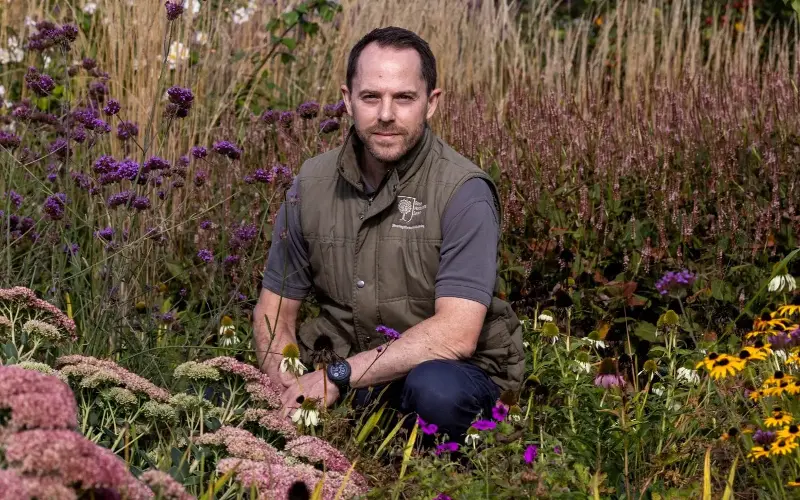
It makes sense to design our gardens to work all year round, says Tom Freeman, garden manager at RHS Hyde Hall in Essex. Especially as our winters appear to be getting milder. “You’ll probably spend sunny winter mornings or afternoons in the garden,” he says. “If everything is cut back in the autumn, there’s nothing to look at and appreciate.”
With our climate on the change, autumn is the perfect time to start planting your winter garden.
“Historically, we’d have done most of our planting in April, May and June, but we can’t do that now,” says Freeman. “Because we’ve had such dry springs the past few years, we look at autumn instead when the soil is much more reliably moist.”
However mild our winters appear to be getting, you still need to select plants to withstand rain, wind and sudden cold snaps. While Freeman says that favourite “good doers”, such as the colourful stems of dogwood (cornus), white-barked birch such as Betula utilis ‘Jacquemontii’ and black grass Ophiopogon planiscapus are stunning staples for a winter garden, he suggests you think outside the box too. There is a huge variety of plants to experiment with, as suggested in the RHS Garden Almanac 2027 and as reflected in Hyde Hall’s own winter garden, which opened in 2018.
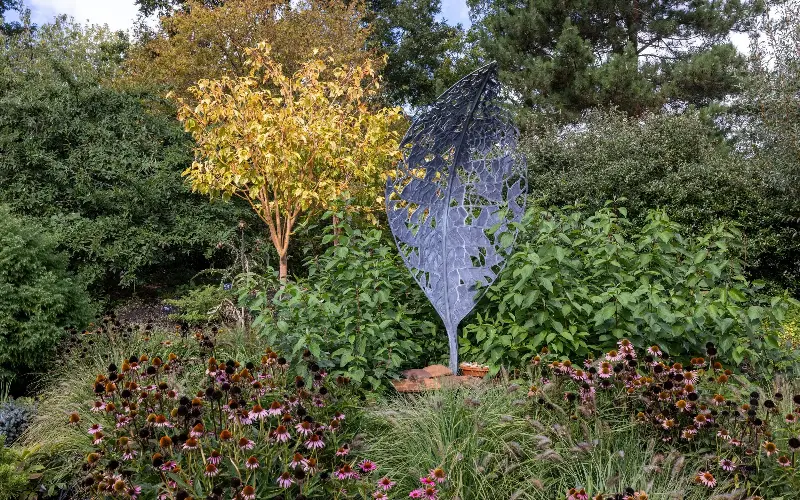
“We wanted to do something a bit different; we didn’t want to copy what other gardens were doing. We wanted to push the boundaries on what people’s perceptions are of what looks good in the winter,” says Freeman.
They began by drastically changing the topography of the site selected for the winter garden. Hyde Hall sits on clay in an exposed site in one of the country’s driest counties and the spot chosen for its new garden was an uninspiring flat hay meadow open to the weather. So the team altered the terrain by taking topsoil from an adjacent field to create an undulating landscape of 6,300 sq m, with mounds of up to about 2.5m high.
“It allowed us to be much more creative and the elevation allows more of the planting to be seen. We placed trees and shrubs on the top to highlight their winter structure with the low sun backlighting them. At the low points, we concentrated on herbaceous planting that gives views across to other parts of the garden.”
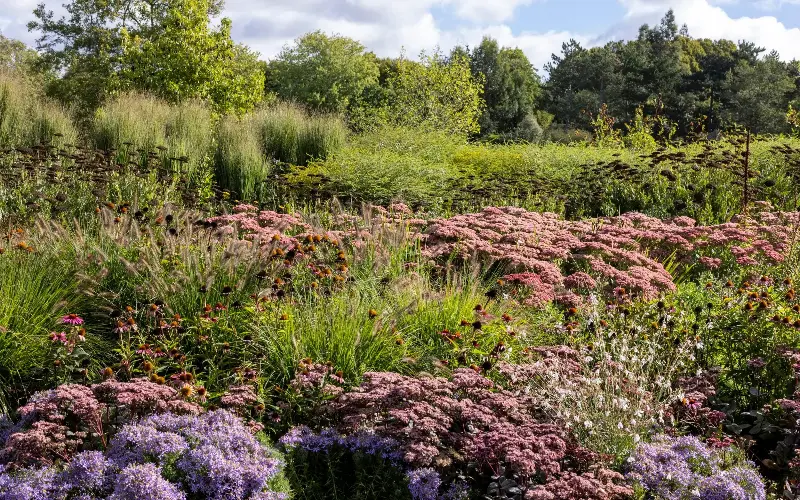
The dips protect the more tender plants from harsh weather and provide a moister soil for those that need it, such as the garden’s sedge ornamental grasses Carex ‘Ice Dance’ and Carex oshimensis ‘Everillo’; and the semi-green perennial Acorus gramineus ‘Ogon’.
A winter garden should start with trees, even planting just one in a small garden will provide structure, says Freeman. Hyde Hall focused on stem colour and texture, with multi-stemmed Prunus serrula, which has a coppery bark; the orange bark of Prunus maackii ‘Amber Beauty’; and Acer griseum’s peeling bark. It added an array of coloured birch cultivars, such as ‘Hakkoda Orange’, ‘China Rose’, ‘Pink Champagne’ and ‘Red Panda’. Tilia cordata ‘Winter Orange’ is pollarded each year for the orange stems of its young growth. Deciduous species look good against a low winter sun, such as the contorted branches of Betula pendula ‘Spider Alley’.
Hyde Hall introduced crab apple trees known to hold on to their fruit, such as Malus ‘Adirondack’ and Malus ‘Evereste’, which, along with medlars and berries, offer variety and food for wildlife.
Do not forget your evergreens. Sally Newbrook, formal ornamental team leader at RHS garden Rosemoor in Devon, whose winter garden has been redone by designer Jo Thompson, says it is a common misconception that evergreens are a must-have but dull winter staple to fill in the gaps. If you select the right species, they are far from an uninspiring blob, she says.
“A well-positioned evergreen shrub or tree, like an early flowering rhododendron or sweetly scented Christmas box (Sarcococca confusa), will over time add natural structure with rich green leaves that act as a wonderful backdrop for other vibrant plants,” says Newbrook. “Some grow in interesting shapes like weeping Xanthocyparis nootkatensis ‘Pendula’ (cypress), others have textural leaves that change colour like Cryptomeria japonica. Some are showstoppers like Daphne bholua ‘Cobhay Purple Clouds’, covered in richly scented, vibrant flowers through January and February.”
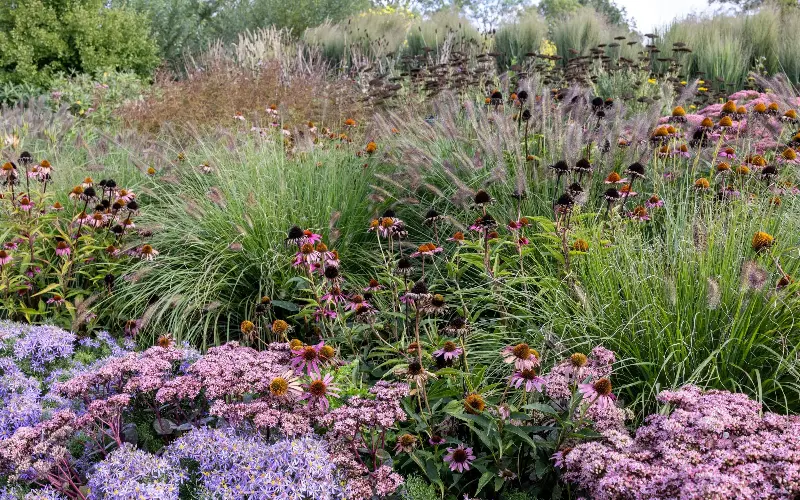
Hyde Hall allows the seedheads of herbaceous perennials to carry on until March for visual appeal and to provide food and shelter for wildlife. Glycyrrhiza yunnanensis’s spiky seedheads turn from green to purple to brown through winter; Echinacea purpurea ‘White Swan’ has dark cones that are eye-catching when covered in frost; while the foliage of evergreen perennial Bergenia ‘Eroica’ turns red in the colder months.
Thinking outside the box includes viewing plants in a new way.
“We positioned a rose called Rosa sericea ‘Pteracantha’ on top of the mound where the sun comes round. It has red winged thorns on the younger growth, so we coppice it every year. Because we cut it down to the ground every year, this rose never flowers; we planted it just to appreciate the thorns,” says Freeman.
Movement and scent are must-haves for the winter. Ornamental grasses give the former, including the tried and tested Calamagrostis × acutiflora ‘Karl Foerster’ and Stipa tenuissima. Viburnum farreri ‘Farrer’s Pink’; Viburnum × bodnantense ‘Charles Lamont’; and Chimonanthus praecox (wintersweet) have powerfully scented flowers.
Last but importantly, are your sculptures. Hyde Hall’s trilogy of sculptures by David Watkinson walks you through the winter garden with the slow decay of a leaf in three stages. If you cannot run to buying a piece, make your own. Hyde Hall’s garden team fashions sculptures every year from pollarded willow cuttings. It encapsulates the garden’s focus on thinking creatively, says Freeman.
“We do something different each time. We’ve produced flowers with rising stamens, butterflies, dolphins, even an octopus. Last year, we made a barn owl, a bat and a snail. It’s probably my favourite part of the winter garden.”
The RHS Garden Almanac 2027 by Zia Allaway and Guy Barter, £14.99, Francis Lincoln