



I’m sitting in a handsome wooden hut in Slovakia’s High Tatras mountains, demolishing a big plate of venison stew, and washing it down with a crisp, cold beer. It’s barely noon, but I’ve already built up a ravenous appetite – a couple of hours hiking are behind me and several more are ahead.
My destination is another of these rustic chalets – or chaty, as Slovaks call them – only a few miles away but nearly 1,000ft above. My current altitude is 4,413ft (1,475m), over 400ft higher than Britain’s tallest peak, Ben Nevis. After lunch, I’ll be walking onwards (and upwards) to Skalnata chata, at 5,744ft (1,751m).
I’m no fitness fanatic – about average for my 60 years, I guess. I’ve got dodgy knees, high cholesterol and a lousy head for heights. But as I stride towards the summit, I feel fantastic – 10 years younger, at least. Locals tell me it’s the mountain air. I think they may be right.
I first heard about the High Tatras mountains two years ago on a trip to Bratislava, the Slovak capital. I had a great time, but it was the people who made it special – warm, welcoming, and full of fun. “If you like Bratislava, check out the High Tatras,” they urged.
It’s Europe’s last undiscovered wilderness, they told me – home to eagles, lynx, wolves and bears. The entire region is a nature reserve, with 373 miles of footpaths and no roads. There are a dozen mountain lodges, which are only accessible on foot, and where you can eat or stay overnight, yet there’s no need to rough it.
There are some grand old hotels in the valleys, ghostly remnants of Slovakia’s Habsburg past. It was those grand hotels that convinced me (I like hiking, but I like my creature comforts even more). I opted for a four-day trip. I had a hunch it would be a real adventure.
Hot springs and grand hotels
My local guide, Lucia, met me at Poprad’s compact airport. On the short drive into town, she told me more about the High Tatras. There’s some skiing in the winter, but summers are getting busier. Time was, most hikers were Slovaks, but now more foreigners are discovering this untainted biosphere, a Unesco World Heritage Site because of its rare flora and fauna.
Poprad’s antique old town is a quaint relic of a bygone age. We stopped off for coffee in the cobbled square – “1611” read the sign outside the café. The surrounding buildings looked even older. We drove on to a sleek water park called AquaCity, fed by Poprad’s hot springs. The building is bland and functional, but the ambience was charming: Slovaks of all ages, splashing about in balmy, bubbly thermal pools.
Lucia dropped me off at the Grandhotel Starý Smokovec. Have you ever seen Wes Anderson’s wonderful movie, The Grand Budapest Hotel? If you have, you’ll be able to picture the romantic aura of this majestic, melancholy landmark. Unlike a lot of grand hotels, it’s not remotely stuffy, yet my bedroom was palatial. I felt at home straight away.
After lunch at Koliba Kamzík, a folksy restaurant just down the road, I visited the Sherpa Caffe for a big mug of Kofola (Slovakia’s answer to Coke or Pepsi) and started talking to the proprietor, Stefan Backor: sherpa, park ranger and member of the mountain rescue team (“If you want to live here in the mountains, you have to have two or three jobs,” he explained). Stefan’s cosy café doubles as a makeshift museum, honouring the region’s sherpas (aka mountain porters).
“We are the last community of mountain porters in Europe,” said Stefan, proudly, as he showed me photos of his hardy colleagues lugging back-breaking loads up dizzy mountain paths. Since there are no roads, all provisions and equipment must be carried to those huts on foot, a task requiring the strength of a weightlifter and the balance of a ballerina. I got to bed early, in preparation for my own (much easier) hiking.
Into the mountains
After a big breakfast, I boarded the funicular, right outside my hotel, to Hrebienok, the starting point of my hike. I walked through a rocky ravine, following a cascading river, stopping off at Rainerova chata, the oldest hut in these mountains, built in 1863.
I stocked up on protein bars and bottled water, and headed on up a steep stone path, past a roaring waterfall, to Zamkovského chata, named after the man who built it during the Second World War, a mountain guide called Stefan Zamkovsky. When the communists nationalised these huts after the war, Zamkovsky was evicted and exiled from the land he loved. His bucolic refuge has outlived that cruel regime.
I doubled back to Hrebienok and spent the night at Bilíkova chata. It’s smarter than most of these mountain huts, with en-suite bedrooms rather than hostel bunk beds, but was still really atmospheric. After a hearty, meaty supper I staggered upstairs to bed and fell asleep while it was still light.
The next morning, I retraced my steps to Zamkovskeho chata. You see so much more when you walk the same route a second time. Now came the most demanding, and thrilling, part of my trip. I zigzagged up and up, crossing several bridges that straddle gushing waterfalls, until I reached a path that hugs the mountainside, with marvellous views over the green plains far below.
After an hour or so, I reached Skalnata chata, my final destination. I went in and warmed my hands over a cup of coffee. There’s a colourful display around the walls of this simple hut, commemorating the pioneering women who’ve scaled these peaks, dating back to the 16th century.
I caught the cable car down to Tatranska Lomnica, a jumble of Belle Époque villas and communist apartment blocks, half-hidden amid a nest of trees. After a scrumptious lunch at Humno – sheep’s cheese, crispy bacon and spring onions, a local delicacy – I visited the town’s chic little Ski Museum. It’s full of fascinating artefacts from the golden age of winter sports, and lots of evocative old photos. Those old-timers had a hard life, but they knew how to have a good time. I boarded the train back to Stary Smokovec, returned to that slightly spooky grand hotel, soaked my aching legs in the homely spa and slept like the dead.
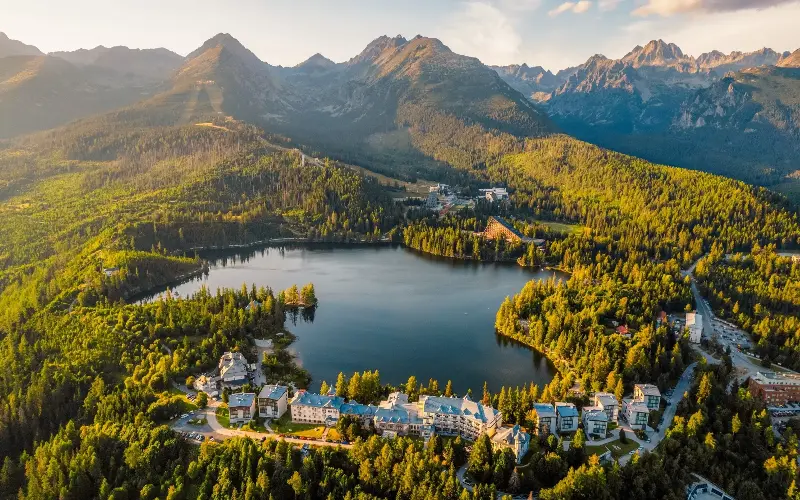
On my last day I headed west to Strbske Pleso and checked in to the Grand Hotel Kempinski. The town is underwhelming, a mishmash of modern high-rise, but the hotel is glorious, a Jugendstil mansion beside a languid lake with forest all around.
I took a walk around the lake, then swam a few lengths in the hotel’s lakeside pool, which looks out across the cool, still water and the barren snow-capped peaks beyond. I closed my eyes and imagined myself back in the mountains.
When I went outside again at dusk, the lake was shrouded in mist. You couldn’t even see the water. As I headed out into the twilight, I encountered two deer, grazing contentedly on dandelions. They took no notice as I walked past.
How to do it
Fly from London Luton to Poprad-Tatry with Wizz Air.
Doubles at the four-star Grandhotel Starý Smokovec from €165 (£140), including breakfast and passes to local cable cars. Doubles at Bilíkova chata from €119 (£101), including breakfast. Doubles at the five-star Grand Hotel Kempinski High Tatras from €300 (£255), including breakfast.
Download the free mapy.com app to track your route on all the hiking trails, but also take a paper map, in case your mobile misbehaves. Take wet-weather and cold-weather clothing, food and water, and tell someone where you’re going. All the routes I walked were well signposted and well maintained.
For more information, visit regiontatry.sk.