



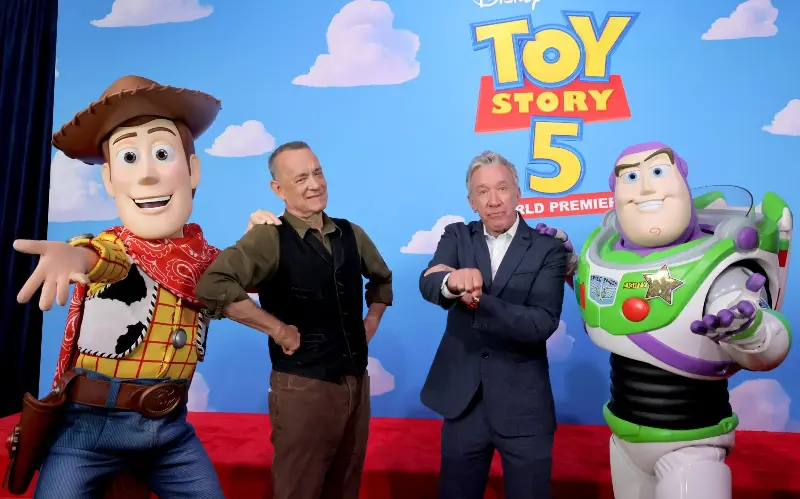
Tom Hanks has suggested he could be replaced with AI in future Toy Story films.
The double Oscar-winner, who has voiced cowboy Woody since the original film in 1995, said advances in the emerging technology could mean sequels of the popular franchise are produced without his input at all.
Speaking about the possibility after he reprised his role for Toy Story 5, which opened to a franchise record of $300m (£227m) in ticket sales globally, Hanks told Entertainment Weekly: “Time is undefeated. The question would be whether or not we could cobble together some version of me.”
He added: “Every word we have ever recorded in time in Toy Story is on digital media somewhere, so they could put together anything they would want.”
Discussing the possibility of future adaptations after the fifth iteration’s success, the American actor said: “If you’re gonna do another ‘Toy Story,’ it better be worthwhile.
“It better be great. You better be examining some theme that is not just dragging it out because people like the title.
“I mean, it is a huge corporate business without a doubt, I’m not gonna discount that. But unless it’s good, new, fresh, there’s no reason to do it at all.”
The studio has access to all of Hanks’s voice recordings over the last 31 years, meaning AI could use this input for a new speaking role without the actor’s participation, he suggested.
His Toy Story co-star, Tim Allen, who plays Buzz Lightyear, agreed the idea of this being done without their input was “a scary thought”.
Hanks has previously expressed concerns about the technology’s effect on the film industry, which was also a critical issue during the Hollywood actors’ and screenwriters’ strikes.
Actors are fearful that AI could be used to generate their likeness without permission, something that the Forrest Gump actor has experienced first-hand in a fake AI-generated dental advertisement starring him in 2023.
At the time, he warned his fans on Instagram, saying: “Beware! There’s a video out there promoting some dental plan with an AI version of me. I have nothing to do with it.”
Bruce Willis, who is living with frontotemporal dementia, became the first Hollywood star to sell his rights to allow a “digital twin” of himself to be created for use on screen.
Hanks said that the industry “saw this coming” as early as the 2004 animated Christmas film The Polar Express.
He explained: “We saw this coming, we saw that there was going to be this ability to take zeros and ones from inside a computer and turn it into a face and a character. That has only grown a billion-fold since then and we see it everywhere.
“Anybody can now recreate themselves at any age they are by way of AI or deepfake technology. I could be hit by a bus tomorrow and that’s it, but performances can go on and on and on and on.”
In an interview with Adam Buxton, the comedian, in 2023, Hanks added: “Outside the understanding of AI and deepfake, there’ll be nothing to tell you that it’s not me and me alone.
“And it’s going to have some degree of lifelike quality. That’s certainly an artistic challenge but it’s also a legal one.”
The latest iteration of Toy Story depicts a toy-vs-tech narrative amid a rise in screen-time addiction for children and teenagers.
The film, directed by Finding Nemo’s Andrew Stanton has been described by Pixar as the story of “toy meets tech”.
Its official description reads: “Buzz, Woody, Jessie and the rest of the gang’s jobs are challenged when they’re introduced to what kids are obsessed with today... electronics.”
While the franchise has grappled with the big questions of human life and purpose, it has not previously tackled the timely and growing concern about children and technology.
In May, the Academy of Motion Picture Arts and Sciences banned performances and scripts produced by AI from its awards in an attempt to protect the film industry.
The decision was partly fuelled by the posthumous use of an AI-generated likeness of Val Kilmer in As Deep as the Grave, a forthcoming Western.
Another instance of emerging technology using an actor’s likeness was during the production of Fast and Furious 7, following Paul Walker’s death in 2013.
His scenes were posthumously completed using CGI and his brothers, Caleb and Cody, as body doubles.