



The sound of a trickling stream was interrupted by a wooden shutter creaking open. “What are you doing here?” a puzzled lady asked from her balcony.
A few minutes later, another window-peerer asked me the same question. I had now met almost half the population of Aldeanueva de Cameros.
Its five inhabitants have to themselves a hamlet which looks plucked from a fairy-tale: a miniature stone footbridge over a brook; daisy-dappled grass; a chapel, emerging from the end of a tree-lined path directly in the fold between two mountains.
But the Iregua Valley is a shape-shifter. To get here, we had passed red, craggy rock formations which looked as if they belonged in Arizona. Vultures had soared overhead.
“I always ask myself: ‘Do I show people this place? Do I not?’ It’s an internal debate,” said my guide, Juan Arguisjuela, as we wandered back to the car. After a few days in La Rioja, I felt much the same.
Empty Spain
La Rioja is Spain’s least-visited region, with less than one per cent of British holidaymakers to the country venturing into it last year. It is also the smallest of the nation’s autonomous communities, and best known for its wine production, with the Rioja wine region covering around half of La Rioja, but also bleeding into neighbouring Navarre and the Basque Country.
To say that La Rioja can be understood without its viticulture would be to lie, so it makes sense that those tourists who visit do so largely to sample this famous export. But those who descend upon its wineries are mostly merrily oblivious to what lies beyond the vineyards.
That is not the sole reason for Aldeanueva de Cameros’ quietness, though. Across “empty Spain”, over 3,000 villages have been left deserted by rural depopulation. Most of these stone houses had nobody to swing the shutters open and grumble that some tourist was photographing the footbridge again, nor did any curtains twitch in its single guest-house.
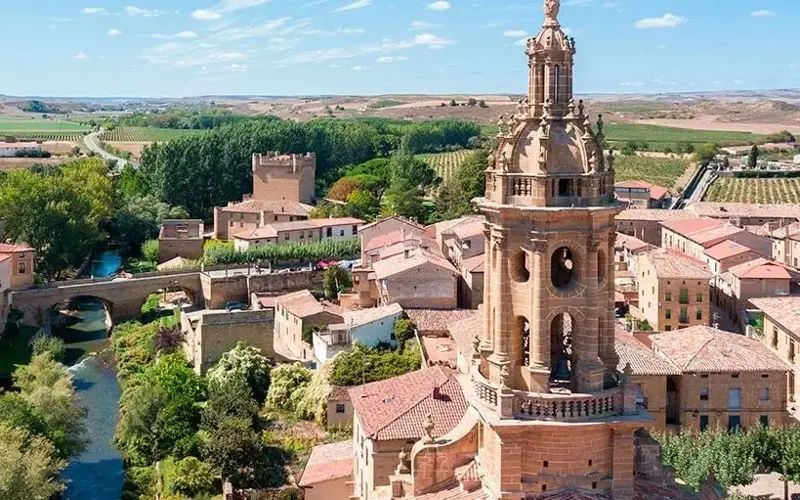
Things could not have been more different on my arrival in Cuzcurrita de Río Tirón. Its square was bustling as locals and visitors, after a day touring the bodegas, danced to a crackling sound system and ordered hastily from the village’s only open bar.
The baroque church glowed orange in the sunset, and kids with firecrackers zipped around flirting teens and two-stepping pensioners.
Unlike Aldeanueva, this place sits firmly within the wine lands. “Wine tourism has pretty much been our salvation”, said Jaime del Val Gutiérrez at his restaurant in Haro, Rioja wine’s main hub just a few minutes up the road.
“People are investing in old houses that are about to be demolished, restoring them, and making them touristic. It’s the best thing that could happen.”
Del Val is the sixth generation of his family to run Terete, and chatted to me as he cut up its signature dish of roasted lamb at the table. “But,” he said, “many people come to get drunk, not to get to know La Rioja.”
Pinchos and pilgrims
This was certainly true of the stag dos that flooded the regional capital as soon as the weekend rolled around.
Logroño’s packed Calle Laurel – a pulsing alley rumoured to have the most pinchos (the Castilian spelling of the Basque pintxos) bars per square metre in the country – was awash with grooms-to-be dressed as everything from fairies to handcuffed Nicholás Maduro.
Somehow, they only marginally lowered the brow of it all. Their chaos was offset by the multitude of tourists gently sipping on glasses of Crianza, or queuing outside Bar Angel for its celebrated snack of stacked mushrooms (La Rioja produces 90 percent of the fungi in Spain).
Still, the locals tended to steer clear, and could be found in the establishments of Calle San Juan instead.
Calle Laurel’s clientele was, unsurprisingly, nowhere to be seen the following morning as I enjoyed a coffee in the main plaza. On its corner, the co-cathedral with its twin spires looms beautifully over a place which once saw so much horror.
In 1610, the Spanish Inquisition’s largest witch trials culminated in an auto de fé in this very square. Most of the 7,000 investigated survived, but 11 individuals would be burned at the stake in the woods outside Logroño, with the episode said to be the inspiration behind one of Goya’s most famous paintings, The Witches’ Sabbath.
Only a small plaque on the side of the church, gleaming in the spring sunshine, nodded to the dark past of this now cafe-laden spot.
There was a different sign, however, which was far more noticeable. The yellow shell of the Camino de Santiago is ubiquitous in Logroño; in the paving stones, over doorways, atop water fountains. The city has been pilgrims’ first stop in La Rioja for centuries, and its stone bridge over the Ebro river was specifically constructed for their passage.
I watched as the crossing drip-fed backpack-toting walkers into the narrow streets where they would rest for the night.
For them, the final stop in La Rioja would be Santo Domingo de la Calzada, a sleepy town with a cathedral as eccentric as it is spectacular.
Supposedly the site of a miracle involving the hanging and resurrection of a pilgrim, and the equally miraculous resurrection of someone’s chicken dinner, a live rooster and hen now occupy the cathedral’s nave.
It’s a curious sight, and one I reflected on while munching an ahorcadito, a delicious pastry oozing with pumpkin jam and made in the shape of a hanged man.
La Rioja’s crown jewel
La Rioja is mountainous, with seven valleys dividing the region like the pleats of a skirt.
They conceal secrets, like Antonio Naharro, the 84-year-old ceramicist keeping Navarrete’s pottery traditions alive, or the dancers of Anguiano, whirling through the streets like Dervishes on stilts.
Then there’s what may well be La Rioja’s crown jewel: the monastery of San Millán de Yuso, tucked away in the Cárdenas valley in San Millán de la Cogolla, and a good deal too sprawling for the seven monks who inhabit it. With nearby San Millán de Suso, it forms the region’s only World Heritage Site, and erupts from the greenery.
Within its walls, the earliest known written Castilian was put to paper. Although the original 10th-century codex now sits in Madrid, a facsimile resides here, along with a vast archive of manuscripts, some of which are chained to the wall in leather-bound books weighing only slightly less than myself.
As I explored, it was difficult to process how the quiet cloisters and studies, imbued with little more than a distinct smell of damp parchment, were the very cradle of a language now spoken by over 600 million people worldwide.
Looking down on the village from a viewpoint after my monastic visit, it occurred to me that it fits the same unmistakably Riojan blueprint as Aldeanueva de Cameros.
A church swallowed by a valley; rust-red rocks protruding from the surrounding mountains; a place of immense beauty that few people call home, and even fewer visit. There was not a vineyard in sight, but there was plenty to drink in.
How to get there
Vueling offers return flights to Bilbao from £59 per person. You can hire a car and drive to Haro (one hour) or Logroño (90 minutes), but buses also run regularly from Bilbao’s central bus station and cost around €10.
Where to stay
Logroño, for all the trappings of the capital
The five-star Áurea Palacio de Correos is a four-minute walk from the historic central plaza and just a one-minute walk from Calle Laurel. Double rooms start at €96.
Cuzcurrita de Río Tirón, for authentic village charm
Run by Laura and José, Hotel Teatrisso occupies a beautifully renovated, 17th-century mansion just off the village square. Double rooms, with breakfast included, start at €115. Read our review here.
Entrena, for a rural escape
Finca de los Arandinos is a modern hotel set among the vineyards just outside Logroño. Double rooms have spectacular views of the Iregua Valley and start at €135 with breakfast included. Read our review here.
Further information
More information is available via the national (spain.info) and regional (lariojaturismo.com) tourist offices.