



Gazing up at Mount Rushmore, where the faces of four American presidents are writ large across the ancient granite slopes of the Black Hills, it’s hard to imagine how anyone could top the sheer audacity of this man-vs-nature spectacle. But turning west, I can see that a brave soul has, in fact, attempted exactly that.
The Crazy Horse Memorial, depicting the Indigenous Oglala Lakota chief astride his horse, looms out of the mountainside on the far horizon. It’s almost as if its creator, sculptor Korczak Ziolkowski, saw Mount Rushmore and decided to raise the stakes.
It took 14 gruelling years to jackhammer and dynamite the presidents’ faces from the rock at Mount Rushmore. That’s nothing: the still unfinished Crazy Horse Memorial has been in progress for 78 years and counting. Impressed that the presidential faces are 60ft tall? When it’s eventually completed, the Crazy Horse Memorial will reach 563ft in height, making it the largest mountain carving in the world.
Perhaps the only area where Crazy Horse Memorial falls short is tourism numbers. Mount Rushmore, so iconic that schoolchildren on the other side of the globe would recognise it, still attracts roughly twice as many visitors, with around 2.4 million flocking yearly to see the stone-faced commanders-in-chief.
I’ve joined the throng on a road trip around the south-western region of South Dakota. From here, the area’s calling cards – Mount Rushmore, Crazy Horse Memorial, the gold-rush town of Deadwood, frontier battlegrounds, the back-country delights of Custer State Park, and the dramatic Badlands – are all within easy driving distance. Together they paint a picture of an upper Midwestern state rich in both complex history and natural wonders.
Intrigued by this glimpse of the Crazy Horse Memorial, I take the winding road 17 miles through pine-scented woodland for a close-up. A cluster of museum buildings greets me at the entrance. They tell the story of Crazy Horse, the enigmatic leader who was among the fiercest defenders of the Black Hills, a landscape held sacred by the Lakota, Cheyenne and Arapaho tribes.
We know of Crazy Horse today as the warrior who helped defeat the United States Army officer George Armstrong Custer and the 7th Cavalry Regiment in 1876 at the notorious Battle of the Little Bighorn, before dying just months later. The fighting itself took place over the border in present-day Montana, but it was the United States push into these sacred lands after gold was discovered here that led to the wider conflict.
In the museum, a wood-panelled carving gallery reveals the Herculean effort involved in teasing Crazy Horse’s likeness from the huge thrusts of rock. Since work began in 1948, a team of sculptors have blasted and chiselled more than 10 million tons of granite from Thunderhead Mountain, using a combination of heavy explosives, drills and some fairly archaic-looking hand tools.
Through the floor-to-ceiling window in the visitor centre, I watch the workers, tiny as ants, crawling over the monolithic profile as they continue to shape the vast sculpture.
“We’re currently working on the Horse’s Mane,” explains Amanda Allcock, the director of sales and marketing at the monument. “We’re also preparing for an additional tower crane on the mountain to help accelerate the work.”
Even with this added capacity, pinning down a completion date remains difficult, Allcock says, as funding, the availability of the crew and equipment, and the whims of the weather all play their part.
From the Crazy Horse Memorial, it’s just an hour’s drive north to the Old West outpost of Deadwood. But instead I opt to take the scenic route, detouring through Custer State Park. Its Wildlife Loop Road, an 18-mile horseshoe-shaped route open year-round, more than lives up to its name. Beyond the windscreen, a blanket of wildflowers erupts in a kaleidoscope of colour, as wide-winged ferruginous hawks circle overhead.
Blissfully, there’s hardly another car on the road, lending the sense of being far, far removed from it all. The only time I need to brake isn’t for another driver, but for a raucous gaggle of burros that have ambled into my path.
These long-eared donkeys are a relic of the area’s gold-rush era. When the miners skipped town, they abandoned the pack animals, which have been happily roaming ever since. They are often described as “begging burros”, straddling the line between feral and tame, having become all too accustomed to tourists and their handouts. After a brief inspection of my car, one donkey poking its head through the open window in search of snacks, they soon lose interest and saunter off to pastures new.
Then, up ahead, a shaggy herd of bison, the undisputed stars of Custer State Park, lumbers into view. It’s a magnificent sight, made all the more special by the fact that these mighty beasts were nearly wiped out in the late 19th century through overhunting. These days, thanks to a conservation success story, a herd of around 1,500 bison now call Custer State Park home, freely grazing the 114 square miles of grasslands and rolling hills.
For those craving a closer encounter, Custer State Park Resort offers off-road safari jeep tours, as well as log cabins for overnight stays. Alongside the beloved bison, visitors might also spot pronghorn, elk, deer, coyotes and bighorn sheep. Keep an eye out, too, for prairie dogs – chubby, burrow-dwelling rodents that often stand upright on their hind legs, watching passing traffic with bemused curiosity.
Ninety minutes south-east lies the Lakota Pine Ridge Indian Reservation, home to the site of the Battle of Wounded Knee. The road out here runs through wide, open prairie, where houses thin out and the horizon gradually takes over the windscreen. It was here, in 1890, that around 300 Lakota men, women and children were killed by US Army troops led on the ground by Colonel James W Forsyth of the 7th Cavalry Regiment.
Around 25 US soldiers also died after fighting broke out during the attempted disarmament of the Lakota band. The massacre lasted little more than an hour, yet it remains one of the most contested and painful episodes of the American frontier wars. Today, a simple stone monument marks the site, looking out across grassy plains now designated a National Historic Landmark.
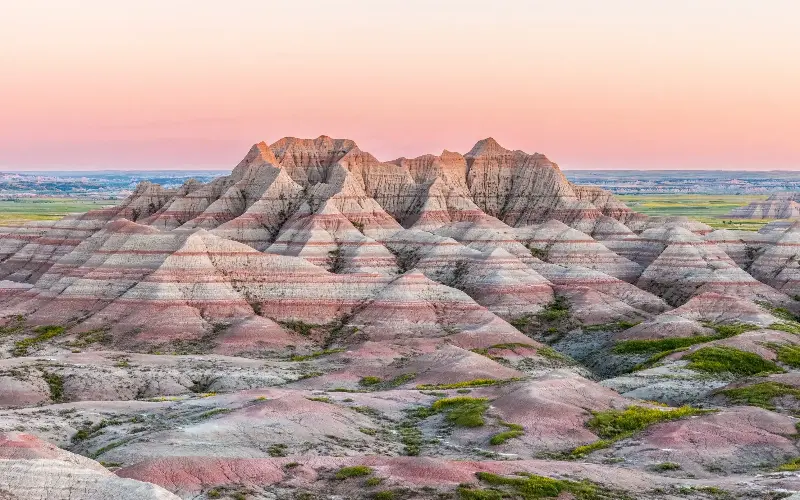
Heading north, I soon reach the Badlands, where the landscape shifts abruptly into something quite otherworldly: a raw, sculpted expanse of jagged buttes and eroded rock formations, streaked in burnt orange, ash and gold, like the earth itself has been carved and re-carved by time and weather. The 31-mile Badlands Loop Road takes you through this extraordinary place.
Rolling onwards into the time-capsule town of Deadwood for my final act feels a bit like stepping onto the set of a technicolour John Wayne cowboy film. Established in the 1870s, it drew prospectors, gamblers and outlaws, all with dollar signs glinting in their eyes following whispers of a creek full of gold. Its chaotic, lawless reputation attracted larger-than-life figures such as Wild Bill Hickok and Calamity Jane, a colourful history later brought to life on the small screen in HBO’s Deadwood.
Inevitably, bust followed boom, but today Deadwood leans proudly into its fabled Old West heritage. I stroll along Main Street’s creaking wooden boardwalk, past spit-and-sawdust saloons with names like the Bloody Nose Saloon and a former house of ill repute, now a museum dedicated to the world’s oldest profession.
Out in the dusty street, re-enactors in chaps are warming up for their daily shoot out show, and through the swing doors of a saloon I spot a bison head displayed triumphantly above the mahogany bar. From presidents and chiefs chiselled from rock, to bison, free-roaming or mounted, South Dakota’s mysterious old mountains are a place where you’re never too far from a familiar face.
Essentials
The Black Hills and the south-west of South Dakota are best served by Rapid City Regional Airport. Fly from Heathrow, via Denver, with United Airlines or Lufthansa, and pick up a hire car.
Under Canvas Mount Rushmore offers glamping in extremely lovely safari-style tents (with proper beds), set in pine forest on the site of a former gold mine. Tents from $258 (£195) per night.
Hotel Alex Johnson is a 1920s hotel in Rapid City with a rooftop bar. Doubles from $258 (£195).