



The Lake District has been one of England’s most renowned beauty spots since author Jane Austen was a girl. While the wealthy departed for the Grand Tour in Europe, the Lakes were regarded as one of the few domestic destinations where you could experience the same sense of wonder: a landscape that offered the beautiful, the picturesque and the sublime.
Poets flocked, Wordsworth’s daffodils fluttered and danced in the breeze, and even Pride and Prejudice’s Lizzie Bennett wanted to visit. (She went to Derbyshire instead, of course, where luckily she was just in time to meet Mr Darcy.)
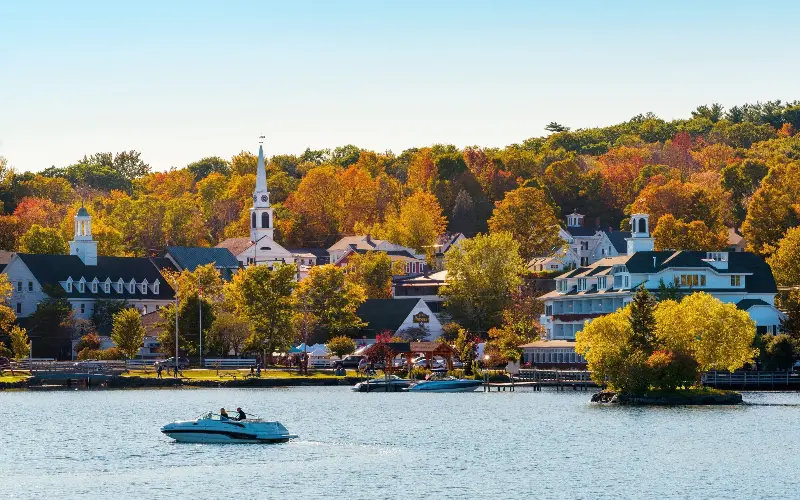
Curiously enough, around that time something similar was going on in the United States. In 1770, Wolfeboro in New England’s own Lake District became the first holiday town in the country. Its claim – “The Oldest Summer Resort in America” – is based on the holiday home built there by John Wentworth, appointed by George II as New Hampshire’s colonial governor.
He may have been the first, but the state’s cute towns with their painted clapboard inns were soon drawing families from Boston to enjoy summer on the water, with the first hotel, Sheraton House, opening in 1795. And, with the arrival of the railroad in 1872, the crowds would flock in ever greater numbers and from ever farther afield.
The two Lake Districts both have, unsurprisingly, picturesque lakes and mountains in common – but there the similarities end. As you might expect, the American version is bigger – much bigger. New Hampshire has 273 lakes and, while some of them are arguably more like ponds, they certainly far outnumber our own 16 (to be fair, we don’t count the smaller tarns).
The largest of the American lakes, Winnipesaukee (it might mean “Smile of the Great Spirit” in the local Abenaki language, though that’s hotly debated) is 72 sq miles, while our own Windermere is a mere (as it were) 5.7.
Winnipesaukee is undoubtedly beautiful with its surrounding thickly forested hillsides, though some might argue that the Squam Lakes (Big Squam and Little Squam) are just as lovely. The nearby White Oak Pond is so picturesque it became a major player in the film On Golden Pond.
When it comes to the summer pleasures of the New Hampshire lakes, though, these are not so different from the Cumbrian variety. There are guided tours of several of the bigger lakes, where there is plenty of sailing and swimming, paddle-boarding and fishing. You can go hiking in the hills – the Castle in the Clouds (actually an Arts and Crafts mansion) has 35 miles of trails in a conservation area of some 5,500 acres.
If you’d rather go by rail, Winnipesaukee has its own Scenic Railroad around the lake, while Mount Washington (1,917m), which towers over the lakes from its own nearby 800,000-acre national park, has its own cog railway too.
The towns – such as Meredith, built around its old white clapboard linen mill – are all cute as cupcakes. They stand in a long line of timbered simplicity going right the way back to the early pioneers, like the Shakers whose village at Canterbury is now a museum (it had been a 200-year-old living community until Ethel Hudson, the last member of the community, died in 1992, aged 96).
Very different from many other dour and technophobic sects of the time, the Shakers were intent on building “heaven on earth” (they were very keen on “ecstatic worship”) and, as well as being designers of furniture that is still influential today, they were great inventors – they made the first washing machines, wood-burning stoves and conceived the idea of selling seeds in packets.
The New Hampshire Great Outdoors is not, though, just a place for summer activities. It is, in fact, particularly enticing in the autumn. The hills and mountains around these lakes are dense with maples, beeches and silver birches that unite to create a great shout of joyous autumnal colour. Not surprisingly, it’s a leaf-peeping hot spot.
You won’t be alone in the woods, however. There are moose and deer here, as well as raccoons and beavers and – at the Squam Lakes Natural Science Center, where they are on the other side of a fence – black bears and mountain lions, the latter now extinct in the wild.
There are a lot of raptors, too, but the region’s most iconic bird is surely the loon, a creature with the most uncanny and mournful of calls. If you’re there in the springtime, you may spot them on the lakes carrying their young on their backs to keep them safe from hungry fish and turtles.
New Hampshire’s most unexpected visitor season, though, is surely the winter. The state does have a few ski spots – though these are nothing to compare with those of neighbouring Vermont – and snowshoeing is very popular (you’ll spot many an antique pair on the walls of those historic inns).
In the Wright Museum, just outside Wolfeboro, there is, among many fascinating exhibits, the first ever snow mobile: a Model T Ford – just with added skis.
It is the lake itself, though, that is the biggest winter holiday spot. It freezes solid, making it ideal for sledging and ice fishing, ice skating and hockey and, of course, snowmobiling, albeit in a more contemporary iteration.
You can even land your plane on the ice. In most years, for a few midwinter weeks, Lake Winnipesaukee becomes home to an ice airport – one of only two in the United States, the other being in Alaska. In summer, the Alton Bay Seaplane Base is for planes with floats instead of wheels. In the winter, though, the ice is so solid that it’s “ploughed” to make landings “easier”.
That, of course, is entirely relative. You have to be a highly proficient pilot, have a fairly small plane (the runway is a maximum of 3,000ft long) and be able to cope with potential turbulence, courtesy of the surrounding White Mountains and the changing conditions of the ice (which can, I’m told, lead to a “skating rink” effect). This becomes a day out in itself and considerable numbers of spectators arrive to watch the landings and take-offs of what is surely the most skilful and unusual winter sport on the planet.
Essentials
Journeyscape specialises in travel to all of North America, and has a 15-day holiday visiting the best of New England (including Boston and New Hampshire) from £4,980 per person. The price includes flights from London, car hire, excursions and good-quality hotels.